
Growth was never the same thing as access, and the data is now making that gap visible.
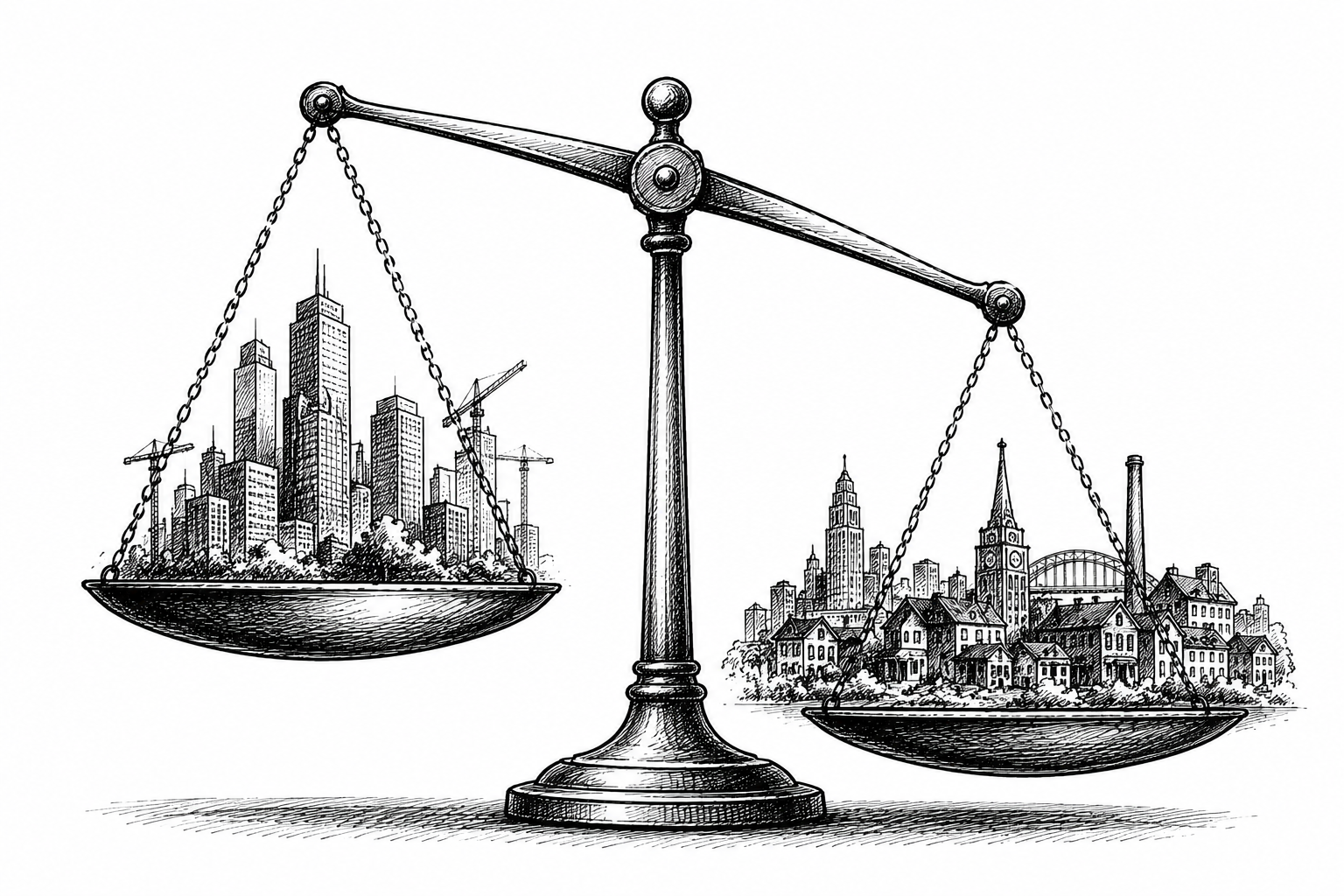
For years, the story of American housing was sorted into winners and losers — booming Sun Belt metros versus stagnant Rust Belt cities. That story has now inverted. The American Enterprise Institute’s Housing Center reports that the formerly sizzling Sun Belt metros have gone cold while previously written-off Rust Belt cities are back in demand — Cape Coral, Florida saw home prices fall 9.6 percent between February 2025 and February 2026, while Kansas City rose 8.6 percent, and Pittsburgh and Cleveland each gained more than 5.5 percent.
The mechanism behind the reversal matters more than the reversal itself. AEI describes this as a “reversion to the mean” — the metros that led growth in 2022 are now posting some of the steepest declines, while the unsexy plodders of that era are back in vogue. Growth, in other words, was never a permanent state. It was a temporary allocation of capital and migration that has now begun to rebalance — and the cities that absorbed the most growth are discovering that growth alone didn’t build durable access for the people living there.
The underlying affordability picture explains why neither boom nor bust city has actually solved the access problem. House prices have reached historically high levels in many markets, with price growth outpacing income growth almost everywhere — and if the pattern continues, the U.S. will reach a point where homeownership is generally unaffordable to the middle class in the majority of metro areas that have large numbers of good jobs. A balanced housing market typically carries about six months of supply; in 2026, inventory sits closer to four months — meaning fewer choices for buyers and continued pricing power for sellers even in markets where prices are nominally falling.
The displacement risk runs in both directions — toward booming cities and away from them. The National League of Cities frames this directly: cities cannot afford to stagnate or resist growth, because families need stable and affordable housing — but unplanned growth can decline housing quality, erode affordability, and deepen community inequities if displacement prevention isn’t built into housing strategy from the outset. Economic vacancy — units sitting empty due to nonpayment of rent — has worsened since the pandemic in cities like Washington, D.C. and New York, a dynamic that threatens the financial viability of affordable housing developments themselves and can accelerate eviction and displacement even in markets with nominal housing growth.
The scale of the underlying shortage explains why price reversals in either direction don’t translate into access gains. The U.S. still lacks millions of housing units — a shortage built over years of underbuilding that supply has not caught up to, regardless of which metro areas are currently rising or falling. A city where prices fall 9.6 percent in a year hasn’t necessarily become more accessible if it was already short on supply relative to its population; a city where prices rise 8.6 percent hasn’t necessarily become less accessible if wages and supply are rising in tandem. The price chart alone doesn’t tell you who can actually live there.
What this signals going forward: the next phase of the American housing story won’t be written in which cities are “hot” or “cold” — it will be written in which cities built the supply and displacement-prevention infrastructure during their growth years, and which ones treated growth itself as the end goal. The metros now cooling after 2022’s boom are a live test of that distinction, and the early data suggests most of them didn’t build it.