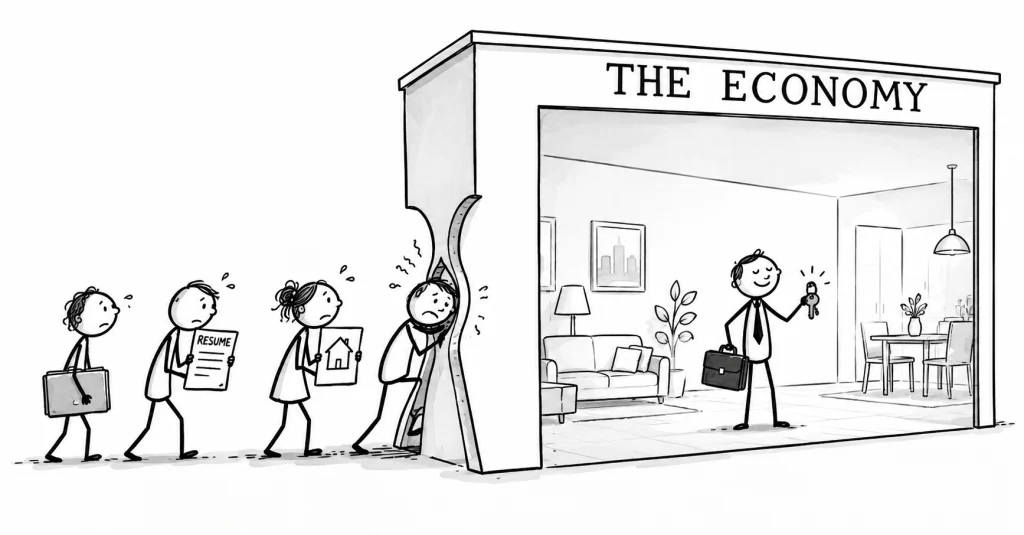
Mortgage rates have reached 7.28%, employers added only 29,000 jobs in September and consumer confidence has fallen sharply. The economy is still growing, but the cost of moving into a home, a new job or a stronger financial position is rising.
The U.S. economy is producing an increasingly unusual combination of resilience and restriction. Employers added only 29,000 jobs in September, unemployment edged up to 4.2%, and job openings fell to about 7.08 million in August. At the same time, layoffs remain relatively low, economic growth has continued and consumer spending has not collapsed. Housing presents a similar contradiction: the average 30-year mortgage rate climbed to 7.28%, its highest level since November 2023, even as the broader economy remains far from a conventional recession. The economy is still functioning. The difficulty is increasingly concentrated around getting into something new.
A Mortgage Rate Can Close the Door Without Home Prices Falling
Mortgage rates have now risen for six consecutive weeks, according to Freddie Mac data reported by the Associated Press. The 30-year rate jumped from 7.03% to 7.28% in a single week, while the 15-year rate reached 6.60%. On a $400,000 mortgage, the increase translates into roughly $276 more per month than the same loan would cost at the lower rate cited by AP. Mortgage applications fell 6% in one week, and existing-home sales dropped 2% in August.
The effect goes beyond the prospective buyer. Millions of existing homeowners locked in much lower mortgage rates when borrowing costs were near historic lows, giving them a financial reason not to sell. Moving can mean trading a 3% or 4% mortgage for one above 7%, even if the homeowner is buying a similarly priced property. That keeps inventory constrained and reduces the normal movement of households through the market. First-time buyers are therefore entering a system where financing is expensive and many would-be sellers have strong incentives to remain where they are.
Jobs Are Available, but Fewer Doors Are Opening
The labor market is generating the same type of friction. September payroll growth of 29,000 jobs was far weaker than the expansion Americans became accustomed to during the post-pandemic recovery. Job openings also declined in August, while layoffs remained subdued. That combination extends a pattern SSC examined earlier in The Labor Market Isn’t Collapsing. It Is Becoming Harder to Enter. Employers are still holding on to many of the workers they already have, but they are creating fewer openings for people trying to get hired, change companies or enter the workforce. The result is a labor market that offers substantially more security to someone already employed than opportunity to someone trying to get in.
That changes the practical meaning of a low unemployment rate. A worker can remain employed while becoming less confident about changing companies, negotiating a higher salary or moving into a different field. A recent graduate can enter a labor market without mass layoffs and still struggle to receive interviews. An unemployed worker can encounter a declining number of vacancies even though employers are not cutting deeply. Stability for incumbents and scarcity for entrants can exist at the same time.
Confidence Is Starting to Reflect the Constraint
Consumers appear to be noticing. The Conference Board’s consumer-confidence index dropped to 81.9 in September from 88.6 in August, placing it near its lowest level in roughly 12½ years. Reuters reported that the decline cut across political affiliations, age groups and income levels and was driven partly by concerns about employment, prices and future business conditions.
That pessimism sits alongside economic indicators that still look respectable. The U.S. economy grew at an annualized 2.2% rate in the second quarter, consumer spending remained resilient and stock markets have traded near record levels. Inflation has also shown some moderation. None of those conditions resembles a broad economic collapse.
The disconnect comes from what aggregate indicators measure versus what households are trying to do. GDP can rise without making a mortgage affordable. Low layoffs can coexist with a frustrating job search. A strong stock market offers little immediate relief to someone trying to accumulate a down payment or find a first full-time position.
The Divide Is Increasingly Between Insiders and Entrants
The economy therefore looks different depending on the position someone already occupies. A household with a stable job, a low-rate mortgage and accumulated assets may be relatively insulated from today’s higher borrowing costs. A household trying to buy its first home, change careers or rebuild after unemployment encounters those higher costs immediately.
As SSC has been tracking in the labor market, stability does not necessarily mean accessibility. The central question is not only whether Americans are losing jobs or homes. It is whether people can still move into the institutions that historically created mobility: employment, homeownership and affordable credit. The economy can remain technically stable while those entry points become progressively narrower.