
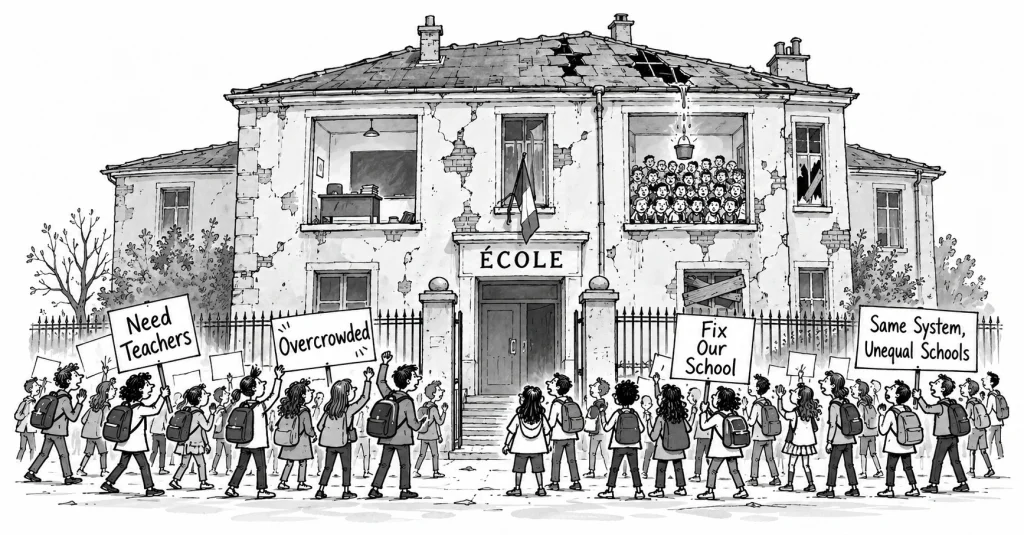
Students in disadvantaged Paris suburbs helped ignite a national protest movement over teacher shortages, overcrowded classrooms and deteriorating buildings. The unrest is exposing how unequal public services can become even when every student is formally enrolled in the same national system.
A protest movement that began with high school students in some of the poorest suburbs around Paris has spread to more than 1,200 schools across France. Students have cited overcrowded classrooms, decaying facilities and chronic shortages of teachers, particularly in places such as Seine-Saint-Denis. Reuters reported that the demonstrations have escalated into serious unrest, with roughly 5,000 arrests, most involving teenagers, along with injuries to protesters, police and teachers. The violence has increasingly dominated the national conversation, but the movement began with a more basic complaint: students say the quality of the education they receive depends heavily on the resources available in the neighborhood where they happen to live.
The Same Exam, Different Preparation
France operates a centralized education system built around the idea that students should receive broadly comparable public schooling regardless of region. The protests are challenging how well that promise holds in practice. Reuters spoke with students who said classes had gone without teachers for extended periods and who worried about approaching national exams without having completed the material they were expected to know. In lower-income suburbs, shortages can compound other disadvantages because families often have fewer resources to replace missing instruction with private tutoring or other support. Students may eventually sit the same national examination, but they do not necessarily arrive with the same amount of teaching behind them.
That is why protesters have described the problem in terms of inequality rather than inconvenience. Some students and organizers have called the education system classist and racist because poorer, more ethnically diverse communities are reporting some of the worst conditions. Those are political judgments, but the underlying resource disparities are central to the demonstrations. A national school system can offer the same curriculum on paper while delivering it through very different classroom conditions. When that gap persists, formal equality does not necessarily translate into equal preparation.
France Is Trying to Cut Costs at the Same Time
The protests are colliding with a much broader fiscal problem. France is under pressure to reduce public spending as government debt and borrowing costs rise. Reuters reports that the proposed 2027 budget would increase education spending by only 1.7%, below inflation, even as schools continue reporting staffing and infrastructure shortages. Debt-service costs are also becoming a larger part of the national budget, limiting the government’s room to respond simply by increasing spending everywhere demands are rising.
That creates two very different views of the same budget. National officials see debt ratios, bond yields and long-term fiscal sustainability. A student experiences the budget through whether a physics teacher arrives, whether a classroom has enough space and whether a broken facility gets repaired. Fiscal restraint may be necessary at the national level, but it becomes politically difficult when the most visible reductions appear concentrated in communities already operating with fewer resources. The argument then stops being only about how much government spends and becomes about where restraint is felt first.
Violence Is Threatening to Eclipse the Original Complaint
The scale of the unrest has complicated the movement. Paris police chief Patrice Faure said the protests had become “out of control,” with more than 600 police officers injured and property damage running into tens of millions of euros. Authorities have accused professional rioters and extremist groups of exploiting demonstrations, while rights organizations and some student groups have raised concerns about the treatment of minors by police. Teachers’ unions have also joined parts of the protest movement, and another national demonstration has been called.
Those clashes can shift attention away from the conditions that started the protests. Once images of fires, damaged buildings and confrontations dominate coverage, a dispute over teacher shortages becomes a public-order story. That gives the government a different problem to solve, but it does not replace the original one. Hundreds of schools do not become adequately staffed simply because demonstrations turn violent.
Public Education Is Being Asked to Prove Its Promise
France has faced similar student movements before, including protests in the 1990s that resulted in additional investment in disadvantaged schools. The current environment is less forgiving because the government has less fiscal room and the political system is already under pressure. That makes the response a test of whether the state can correct unequal conditions without abandoning its broader effort to control spending.
The students’ argument reaches beyond France. Public education is often defended as one of the few institutions capable of reducing the advantages and disadvantages children inherit from where they live. But that promise depends on the public system itself not reproducing those differences. A student cannot choose the tax base, staffing pipeline or infrastructure budget attached to a neighborhood school. If those conditions determine the quality of instruction anyway, the institution meant to create mobility can begin reinforcing the geography students were supposed to be able to move beyond.