
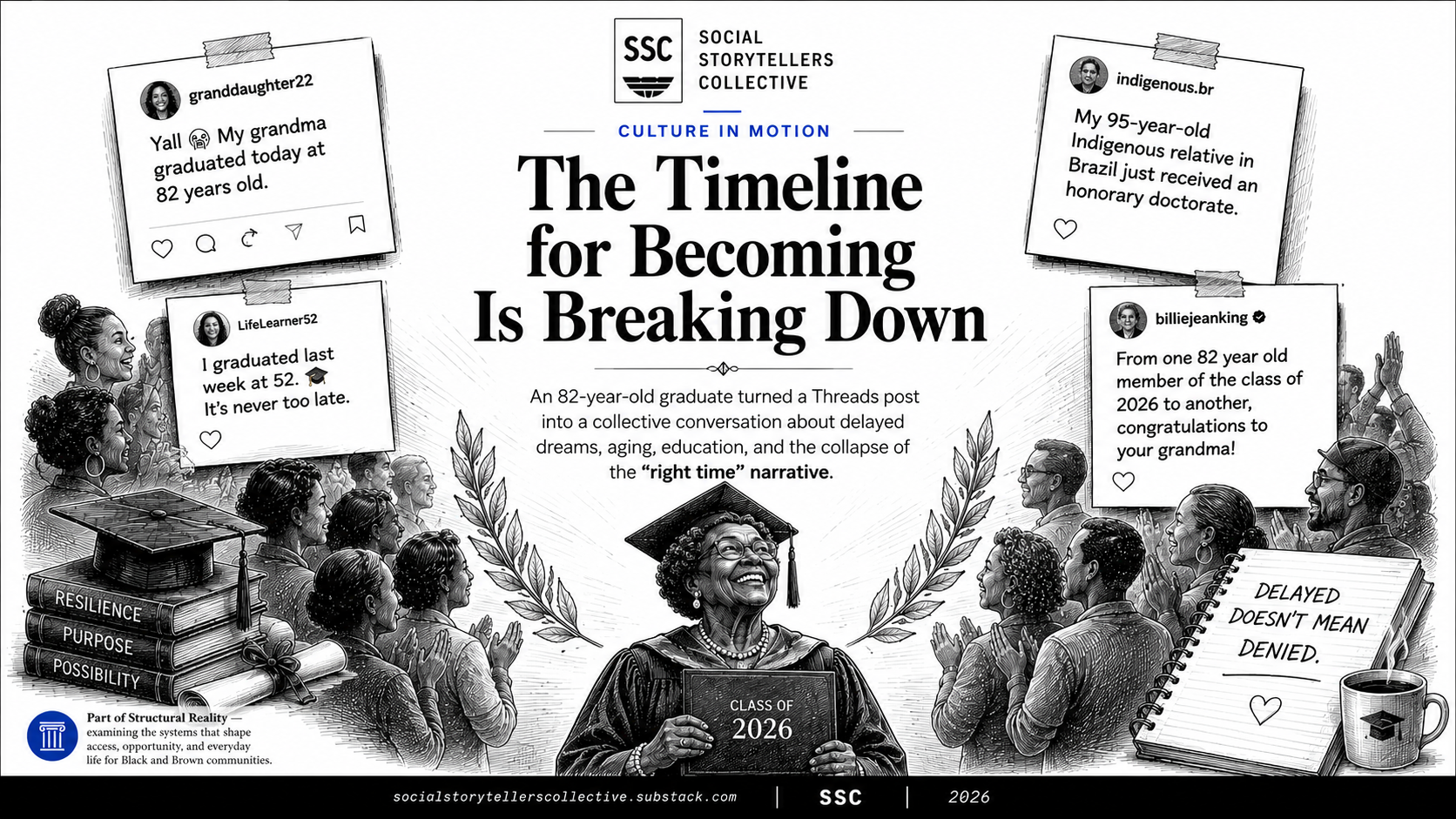
The internet is often described as cynical, fragmented, and attention-deficient. But every so often, a single post cuts through the algorithm and briefly reorganizes people around something deeply human. This week, that moment came from a woman graduating at 82 years old. “Yall 😭 My grandma graduated today at 82 years old,” the original Threads post read. Within hours, the responses stopped behaving like replies and started behaving like testimony. A 52-year-old woman posted her own graduation photo from the previous week. Another user shared that her 95-year-old Indigenous relative in Brazil had just been recognized with an honorary doctorate. Billie Jean King entered the thread herself: “From one 82 year old member of the class of 2026 to another, congratulations to your grandma!” What began as a family celebration quickly transformed into something much larger — a spontaneous archive of delayed milestones, interrupted timelines, second acts, and collective permission.
That transformation matters because the emotional force of the thread was not really about age. It was about relief. For decades, American culture has quietly operated on an invisible timeline model: graduate young, establish stability early, build career momentum quickly, and treat delays as evidence of failure. Even inspirational language around education often reinforces that sequencing. The “traditional student” becomes the assumed default, while everyone else is framed as exceptional, nontraditional, or somehow late. But the reactions flooding this thread suggest millions of people no longer experience life that way — if they ever truly did.
Instead, people increasingly live in interrupted sequences shaped by economic instability, caregiving responsibilities, parenting, illness, military service, layoffs, burnout, housing costs, and systemic inequality. Many people are returning to school later because they simply could not afford to prioritize themselves earlier. Others are re-entering educational systems after decades spent surviving. What the thread revealed was not simply admiration for one woman’s persistence, but widespread recognition of how many lives no longer fit the clean chronology society still quietly rewards. The old script assumed adulthood unfolded in order. Modern life increasingly unfolds in fragments.
That is what made the thread feel emotionally contagious. People were not just congratulating one grandmother. They were reacting to what her image disrupted psychologically: the idea that there is an expiration date on becoming. One commenter wrote, “This reaffirms that I’m going to try to go to law school.” Another described the thread as something that “made everyone’s day.” Others shared stories about mothers finally earning degrees after raising children, older adults completing unfinished goals decades later, and family members receiving academic recognition deep into old age. The comment section evolved into a public record of people renegotiating their relationship with time itself.
Social platforms rarely reward that kind of emotional architecture anymore because most algorithmic systems are designed around acceleration. Outrage spreads quickly. Aspiration spreads quickly. Humiliation spreads quickly. Envy spreads quickly. But this thread moved differently. It spread through recognition. People saw themselves in it, or perhaps more accurately, they saw the version of themselves they feared they had already run out of time to become. In that sense, the grandmother’s graduation photo became a direct counter-narrative to one of the dominant pressures of digital life: accelerated achievement culture.
Modern internet culture compresses timelines constantly. By 25, you should have the career. By 30, the relationship. By 35, the house. By 40, the wealth. Social media intensifies that pressure by turning life into a visible sequence of milestones displayed simultaneously and algorithmically. People are no longer comparing themselves only to classmates or neighbors. They are comparing themselves against millions of curated trajectories all at once. The result is a constant low-grade feeling that everyone else arrived earlier, figured it out faster, or built stability more efficiently.
Threads like this interrupt that machinery because they detach achievement from urgency. An 82-year-old graduate destabilizes the cultural assumption that accomplishment only matters when it happens young. That is why so many reactions sounded almost startled by their own optimism. The post did not merely inspire people. It challenged the internalized belief that their personal timeline had already closed. For many viewers, the emotional response was not admiration alone. It was permission.
And notably, the reactions crossed generations. Younger users saw hope. Middle-aged users saw possibility. Older users saw validation. The thread created a rare moment where the internet temporarily stopped treating aging as disappearance and instead treated it as continuation. That shift matters culturally because societies increasingly structured around longevity, career reinvention, economic instability, and delayed financial milestones may eventually require entirely new emotional narratives around adulthood itself. The old linear model — school, work, retirement — no longer reflects how millions of people actually move through life.
The grandmother at the center of the thread probably did not intend to become a symbol of that transformation. But for a brief moment online, she became exactly that: living evidence that progress delayed is not always progress denied. And judging by the response, a lot of people desperately needed to see someone embody that possibility in public.