
We’ve been watching this pattern long enough to know what it looks like when the target shifts.
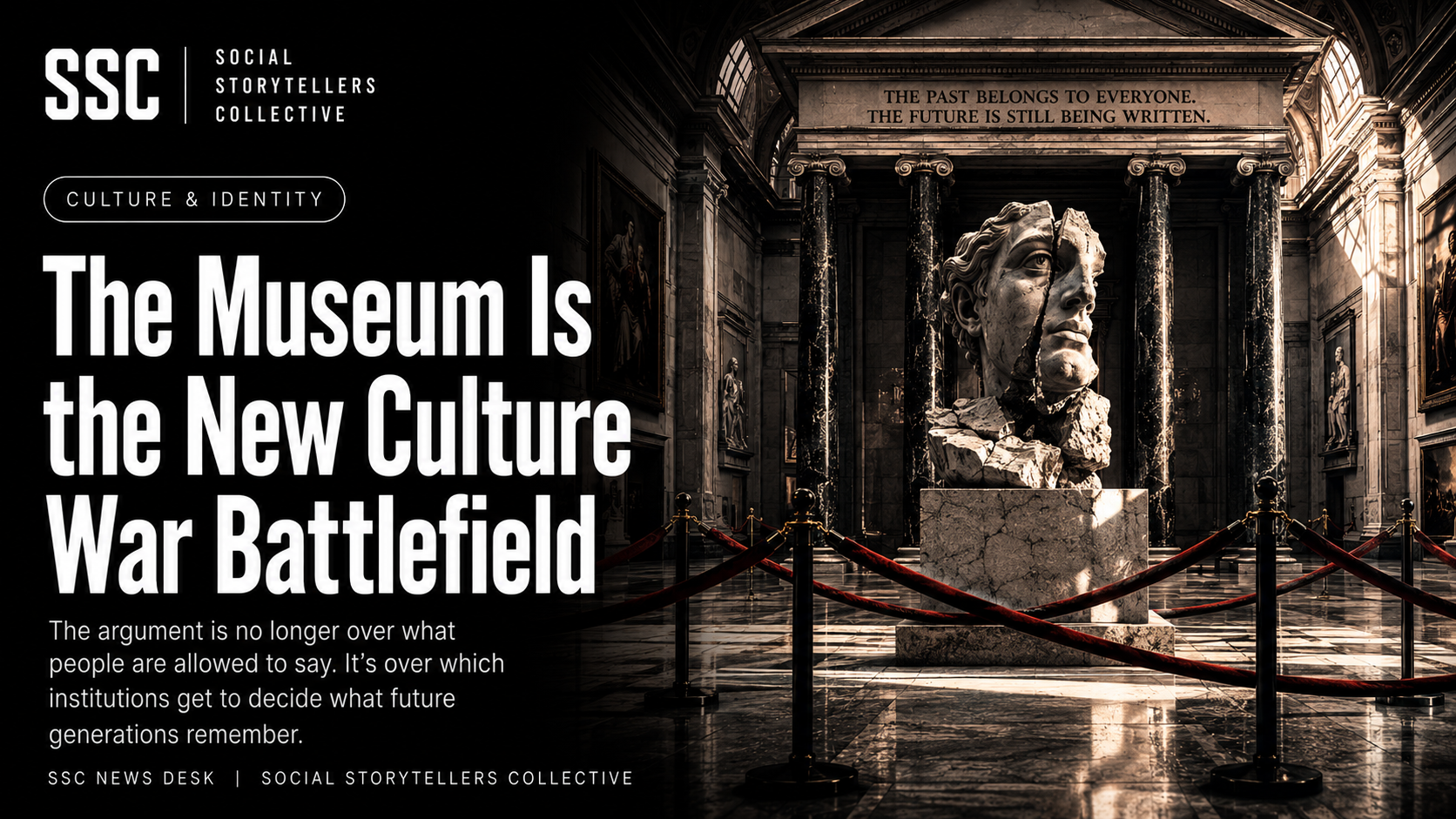
The British Museum’s decision to postpone a Jewish Culture Month lecture — after learning protesters planned to disrupt it — got swallowed almost immediately by the usual cycle. Critics called it capitulation. Defenders cited safety. The argument moved on. But the argument that got covered was not actually the argument that matters. The real story is not about one lecture, one museum, or one bad week in London. It is about something more durable: the growing recognition that museums, archives, and cultural institutions have become among the most contested spaces in public life, and that the people doing the contesting understand exactly what they are fighting over.
For most of the twentieth century, culture wars were primarily about speech. What books could circulate. What films could be made. Whether certain ideas were allowed into public conversation. The fight was about entry — could a message get in the door? That fight has not disappeared, but it has been joined by a different one. Today, the struggle is less about the message and more about who controls the infrastructure of memory itself. Less about what gets said and more about which institutions have the authority to determine what is worth preserving, what belongs in the historical record, and which experiences deserve to be called history at all.
That shift is visible everywhere you look. In the United States, political battles over the Smithsonian, fights surrounding the still-unrealized National Women’s History Museum, and curriculum wars playing out across school boards are all expressions of the same underlying tension. These are not separate controversies. They are competing bids for authority over collective memory. The museum exhibit, the archive, the cultural center — these have become as politically consequential as the television network or newspaper editorial page once were. Maybe more, because their authority is longer-lasting and harder to dispute.
The reason is straightforward, and I think it gets missed in most of the coverage: institutions confer legitimacy in ways that other platforms cannot. A social media post may reach millions today and vanish tomorrow. A museum exhibition can shape how a community understands itself for decades. Archives determine which stories remain accessible to future scholars, journalists, and citizens. The fight for cultural influence increasingly runs through the organizations that decide what gets preserved, displayed, funded, and taught — and the stakes are not symbolic. They are generational.
This is why controversies that appear unrelated keep feeling connected. The British Museum debate, Smithsonian disputes, fights over public monuments, battles over whose art hangs in which gallery — they stem from the same underlying anxiety. People understand, increasingly explicitly, that culture is not simply inherited. It is curated. Every institution makes choices about which narratives receive attention and which remain marginal. Those choices have always existed. What has changed is public awareness of them — and the willingness of communities that once accepted institutional authority as neutral to challenge the assumptions embedded within it.
For cultural organizations, this is becoming an unsustainable position. The expectation that museums exist above politics is collapsing under the weight of its own contradictions, because history itself has become the site of political contest. Decisions about whose stories are told, whose artifacts are displayed, whose experiences are centered — these reflect values whether institutions acknowledge it or not. The claim of neutrality has increasingly become its own political stance, and more people are naming it as such.
The British Museum controversy will fade. Another institution will become the next flashpoint within weeks. But the pattern will not dissolve. The culture war has moved deeper into the infrastructure — past media, past platforms, into the institutions that hold memory itself. The question is no longer whether museums and archives will be drawn into these debates. They already are. The question is whether they can continue to serve a public that is asking them, with growing urgency, to choose.