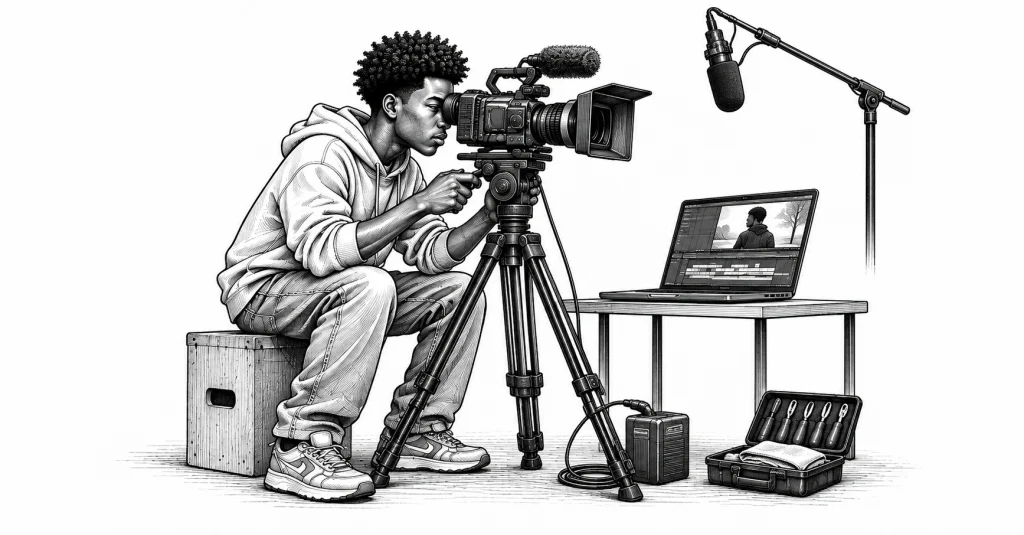
A new multimedia center gives students access to equipment and professional training. Its long-term value will depend on funding the people and operations behind that access.
Morehouse College’s new multimedia center saved students more than $25,000 across 65 to 70 equipment reservations during a soft launch that began last year, inaugural director Emani Saucier told WABE. His estimate compares the borrowed gear with what a local rental house would charge for the same equipment. The Morehouse Multimedia Center formally opened September 23. It has a modular production studio, editing bays and roughly $250,000 worth of equipment, made possible by a 2021 commitment of more than $1 million from Michael Jordan and Jordan Brand. Students borrow the equipment at no cost unless it comes back damaged, and Saucier said reservations will soon open to the rest of campus. The early savings are a concrete measure of what access means before a student lands a job or earns money from a project.
Preparation includes the ability to practice
The center complements a journalism major launched in 2022 and housed in the college’s Journalism in Sports, Culture, and Social Justice department. Morehouse says content produced with the center’s equipment drew more than 1 million social media views in August 2026. It also says the center’s training contributed to a Maroon Tiger interview with Dr. F. DuBois Bowman that won a regional student Emmy. The college reports that nearly 120 alumni of its journalism program work in media and sports, and that more than 60 have earned advanced degrees in the field. Those figures show student work reaching audiences, earning recognition and leading to careers. They do not, by themselves, establish a placement rate or prove that every student who uses the center will build a media career.
The practical advantage is easiest to see in the work itself. A student can study interviewing and still need repeated chances to manage sound, framing, lighting and editing. A mistake made during a campus production becomes part of the learning process, with time to identify it and try again. That opportunity is harder to use when every attempt requires another rental payment. Equipment access lowers the price of practice, while instruction helps turn practice into judgment. Neither substitutes for the other, and an impressive studio without available guidance would leave part of the educational promise unfinished.
The gift has a history, and an operating bill
Journalism at Morehouse traces back to 2007, when alumnus Spike Lee and the late sports columnist Ralph Wiley founded the college’s Journalism and Sports Program. Morehouse’s October 1 account of its journalism investments describes three $1 million contributions over time, associated with Lee, Charles Barkley, and Jordan and Jordan Brand. It also reports an additional $200,000 from Jordan and Jordan Brand in 2024 for a digital media lab. Department chair Mikki Harris told WABE that the 2021 gift funded 32 student scholarships, and the rest went to equipment and to designing and building the space. The new center is the product of accumulated investment, not a newly announced gift. That history places the opening inside a longer effort to connect resources, teaching and opportunities for students to produce work.
The operating question now deserves equal attention. Saucier told WABE that the Jordan funding was meant to get the center started and will not be available to sustain or expand it. He said he wants to raise millions in endowment support to keep the programs going. Harris named paying faculty, paying advisors, staffing the space and updating equipment among the ongoing needs. A camera can be purchased once, but access to it requires scheduling, maintenance and someone who can help students use it. Teaching and advising also recur every year. The ribbon cutting marks the beginning of the facility’s public life. It does not settle how the facility will serve one class after another.
A pipeline needs to survive the launch
For Black storytellers, a campus production space can support more than a portfolio. It can give students a place to choose subjects, develop sources and learn to make editorial decisions that have consequences for their communities. That is an opportunity rather than a guaranteed outcome, and its quality will depend on the instruction, standards and freedom students experience in the room. A useful evaluation would follow who uses the center, how often they return, what they produce and which professional opportunities follow. Counting equipment alone would miss much of the work that connects access to a career.
The next chapter will show whether Morehouse can keep that opportunity dependable. Students need equipment that works, instruction they can reach and enough continuity to grow from beginners into capable producers. Donors and industry partners have a chance to fund the ordinary expenses that make those conditions possible. The center has already delivered a concrete benefit by lowering production costs for students. Whether it keeps delivering that benefit to future classes will decide if the opening becomes a memorable announcement or a lasting part of how Black journalists and creators enter the profession.
Sources: Marlon Hyde, “Morehouse’s new multimedia center faces funding headwinds after initial Jordan investment ends,” WABE, September 28, 2026; Morehouse College, “Morehouse Multimedia Center Celebrates Grand Opening“; Morehouse College, “New Journalism in Sports, Culture, and Social Justice Degree.”