
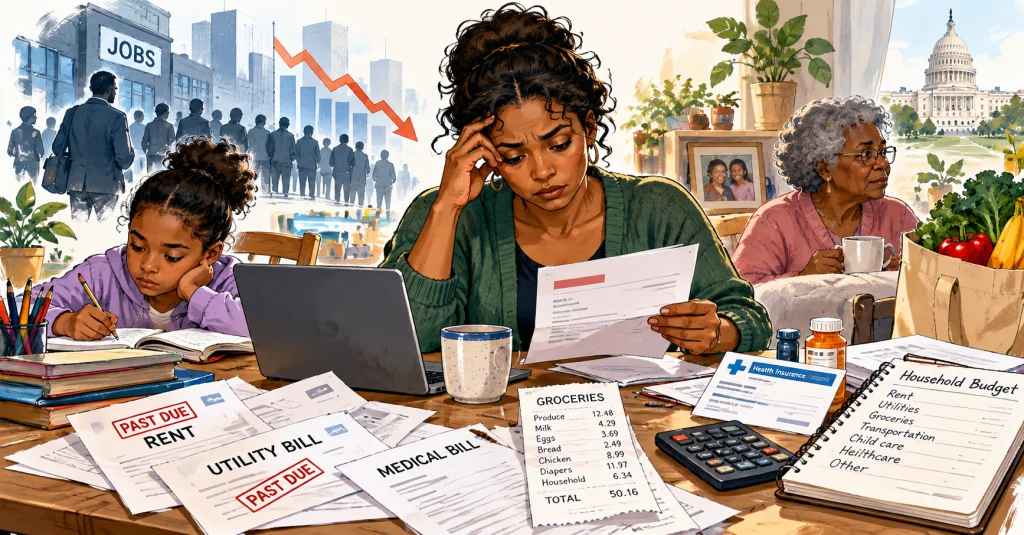
Black unemployment remains well above the rate for White workers. New data presented at the Congressional Black Caucus Foundation conference shows how quickly a lost job can reach household income, health insurance and the people depending on that paycheck.
The national unemployment rate was 4.1% in August, but that headline conceals a persistent gap underneath it. The unemployment rate for Black Americans stood at 6.0%, compared with 3.7% for White Americans, according to the latest Bureau of Labor Statistics data. At a Congressional Black Caucus Foundation panel last week, researchers and advocates focused on what happens after that difference reaches an individual household. The Seattle Medium reported that Ofronama Biu, chief economist at the Maven Collaborative, presented data showing average household income of about $44,000 when a Black woman is unemployed, compared with $80,000 in households with an unemployed White woman. The numbers turn unemployment from a labor-market statistic into a household-finance problem: the loss of one job can mean considerably less income available to absorb rent, food, healthcare and other fixed expenses.
One Lost Job Can Remove More Than a Paycheck
Biu told the panel that health-insurance coverage among unemployed Black women falls from 92% to 79%, according to the Seattle Medium’s account of the discussion. That means losing a job can simultaneously reduce income and weaken access to one of the protections households may need most when money becomes tighter. Panelists also described unemployed workers turning to short-term installment loans to cover expenses such as groceries and gasoline, creating the possibility that temporary unemployment generates longer-lasting debt. Brittany Packnett Cunningham of the Children’s Defense Fund emphasized that the financial consequences can spread beyond the individual worker because Black women frequently support children, extended family members and community networks. The Seattle Medium reported that Rep. Ayanna Pressley cited Black women as primary breadwinners in a large share of Black households, although that specific figure was presented at the panel rather than independently verified in the report. The underlying point is easier to see in the income numbers: when one paycheck represents a significant portion of household resources, unemployment changes the financial position of more than the person whose name was on it.
The disparity is also occurring in a labor market that has become more difficult for people trying to get hired. As SSC has been tracking, employers have remained reluctant to conduct large-scale layoffs while also showing less appetite for adding workers. That combination can protect people already inside companies while extending the search for people trying to reenter employment. For households with substantial savings, a longer search can be manageable. For households already operating with narrower financial cushions, each additional month can require decisions about which bill gets delayed, whether insurance remains affordable or whether borrowing fills the gap. The racial unemployment rate therefore tells only part of the story. The amount of financial room available after unemployment begins helps determine how damaging the same period without work becomes.
A Job Guarantee Returns to the Policy Debate
Pressley is responding with a proposal considerably broader than conventional unemployment assistance. On September 17, she reintroduced a congressional resolution calling for a federal job guarantee that would establish publicly funded jobs for adults seeking work, implemented locally in partnership with communities. Her proposal calls for jobs paying at least $25 an hour, with healthcare, paid leave, retirement benefits, collective-bargaining rights and other worker protections. Potential work identified in the proposal includes child and elder care, transit, neighborhood infrastructure, environmental projects, affordable housing and other public needs. The resolution builds on a proposal Pressley first introduced in 2021 and invokes a longer history of full-employment advocacy associated with figures including Coretta Scott King. It is a proposal, not an enacted jobs program, and Congress has not established a federal employment guarantee.
A federal job guarantee would represent a different approach from unemployment insurance. The current system provides temporary income after someone loses qualifying employment. A guarantee would instead make the government an employer of last resort, offering paid work when the private labor market does not. Supporters argue such a system could stabilize incomes during downturns and set a wage and benefits floor that private employers would have to compete against. Critics of job guarantees have historically raised questions about cost, administration, the kinds of jobs governments could create at scale and whether public employment would compete with private employers for workers. Those debates become especially relevant with a proposed $25 hourly wage and federal-level benefits. Pressley’s resolution sets out the model, but implementing something of that scale would require legislation, funding and significant administrative infrastructure.
The Gap Starts Before the Policy Response
The more immediate numbers do not depend on whether Congress ever adopts that proposal. In August, Black workers continued to experience unemployment at a rate roughly 2.3 percentage points higher than White workers, and the gap has persisted across very different economic conditions. The CBC panel added another layer by showing how unequal household resources can magnify what happens after a job disappears. A worker does not enter unemployment with only an unemployment rate attached to them; they enter it with whatever savings, insurance, household income and family obligations existed the day before.
That is why the $44,000 and $80,000 household-income figures are useful alongside the national unemployment data. They describe two parts of the same labor market: who is more likely to be without work and how much financial protection remains when that happens. The policy debate will continue over whether a federal jobs guarantee is an appropriate response. The underlying economic problem is already measurable: losing a job does not impose the same financial shock on every household, even when the employment status on the government spreadsheet looks identical.