
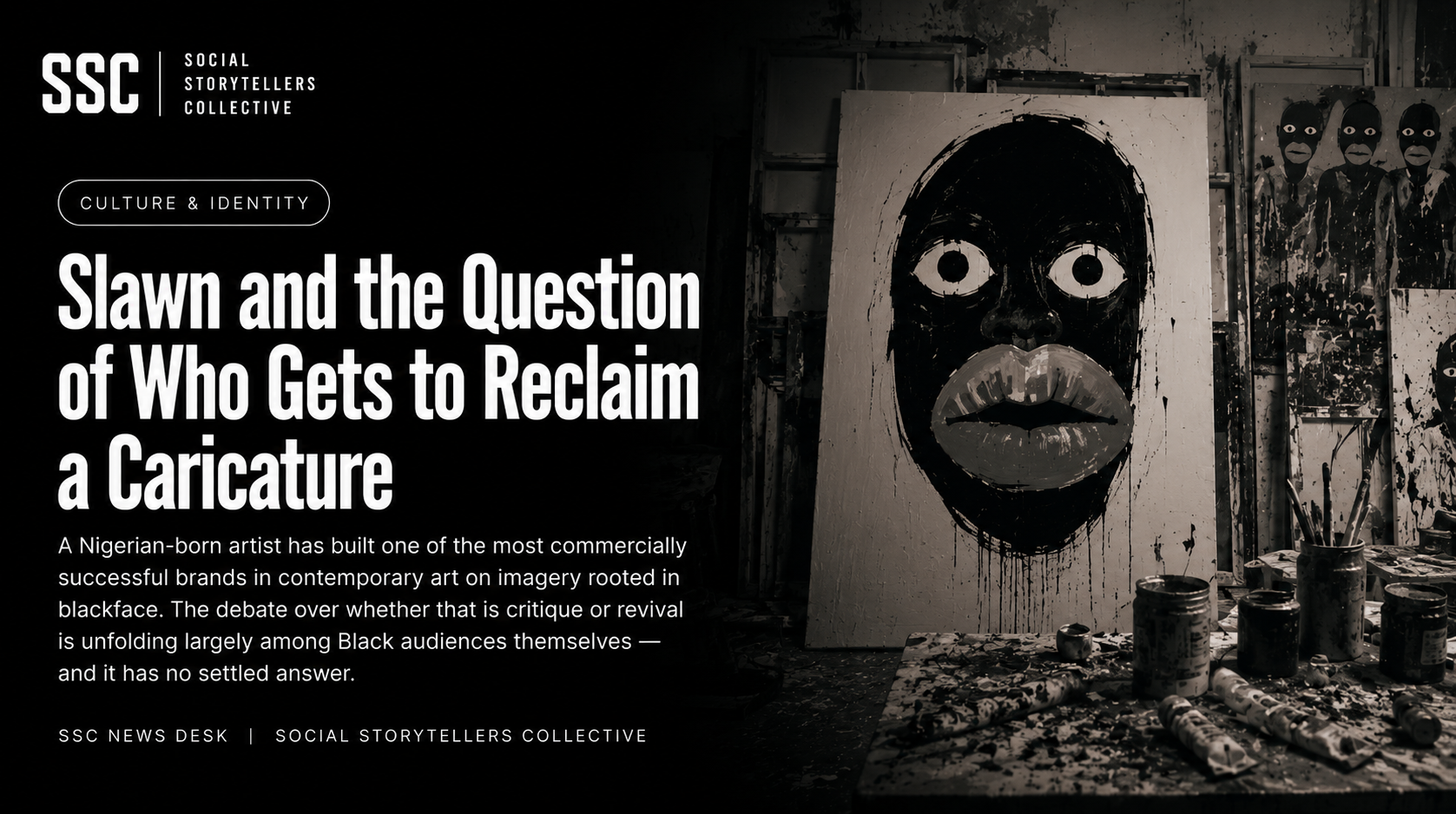
The debate over whether that is critique or revival is unfolding largely among Black audiences themselves — and it has no settled answer.
Olaolu Slawn, who works under the single name Slawn, moved from Lagos to London and became one of the most recognizable young figures in the global art world before turning twenty-five. His signature is a recurring face — exaggerated features, oversized red lips, cartoonish flatness — that he began painting during the 2020 lockdown and has reproduced across hundreds of works since. By his own account, it is the thing he draws most instinctively. It is also the thing that has made him simultaneously celebrated and condemned, sometimes by the same people in the same breath.
The institutional embrace has been substantial and fast. Slawn became the youngest and first Nigerian-born artist to design the BRIT Awards trophy. He redesigned the FA Cup. His work has moved through Sotheby’s, where his painting of three figures nicknamed the “Three Yoruba Brothers” sold for more than thirty thousand pounds in 2024, and through his solo show “1,000 Canvases” at Saatchi Yates, which included deliberately provocative pieces — among them a work depicting a KKK gathering. Louis Vuitton has collaborated with him. The most established gatekeepers in British culture have, in effect, decided his work belongs inside their halls.
That is precisely what alarms his critics. To them, the recurring face is not abstraction but inheritance — a near-direct descendant of minstrel-era caricature, the visual grammar of anti-Black propaganda that was used for more than a century to dehumanize Black people. The argument is that some images carry a historical charge too heavy for an individual artist to neutralize through intention. On this reading, reproducing the imagery at commercial scale, and watching elite institutions reward it, does not interrogate the stereotype so much as recirculate it and assign it a price.
Slawn’s defenders interpret the same work in the opposite direction. They place him inside a long tradition of artists who appropriate offensive symbols precisely to confront audiences with them — to drag the imagery into a gallery and force a reckoning with its history rather than let it fade into comfortable forgetting. In this view, the discomfort is the point, and the work functions as a mirror held up to the viewer’s own associations. Slawn himself has been unbothered by the controversy, embracing his reputation as a provocateur and declining to frame his work as either apology or thesis.
What makes the debate distinct from many controversies about racist imagery is who is actually having it. The sharpest disagreement is not between Black and white audiences but among Black people across the diaspora. Many Black Americans encounter the imagery through the specific history of slavery, Jim Crow, and the minstrel show — a lineage that remains immediate and painful in the United States. Some African artists and viewers approach the same visual language through a different historical frame, one not organized around the American minstrel tradition. The disagreement frequently lands on a single question: whether the artist’s cultural location and stated intent can outweigh the historical weight the image carries regardless of who made it.
That question does not resolve cleanly, and the institutions may have already answered a narrower version of it without addressing the larger one. The galleries, auction houses, awards bodies, and luxury brands elevating Slawn have settled the commercial matter — the work sells, so it stays. The cultural matter is the one still open: whether historically racist imagery can be reclaimed, or whether its original meaning remains too powerful for authorship and intent to override. The same canvas reads as indictment to one viewer and revival to another, and both are looking at the same red lips. That is not a sign the conversation has failed. It may be the most honest evidence that the question itself remains unsettled.
SSC News Desk | Social Storytellers Collective