
A new report tracks more than half a million hateful posts about South Asians on X in 18 months. Researchers tie the surge to fights over H-1B visas, political rhetoric and a community whose growing success and visibility are now being held against it.
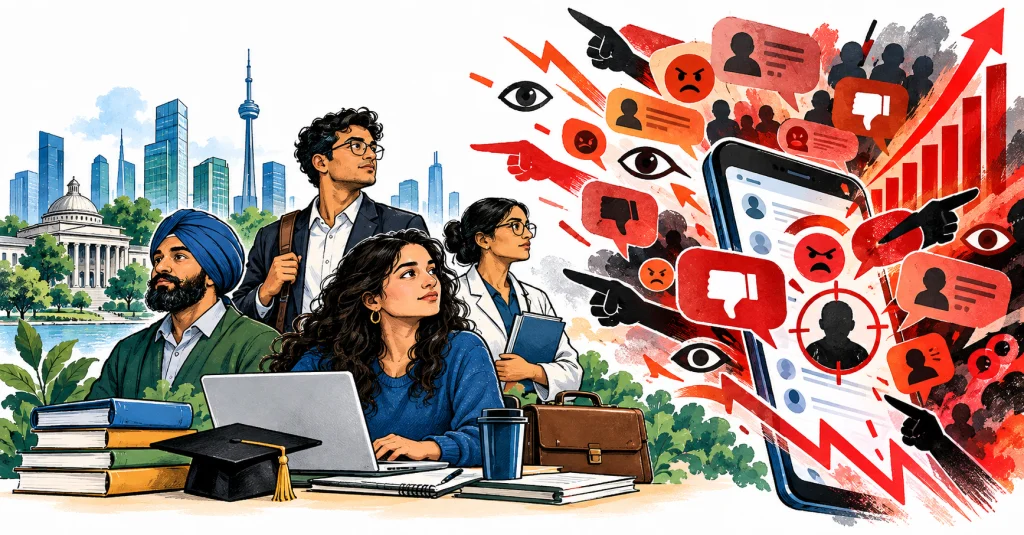
The volume of hate aimed at South Asians in the United States on X more than tripled in two and a half years. Monthly hateful posts rose from 12,904 in January 2024 to 43,843 in June 2026, an increase of 240 percent, according to “The Rising Tide of Anti-South Asian Hate in the United States,” a report released Sunday by the Center for the Study of Organized Hate (CSOH). Researchers identified 542,360 hateful posts on X between January 2025 and June 2026 alone, and five of the six highest months came at the end of that period. On the fringe platforms 4chan, 8chan and Gab, they counted another 397,522 mentions in 2025.
The researchers applied the United Nations definition of hate speech, which covers attacks or pejorative language aimed at people based on identity. They combined keyword tracking of recurring slurs and narratives with manual review, excluding criticism that didn’t meet that threshold. What they found was less a scattering of insults than a set of consistent stories, repeated at scale.
The Narratives Behind the Numbers
The dominant story is about threat. About 45 percent of hateful posts on X, more than 245,000, portrayed South Asians as invading the country, stealing jobs or endangering it demographically. A single derogatory slur aimed at Indians and its variants appeared in 30 percent of hateful posts on X and 45 percent of fringe-platform mentions. The fastest-growing narrative depicted South Asians as dirty or unhygienic, up 171 percent over the study period. Throughout, the hate flattened distinct communities into one. Indians, Pakistanis and Bangladeshis were treated as interchangeable, as were Hindus, Muslims, Sikhs and Christians.
The report ties the timing of the spikes to specific moments in politics. Indians hold more than 70 percent of H-1B visas, the program that lets U.S. employers hire skilled foreign workers. Several spikes followed political fights over it, including the September 2025 decision to impose a $100,000 payment on certain new H-1B petitions. Researchers also point to President Donald Trump‘s July 2025 speech at an AI summit criticizing tech companies for outsourcing jobs to India, which was followed by a sharp rise in anti-South Asian posts. More recent examples in the report include a since-deleted Department of Homeland Security post this month featuring a Sikh man and telling him to “get off our roads.” They also include an Education Department post that followed a Texas Republican’s complaint about South Asians attending a University of Texas football game.
When Success Becomes the Accusation
The most revealing finding may be how the stereotype has turned. For decades, Indian Americans were cast as a “model minority,” a label that was never as flattering as it sounded, since it was often used to measure other groups against them. The report finds that same image of success is now being used against them, reframed as proof that South Asians are opportunists who game the system. The achievement that once earned grudging praise now becomes evidence in an accusation.
Visibility sharpens that turn. South Asians hold some of the most prominent positions in American public life, from former Vice President Kamala Harris and New York Mayor Zohran Mamdani to Usha Vance and Vivek Ramaswamy. The report documents attacks on figures across party lines, and found that Mamdani’s primary and mayoral wins each set off spikes in anti-South Asian and anti-Muslim abuse. Researchers link the broader surge to anxieties about lost status, and to the “Great Replacement” conspiracy theory, which holds that white populations are being deliberately replaced.
It’s a pattern SSC has traced in other forms. In our reporting on why “UK Beast” was never just slang, a two-word insult carried a whole set of judgments about Black British women. Here, a single slur and a handful of stories about invasion and job theft carry a whole case against a community. In both, the internet takes an old prejudice, compresses it into shorthand and spreads it faster than anyone can correct it.
From Posts to People
The report shows how that hate moves offline. Researchers documented X accounts doxxing South Asians accused of taking jobs or committing visa fraud, publishing private details like home addresses. They also documented influencers confronting people at their homes and workplaces and posting the encounters. Generative AI has made the content cheaper to produce, with images depicting South Asians as unclean, predatory or a demographic threat.
The researchers are careful not to claim that online posts cause offline violence directly, but they argue the two feed each other. The report cites a July attack in Utah, in which an Indian Muslim mall employee was repeatedly stabbed and federal prosecutors brought hate crime charges. It also cites the stabbing this month of a Sikh truck driver at a Wyoming truck stop, and a 2025 assault on an Indian nurse in Florida.
The numbers describe a community being redefined in public, from contributors to competitors, from neighbors to threats, and the redefinition is tracking policy. Each fight over visas, jobs and belonging arrives with a spike in the data. As immigration and AI-driven job anxiety stay at the center of American politics, the report suggests the question is no longer whether that rhetoric reaches South Asian Americans. It’s how many of them will pay for it.
Sources: Center for the Study of Organized Hate, “The Rising Tide of Anti-South Asian Hate in the United States,” Sept. 28, 2026; Tamara Khandaker, “Anti-South Asian ‘hate speech’ has exploded online in US, report finds,” Al Jazeera, Sept. 28, 2026.