
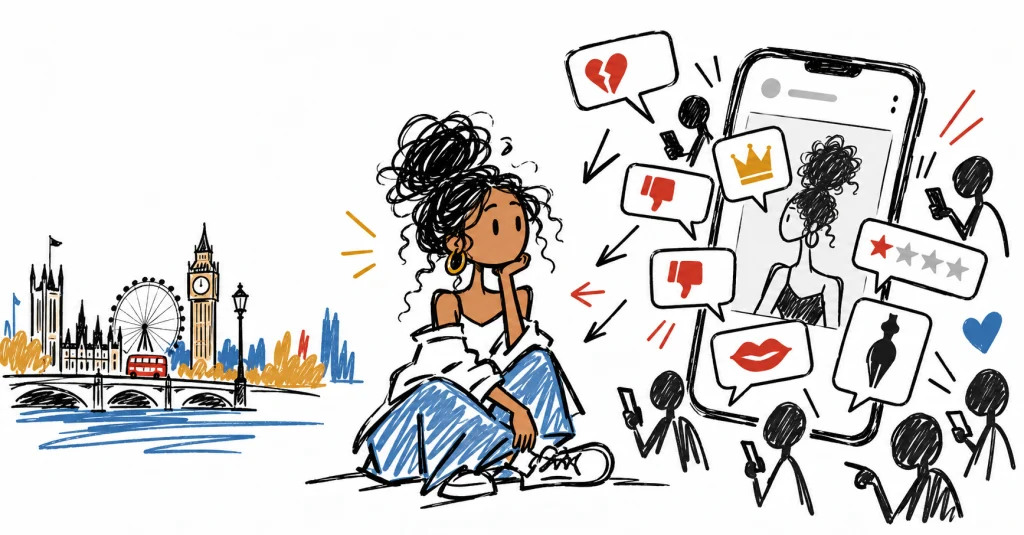
The insult started as a way to mock British women. Black British women say it became something narrower: a shorthand for deciding which Black women count as feminine, attractive and worthy of respect.
A phrase that spread across British social media three years ago is circulating again. Without context, “UK Beast” sounds almost cartoonish, but its history is considerably darker. The term drew widespread attention in late 2023, when Nella Rose, the Belgian-born YouTuber and presenter of Congolese descent, became a frequent target during her run on I’m a Celebrity… Get Me Out of Here! After an on-camera row with First Dates host Fred Sirieix, the phrase followed her across social media.
But it didn’t start with her. NME, citing BBC reporting, noted that the term had already been trending before the series aired. One of its earliest widely cited appearances is a viral 2022 video of a man handing out lollipops to women on a French street, captioned to contrast supposedly attractive, feminine French women with “beasts in the UK.” The insult began as a jab at British women in general, and as it spread online, it narrowed.
When an insult becomes a category
By 2023, online slang dictionaries defined a “UK Beast” as a woman who is masculine and rude. Black British women began pointing out something more important: they were increasingly the ones being placed in that category. TikTok creator Anthonia Edomwande, a 20-year-old from east London, told the BBC she had been called the term repeatedly and believed it was being used specifically to degrade Black women. She said she’s most often attacked over her physical appearance and Afrocentric features, and that it happens far more online, where people can hide who they are. “It’s not a nice thing to say or hear,” she said.
She wasn’t alone. Beauty creator Hindia Andries said the term targets a Black girl’s appearance, especially when she doesn’t fit conventional beauty standards. Actress and director Kelechi Okafor, responding to the comments about Rose, described being horrified by the beast comparisons and connected them to a long history of comparing Black women to apes. Edomwande also pointed to where the phrase came from, saying it began among Black men before being picked up by people of other races, which she worried opened the door to openly racist use.
That matters because the traits built into the insult aren’t culturally neutral. Loud, aggressive, masculine, rude and unfeminine are the same descriptions that have followed Black women for generations. Dr. Kadian Pow, a lecturer in sociology and Black studies at Birmingham City University, described the phenomenon to the BBC as misogynoir, a term coined by scholar Moya Bailey for the specific hatred and prejudice directed at Black women where racism and sexism intersect. Pow argued that terms like “UK Beast” work to deny Black women their femininity and to police their behavior, pushing them to be quieter, more conventional and less willing to speak up. She also rejected the argument that the phrase is about behavior rather than race.
The internet gave an old stereotype new vocabulary
That may be the more important story behind the phrase. Social media didn’t invent the stereotype of the aggressive, unfeminine Black woman, but it gave that stereotype a new, shorter label. Instead of openly saying a Black woman is too loud, too masculine or not attractive enough, a whole set of judgments can be packed into two words. Anyone who knows the reference understands everything it implies, and because it sounds like a joke, it can be used in places where an openly racist remark might get flagged, reported or taken down.
Because internet slang changes quickly, its meaning stays contested. Some users insist “UK Beast” describes behavior, not race, and can apply to a woman of any background. That broader use does exist. But Black British women have argued that the dictionary definition misses how the term is actually used. In a 2024 essay, writer Imeri Agbai pointed to a TikTok post showing influencer Madam Joyce in a heated moment on Footasylum’s Locked In, captioned with the question of whether she was an example of a “UK Beast.” Agbai noted that many commenters agreed, and that one summed up the term as another way of calling dark-skinned Black women aggressive and angry. Both readings of the phrase are still in circulation, and the question is which one keeps showing up under Black women’s photos and videos.
Why it’s back
Now the phrase has returned to another British reality-TV conversation. Viewers of the current series of Big Brother UK, which began airing on ITV2 in mid-September, have been sharing an older video they say shows housemate Omar, a London jewelry seller, using the phrase. The clip has renewed debate about both Omar and the term, and viewer discussions online have explicitly linked it to the 2023 controversy over the phrase’s use against Black women.
There’s an important caveat. The video is circulating and being widely discussed, but SSC hasn’t found independent reporting from a major news organization authenticating the clip or establishing its original context. The online reaction is real and worth reporting, but claims about exactly what Omar said, when he said it or what he meant should be treated cautiously. The larger story doesn’t depend on settling his intent. It’s about how quickly the phrase came back.
It’s also notable that both flare-ups began in the same place. In 2023 and again now, the phrase resurfaced around a reality competition, where viewers critique contestants’ looks, tempers and personalities around the clock on social media. That environment rewards short labels and fast judgments, which is exactly what a two-word insult provides.
Slang can outlast the news cycle
“UK Beast” mostly faded from mainstream coverage after its 2023 moment, but it never left the internet. That’s increasingly how stereotypes spread now. A phrase starts in one online community, becomes a meme, moves into everyday language and eventually separates from the event that made it famous. Years later, someone only has to use those two words for everything behind them to come back.
That makes the renewed conversation bigger than one reality-TV contestant. The question isn’t only whether “UK Beast” can technically describe women of any race. It’s who keeps being called it, which traits the insult treats as undesirable, and why being loud, angry or unfeminine gets attached so easily to some women and not others. The internet is good at inventing new words, and sometimes what looks like new language is an old stereotype with better branding.
Sources: NME, The News International (citing BBC), HBW News (citing BBC), Imeri Agbai, Medium, Big Brother UK, Reddit (r/BigBrotherUK viewer discussion)