
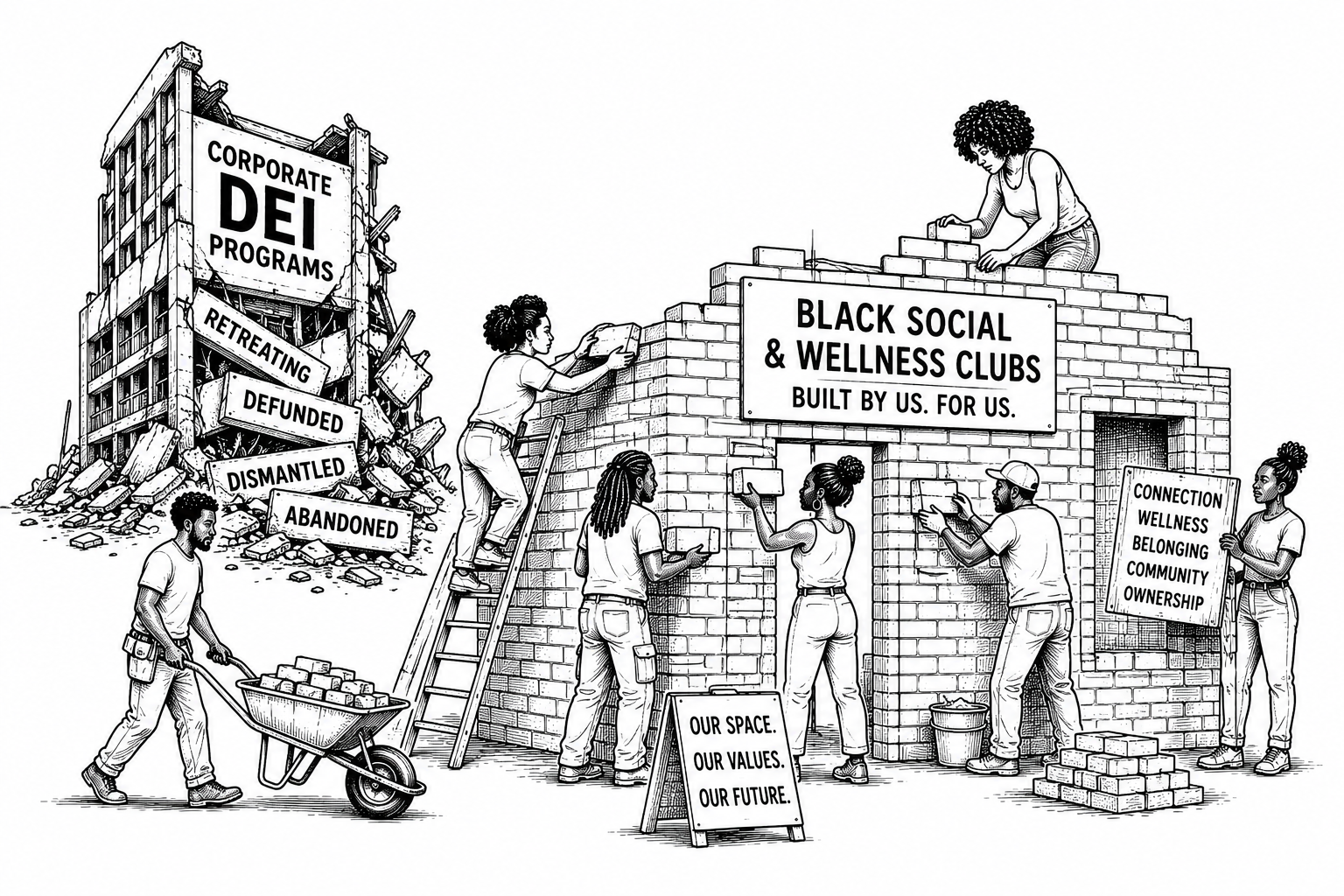
From STEM Soulcial to Black Girl Playground to the Black Girl Social Club, a category of Black-owned and Black-centered social and wellness spaces has been growing steadily for the past several years. They are not a response to a single moment. They are a structural response to a structural condition: the simultaneous retreat of corporate DEI investment, the documented loneliness epidemic, and the recognition that the community infrastructure Black Americans have historically relied on — churches, civic organizations, neighborhood institutions — has been eroding at the same time the corporate programs that were supposed to supplement it are being dismantled.
The timing is not coincidental.
Roughly half of Fortune 500 companies made racial justice commitments after George Floyd’s murder in 2020. By 2025, the majority were scaling back. Amazon phased out leadership training programs aimed at advancing underrepresented employees and reduced funding for employee resource groups. Walmart, Lowe’s, Ford, and Toyota dialed back DEI programs. Target’s retreat from its post-2020 commitments prompted a coordinated consumer campaign — the Target Fast initiative organized through Jamal Bryant’s New Birth Church — that ran through March 2026. The NAACP began tracking which companies honored their racial justice commitments and which did not. The answer, increasingly, is which did not.
Black social and wellness clubs are not filling a corporate diversity gap. They are building something the DEI industrial complex was never designed to provide: community infrastructure that belongs to the people using it.
The distinction matters. Corporate DEI programs exist within corporate permission structures. Employee resource groups are funded, staffed, and ultimately controlled by the same institutions that can eliminate them with a policy change or a legal memo. Black social and wellness clubs operate outside that permission structure entirely. The Black Girl Social Club’s mission statement names the condition it is designed to address: loneliness can be particularly challenging for Black women who face unique social, cultural, and economic barriers. The club provides face-to-face connection, mental and physical wellness programming, and a structure of integrity and dignity that its members build and govern themselves.
The broader social wellness club market is growing rapidly. Vogue identified wellness-focused private member clubs as one of the biggest trends of 2026. Fortune reported that high-end social wellness clubs are commanding memberships of up to $10,000 per month among wealthy urbanites. Social isolation — amplified by remote work and digital overload — has made genuine human connection a rare commodity, and the market is responding. The Black-centered version of this trend carries a different structural logic. It is not a luxury amenity. It is an alternative to institutions that have consistently demonstrated their commitments are conditional.
The power redistribution argument is straightforward. Corporate DEI programs transfer power from institutional accountability to managerial discretion — the company decides whether the commitment exists. Black social and wellness clubs transfer power in the opposite direction: from institutional permission to community ownership. The infrastructure that gets built belongs to the community building it.
The question these clubs are already answering, without waiting for corporate America to decide whether it is convenient, is what community looks like when you build it yourself.
Get SSC analysis delivered to your inbox every day. Subscribe free on Beehiiv: socialstorytellerscollective.beehiiv.com