
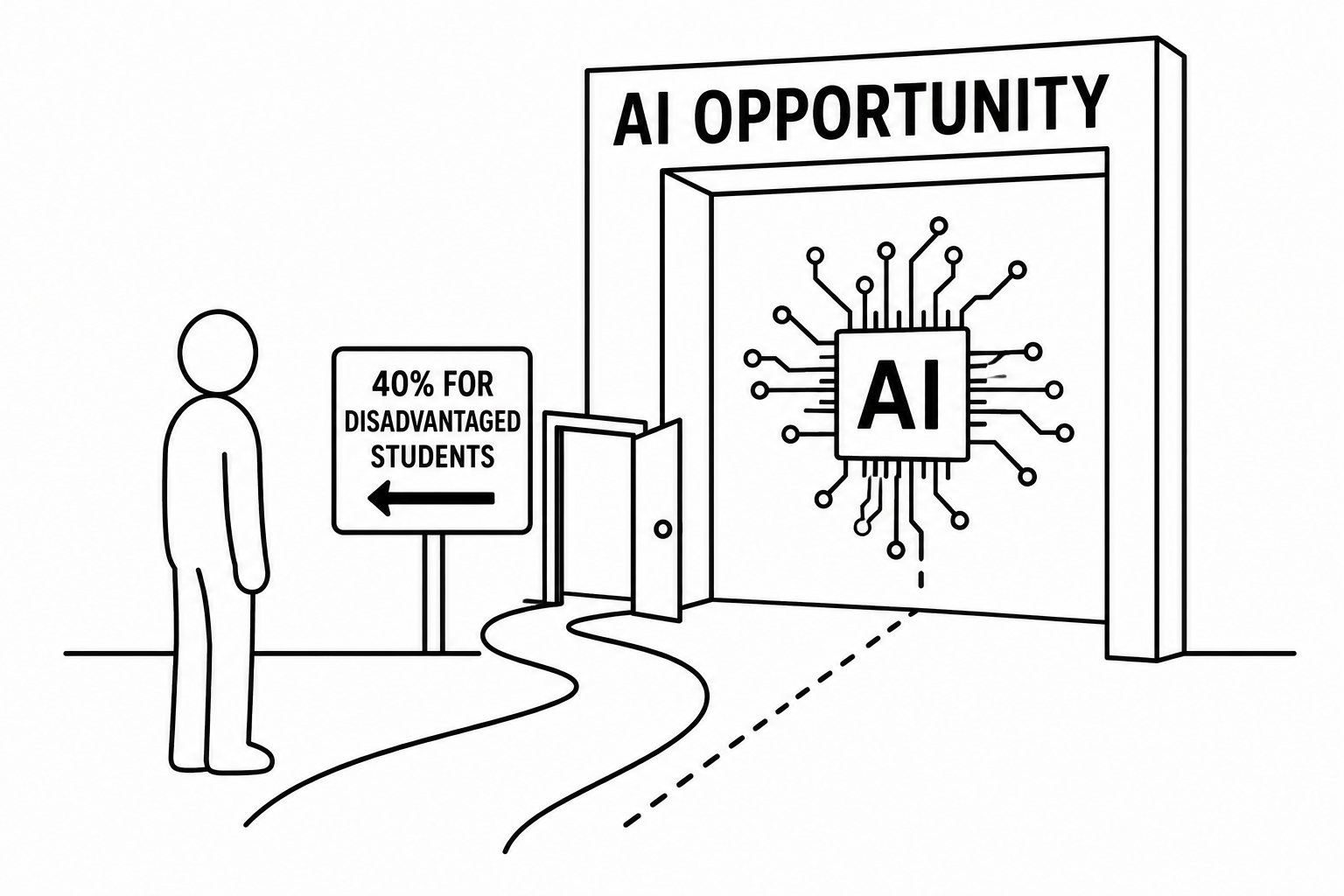
Technology Secretary Liz Kendall told Guardian Economics Editor Heather Stewart on Friday that the Labour government will ensure 40 percent of the 1 million children targeted by its $237 million (£187 million) TechFirst AI training program come from disadvantaged schools — a direct modification to the initiative’s original design. “We’ve got to make sure AI enhances work: that we help people through the jobs transition,” Kendall said. The announcement, made ahead of London Tech Week, signals a growing recognition that the future of AI may depend as much on who gains access to new skills as on the technology itself. Kendall’s framing was explicit: the goal is to make AI work “for workers and people living in the most disadvantaged areas, not just a powerful, unaccountable few.”
The timing reflects a broader shift in how governments are discussing artificial intelligence. For much of the past two years, public debate has focused on the capabilities of AI systems, the companies building them, and the risks associated with rapid adoption. Increasingly, policymakers are confronting a different question: who will be positioned to benefit when AI becomes embedded throughout the labor market? That question moves the conversation from innovation to distribution.
Historically, major technological transitions have rewarded workers who possessed the education, resources, and institutional support needed to adapt. Those advantages are rarely distributed evenly. New industries create opportunities, but they often concentrate those opportunities among people who were already positioned to access them. The TechFirst modification reflects an explicit acknowledgment that AI could follow the same pattern — and that intervention before the labor market shifts is more effective than remediation after. As SSC documented in The AI Resume Screen Won’t See You Coming, AI hiring tools already favor certain candidates over others at the point of entry. The British initiative is attempting to address upstream what SSC has been documenting downstream.
The structure of the program reflects the scale of the challenge. The $237 million (£187 million) TechFirst investment sits alongside a broader $1.26 billion (£1 billion) government commitment to AI research infrastructure and a national supercomputer investment of up to $945 million (£750 million). The disadvantaged school carve-out is a redistributive adjustment within a much larger innovation budget that still flows predominantly toward established institutions and big tech partners including Google, Microsoft, Amazon, and IBM. Kendall’s language acknowledges the tension: “Too much of this debate is as if this is being done to us. The choice is between shaping it to work for us or being left at its mercy.”
The U.S. policy direction is moving in the opposite direction simultaneously. This week, the federal government removed EEOC guidance on discriminatory AI hiring tools, leaving no federal enforcement mechanism for algorithmic bias in hiring. The British government is investing public money to ensure disadvantaged students gain AI skills before the labor market requires them. The American government is removing the oversight that would hold employers accountable when those same students encounter AI screening on the other side of the application. Two major economies. Two policy directions. The workers absorbing the consequences are not abstractions — they are the same population both governments claim to be protecting.
Kendall also announced two pilot summer skills programs — 60 places in the northwest and 20 in the northeast of England — targeting young people not in education, employment, or training, funded through Labour’s Youth Guarantee. The numbers are small. The intent is to scale. IMF Managing Director Kristalina Georgieva has warned that AI will be a “tsunami hitting the labor market, with the young worst affected.” Kendall declined to predict mass job losses but acknowledged that some jobs will go. The summer skills pilots are the government’s early answer to that acknowledgment — modest in scale, significant in what they reveal about where the political conversation is heading.
The British announcement does not resolve the distributional challenge it names. $237 million (£187 million) targeted at disadvantaged schools is a policy intervention inside a technological shift being driven by companies valued in the trillions. The gap between the scale of the investment and the scale of the disruption is visible in the numbers. What the announcement does reveal is that the political cost of ignoring the access question is rising. Governments that treat AI as purely an innovation story are increasingly finding that their own citizens are asking who the innovation is for — and demanding an answer before the labor market provides one.