
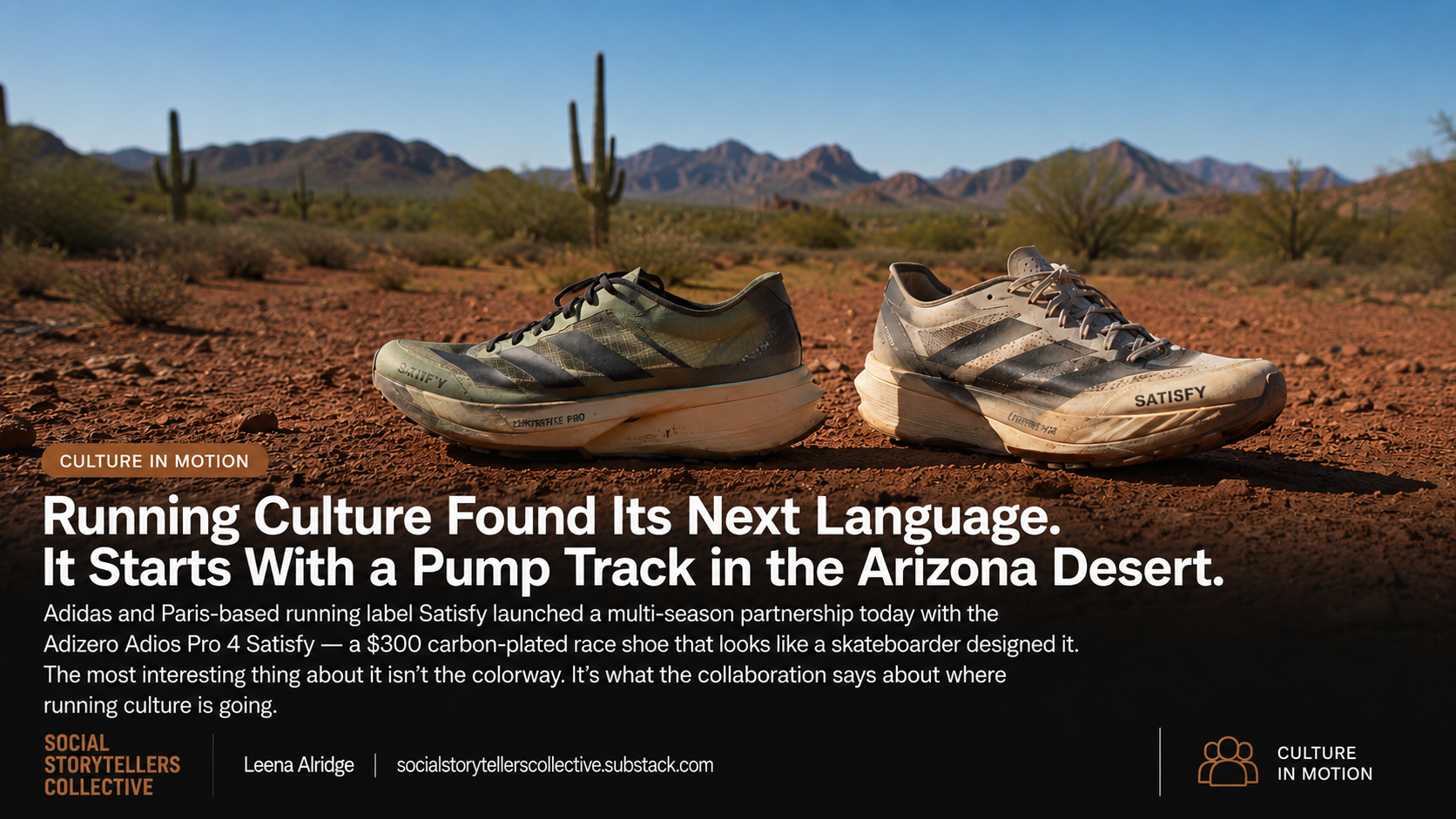
They didn’t do a press event in New York or Paris. They flew to the Sonoran Desert — specifically Oro Valley, Arizona— set up a pump track loop in the middle of it, and called the launch experience “The Circle Pit.” That detail is the whole story before anyone looks at the shoe.
Satisfy is a Paris-based technical running label that has spent years building something rarer than a product line: a genuine subculture. Its community is runners who treat long miles as a lifestyle philosophy — people who log 50-mileweeks and care equally about the aesthetics of the kit they do it in. The brand has previously collaborated with Hoka and Crocs, launched its own debut shoe (TheROCKER) in 2025, and developed a near-religious following among the segment of running culture that exists at the intersection of endurance performance and independent creative identity. When Sabastian Sawe stormed to a record-breaking sub-two-hour victory at the 2026 London Marathon wearing custom Adidas Adizero shoes, adidas running sales surged. Now adidas wants what Satisfy has — credibility that cannot be purchased with a marketing budget.
The shoe itself earns its conversation. The Adizero Adios Pro 4 is one of the most technically decorated racing silhouettes in modern marathon history — full-length Lightstrike Pro cushioning, Carbon Fibre Energy Rods 2.0, Continental rubber outsole with Lighttraxion technology, Lightlock woven upper. None of that changes in the Satisfyversion. What changes is everything visible. The uppers arrive in an asymmetric color fade — each shoe in a pair deliberately mismatched, with the fade running across the two shoes as a gradient. The aesthetic is inspired by skateboarders who wear mismatched shoes and graffiti artists who work in spray-paint fade. Three colorways: Tent Green, Grey, and Tech Earth. Each pair includes the text “Stay Possessed“ hidden on the flip of the heel tab. The $300price point is a $50 premium over the standard Adios Pro 4. The performance is identical. The language is entirely different.
Satisfy chief brand officer Daniel Groh described the collaboration plainly: “Together with Adidas, we want to continue expanding the language and perception of running culture. This collaboration is not simply about combining logos — it exists at the intersection of authentic performance and cultural relevance.”
The collaboration drops today— May 22 — on satisfyrunning.com, with a wider release through the adidas CONFIRMED app and adidas.com on May 25. But the more significant detail is the word “multi-season.” Both brands confirmed a creative partnership extending through 2026 and beyond — not a capsule, not a one-off, a sustained relationship. In an era where most brand collaborations are transactional by design — one limited run, one news cycle, done — adidas and Satisfy are betting on something longer. The strategy reflects where running culture currently is: run clubs have replaced gyms as the social infrastructure of a generation, community-driven events are outperforming traditional brand activations, and the runners who are most influential in that culture are the ones who treat the sport as identity rather than fitness.
adidas is not the only major brand making this calculation. Saucony is three collaborations deep with Minted New York. Hoka has its own boutique partnership history. The pattern is consistent: performance giants get authentic credibility with serious runners, boutique labels get world-class technology and global distribution. What Satisfy brings to this specific deal that others haven’t is a fully realized aesthetic universe — punk rock, skateboarding, long-distance trail running, Paris — that has never been successfully synthesized with a mainstream marathon racing shoe before.
The Satisfy x adidas launch is a culture story about who gets to define what running looks like — and what it means that the answer is increasingly coming from independent labels with devoted communities rather than from performance brands’ internal design teams. For decades, running shoes looked the way running shoes looked because the people making them decided what serious runners should want. The subculture that Satisfy built — and that adidas is now formally partnering with — is a direct challenge to that premise. Serious runners, it turns out, want the shoe that reflects who they are, not just what pace they’re running. The same cultural economy that turned Harlem into intellectual propertyis the one that made a boutique Paris running label the most interesting thing happening in performance footwear in 2026. Authenticity is the scarce resource. The big brands know it. That’s why they’re flying to the Arizona desert and calling it The Circle Pit.