
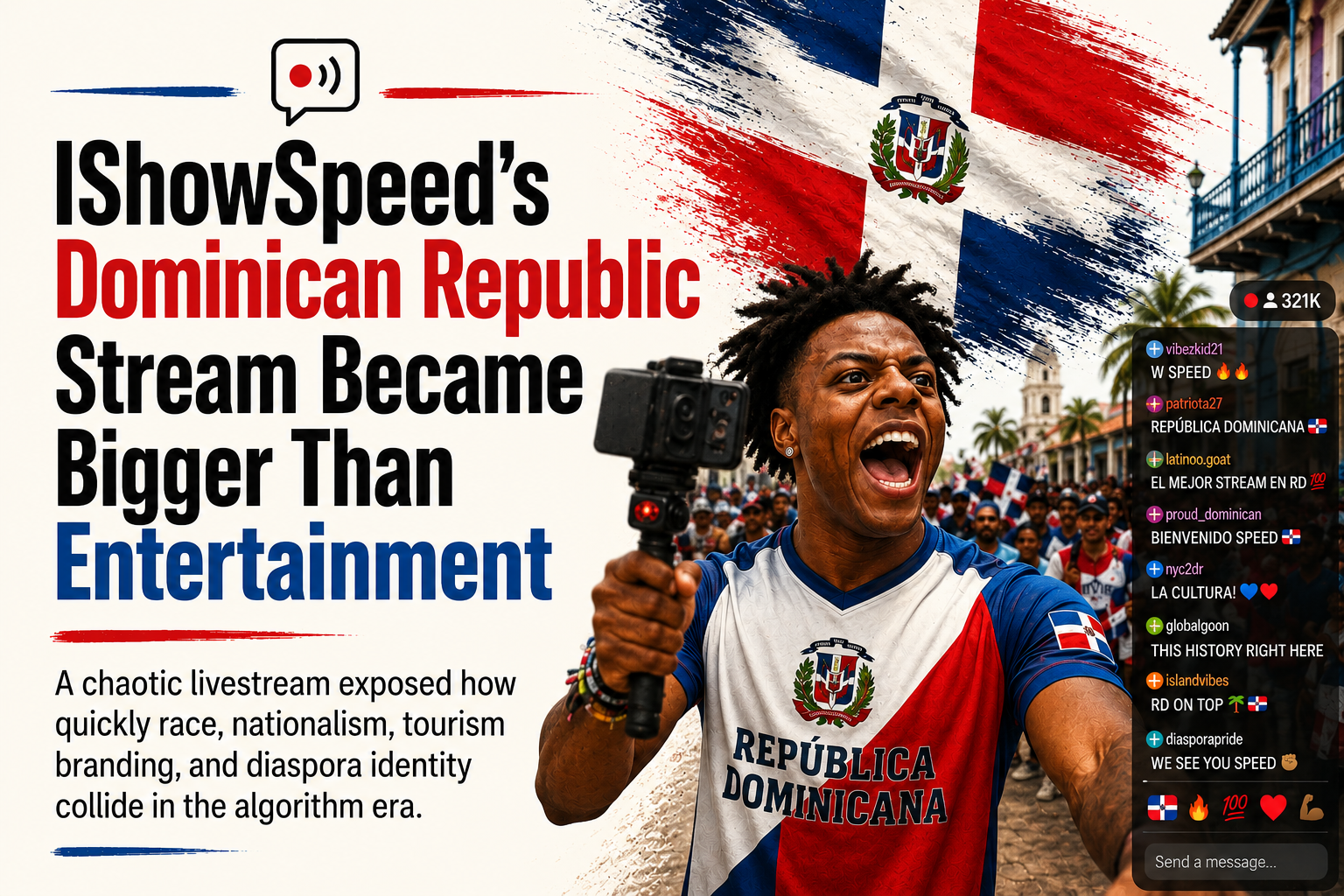
IShowSpeed — the 20-year-old Ohio-born streamer with over 35 million YouTube subscribers — didn’t go to the Dominican Republic to start a debate about race and diaspora politics. He went to make content. The internet had other plans.
What began as another stop on his international streaming tour quickly evolved into something far larger online. During his visit, several chaotic moments from his livestream spread rapidly across TikTok, Instagram, X, and YouTube — triggering a broader debate about anti-Blackness, Dominican identity, anti-Haitian sentiment, and how race is interpreted across the Caribbean diaspora. The stream itself followed the familiar structure of modern influencer tourism content — large crowds, public interactions, escalating fan energy, and unpredictable encounters. But the online reaction transformed the event into a much deeper cultural conversation than the content itself ever intended to be.
What the clips showed and what the internet saw
The immediate viral moments centered on crowd behavior. Clips circulated showing overwhelming fan interactions, tense exchanges in public spaces, and moments where Speed appeared visibly uncomfortable as crowds surged around him. One widely shared clip involving unwanted physical contact intensified discussions about safety and crowd dynamics during creator appearances.
But the larger discourse online moved well beyond whether the environment was chaotic. The conversation shifted toward what many viewers believed the treatment represented culturally and racially — particularly because Speed is one of the most visible young Black internet personalities in the world. And that shift happened almost immediately, before any formal reporting, before any official response, before anyone involved fully understood the scale of what was unfolding.
That speed is the story.
Why the Dominican Republic specifically
That interpretation did not emerge in a vacuum. Discussions surrounding race in the Dominican Republic have long carried international sensitivity because of the country’s complex history involving Haitian migration, Black identity, nationalism, and citizenship policy. Human rights organizations have repeatedly scrutinized Dominican immigration enforcement and policies affecting Haitians and Dominicans of Haitian descent over the past decade. Those realities created an existing framework through which many viewers interpreted the livestream clips almost immediately.
For some audiences the stream appeared to confirm perceptions about anti-Blackness and anti-Haitian bias inside the country. For others the backlash itself felt unfairly reductive — flattening an entire population into stereotypes based on selective viral footage. Neither position is fully satisfying. Both are doing real work in the culture.
The Dominican Republic occupies a particularly complicated position within these discussions because the country simultaneously exports globally recognized Black cultural influence while facing scrutiny over racial politics internally. Dominican music, baseball, nightlife, tourism culture, and aesthetics are deeply embedded inside global Black and Caribbean culture. Yet conversations surrounding Haitian migration and Dominican racial identity continue generating controversy internationally. That contradiction helps explain why Speed’s stream escalated so quickly into a symbolic debate larger than the creator himself. The footage became a canvas onto which audiences projected larger unresolved arguments about race and belonging across the region.
The algorithm problem
Much of the online discourse also demonstrated the dangers of algorithm-driven interpretation. Viral clips rarely provide full social or cultural context, and emotionally charged commentary spreads faster than verified reporting. Some viewers interpreted isolated moments as definitive evidence of systemic racism. Others dismissed all criticism as anti-Dominican bias. The reality is likely more layered than either extreme. Public crowd behavior, livestream chaos, nationalism, tourism performance, internet trolling, and existing racial tensions can all exist simultaneously without reducing an entire country or population to a single narrative.
SSC has been tracking this dynamic across multiple beats this week. The Pitchfork/Chris Brown piece examined how review scores get read through ideology and institutional bias before they are read as music evaluation. The deja.zhane beauty piece traced how Black American identity gets absorbed into broader categories in ways that make specific communities harder to see. The masculinity piece documented how online discourse consistently redirects structural arguments toward identity debates that are easier to monetize and harder to resolve. The IShowSpeed moment is the same pattern operating at global scale — a livestream becoming a proxy war for arguments that were already happening before the stream started.
What this reveals about creators as cultural ambassadors
What makes the story important beyond influencer culture is how clearly it demonstrates the changing role of creators inside global media ecosystems. Streamers now operate almost like informal cultural ambassadors — whether intentionally or not. Their livestreams can shape international perception of cities and countries faster than traditional tourism campaigns, news coverage, or official government messaging. A single viral interaction can become part of a broader geopolitical or racial conversation within hours because audiences increasingly consume global identity through fragmented social content rather than formal reporting.
IShowSpeed did not arrive in the Dominican Republic as a journalist or a diplomat. He arrived as a content creator with a massive audience and no editorial framework for what his presence might activate. That gap — between creator intention and audience interpretation — is where the controversy lives. And it is a gap that will only grow as creators with global audiences continue entering communities with complex histories and minimal contextual preparation.
The deeper takeaway
The controversy is not simply about whether IShowSpeed had a good or bad experience in the Dominican Republic. It is about what internet culture now does to complicated historical conversations. Race, identity, tourism, nationalism, and diaspora politics no longer stay confined to academic debate or political reporting. They now unfold inside livestream chats, clipped videos, reaction posts, and algorithmic outrage — often before anyone involved fully understands the scale of the conversation they have entered.
The stream ended. The conversation it activated did not. That is the new normal for creators operating at global scale — and for the communities they visit without warning.