THE COST OF WORK
A dispute over employer sponsorship can interrupt workers’ plans long before a company feels the consequences.
Analysis | Social Storytellers Collective
Part of SSC’s reporting series examining labor pressure, workplace rules and who absorbs the cost.
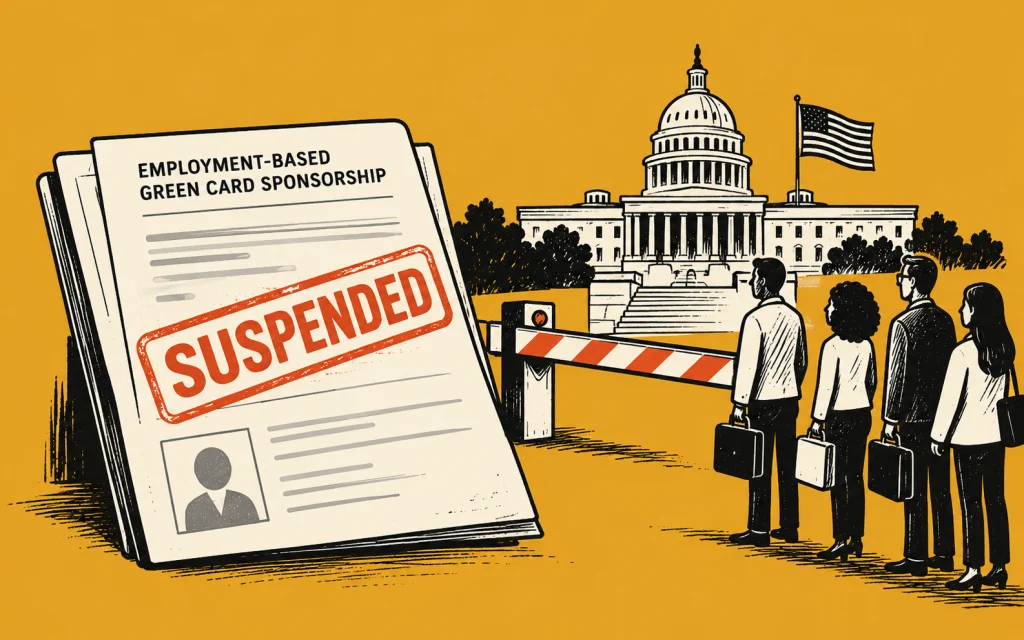
Eight companies, including Microsoft and Adobe, are being suspended from a federal labor-certification program used in employment-based green-card sponsorship. Labor Secretary Keith Sonderling said October 8 that the department would stop accepting new applications and processing pending ones involving the named firms, according to Reuters’ reporting on the announcement. Officials alleged abuses; those accusations are not findings of guilt. The action concerns a route toward permanent residency. It does not establish that every affected employee’s current visa has been canceled. For someone building a life around employer sponsorship, however, an interrupted process can introduce uncertainty well before a job or existing immigration permission ends.
Employer Sponsorship Shapes the Process.
The Labor Department’s explanation of permanent labor certification shows where the employer enters the process. Employers, rather than employees, file the applications. In most cases requiring certification, the department must establish that sufficient qualified, available U.S. workers cannot fill the position and that hiring a foreign worker will not adversely affect comparable workers’ wages and conditions. Immigration authorization follows through U.S. Citizenship and Immigration Services. These are separate steps involving separate responsibilities. A suspension at the labor-certification stage therefore deserves a precise explanation: which application is affected, what stage it has reached and what the government has actually instructed the employer to do.
Microsoft disputed the portrayal of its hiring in an October 8 company statement. Of approximately 6,000 H-1B applications submitted in the previous fiscal year, the company said 80% extended or changed the status of existing employees. It said the remaining filings involved people already legally in the United States and equaled 1% of its U.S. workforce. Microsoft also said it pays H-1B employees the same as others doing comparable work. These are company assertions, not an independent audit. They nevertheless show why application counts cannot automatically be described as new hires or replacements for laid-off workers.
Uncertainty Travels Into the Household.
SSC’s analysis is that the workplace consequences extend beyond the argument about recruitment. An employer can respond through legal counsel, public statements and negotiations with government. An employee may have to decide whether to renew a lease, pursue another position or postpone a family plan while waiting for information they cannot obtain independently. Those are possible consequences, not accounts from workers interviewed for this article. The point is the uneven ability to manage uncertainty. A corporation can treat a sponsorship dispute as one issue within a large operation; the person relying on that sponsorship may experience it as a constraint on decisions across an entire household.
That dependency adds another dimension to SSC’s reporting on tech layoffs and the uneven pace of job cuts. A layoff count records positions eliminated. It cannot, by itself, describe the obligations attached to each position. Workers can share an occupation or salary range while facing different consequences if employment changes. Immigration paperwork may be one of those differences, alongside caregiving responsibilities, health coverage and savings. Employers discussing workforce flexibility should acknowledge those obligations when they communicate changes. A generic reassurance about business continuity offers little help to someone who needs a specific account of their own application.
Workers Need Answers About Their Own Cases.
Useful communication would identify the affected process, distinguish submitted applications from future filings and explain where employees can obtain case-specific answers. Employers should also say what they know, what remains unresolved and when they expect to provide another update. Workers considering a job change or international travel should seek guidance from qualified immigration counsel familiar with their documents rather than assume a headline applies identically to every case. This is a recommendation about obtaining reliable information, not a prediction about anyone’s eligibility. The application stage, immigration category and individual history must be assessed before a practical consequence can responsibly be stated.
The next development to watch is how the announced suspension is implemented and explained to employees. Enforcement aimed at employers should be evaluated both on its evidence and on what it does to the people those employers sponsor. Protecting U.S. workers and investigating alleged misconduct are stated policy goals; a clear account of implementation is still necessary to judge the results. For The Cost of Work, this is another place where employment reaches beyond paid hours. The work agreement can shape the freedom to plan, negotiate and move. Reporting should follow that freedom as closely as it follows the company’s response.