
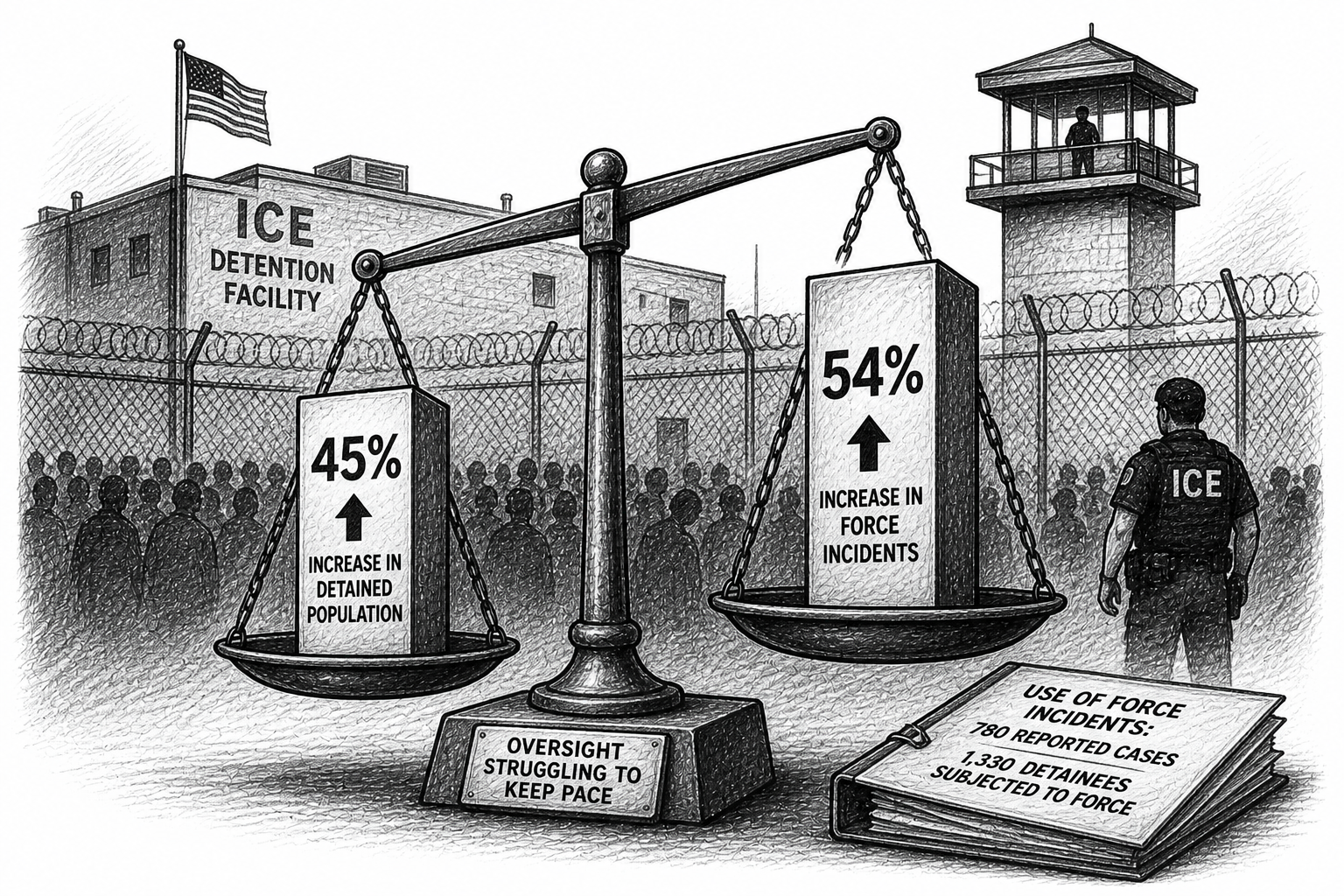
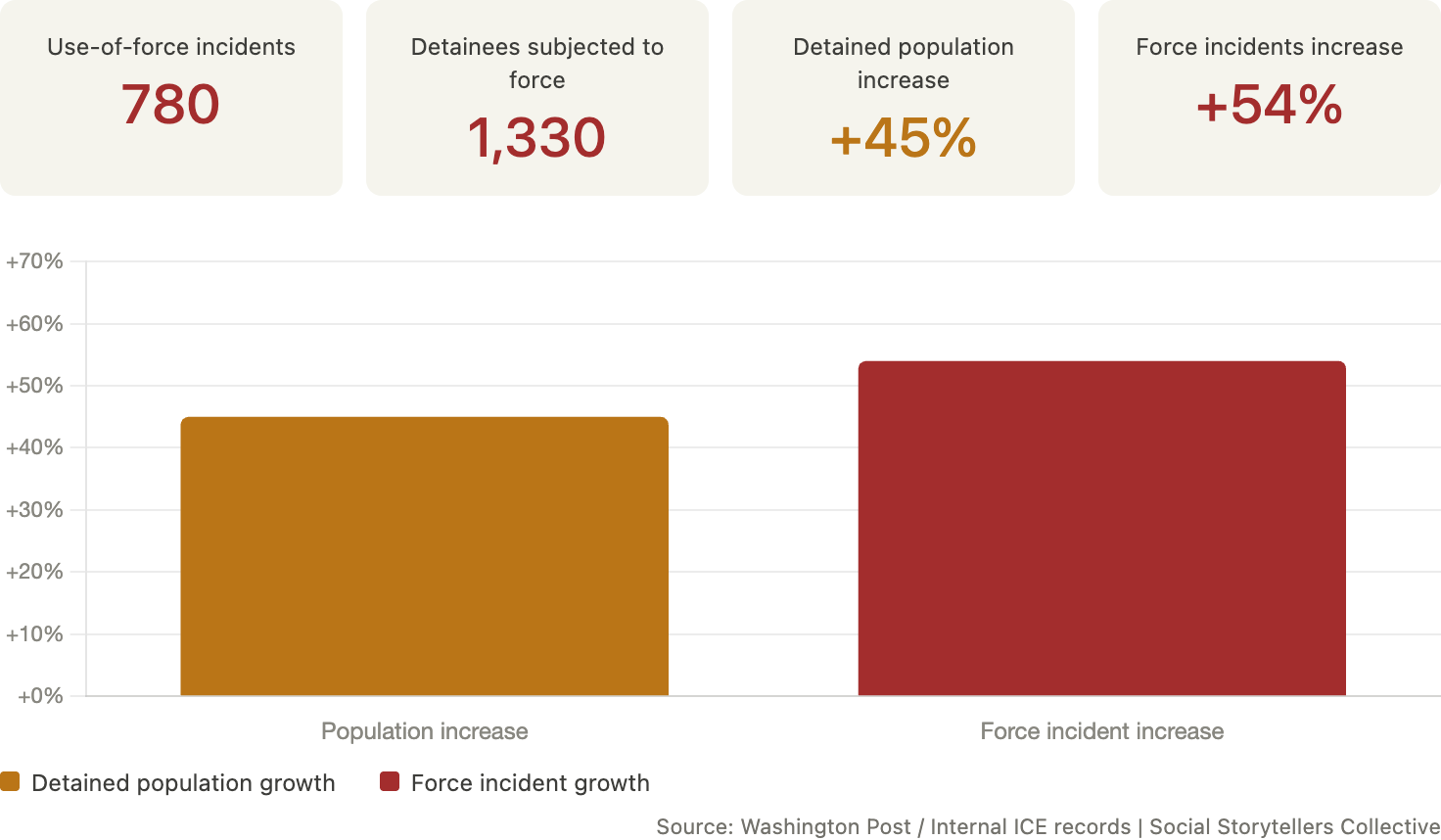
A new Washington Post investigation into ICE detention operations documents what happens when a system is told to scale faster than it was built to hold. During the first year of the Trump administration’s second term, use-of-force incidents across ICE detention facilities reached at least 780 reported cases — with 1,330 detainees subjected to force over the period examined. The detained population rose 45 percent. The number of detainees subjected to force rose 54 percent. That nine-point gap is not a rounding error. It is the story.
Detention systems do not scale linearly. As populations rise, staffing shortages, overcrowding, medical gaps, and procedural strain compound one another. The administration’s push for accelerated immigration enforcement has created a system absorbing more people, more quickly, while the oversight structures meant to govern that system struggle to keep pace. ICE maintains that force is used only when necessary to maintain safety and order. But the data reveals a pattern where escalation is outrunning the population growth that supposedly justifies it — which raises the question of whether force is becoming normalized rather than exceptional inside facilities already operating under pressure before the expansion began.
This pattern is not new to SSC’s coverage. The Airport Isn’t Just a Transit Hub Anymore — It’s a Checkpoint documented how the expansion of immigration enforcement into civilian infrastructure follows the same structural logic: enforcement scales first, accountability catches up later, if at all. When Houston reversed course on its ICE cooperation ordinance under threat of losing World Cup-related public safety funding, the same mechanism was visible at the municipal level — enforcement infrastructure expanding into new environments, with the communities absorbing the cost being the ones with the least institutional protection, while the policy decisions driving that expansion are made at levels those communities cannot access.
The broader political context matters. Immigration enforcement has increasingly become tied to visible demonstrations of state control, particularly as border politics dominate the national conversation. Detention infrastructure is no longer operating quietly in the background of immigration policy. It has become one of the administration’s most visible instruments of enforcement power. That visibility creates structural incentives for scale — more raids, more detentions, more capacity — even as public scrutiny around conditions intensifies. Historically, rapid detention expansion has repeatedly exposed weaknesses in contractor oversight, healthcare access, staffing, and due process protections. The current expansion is following the same pattern at a faster pace.
What makes this story larger than immigration alone is the governance model it reflects. Institutions facing political demands for speed and visibility consistently expand operationally before expanding safeguards. The same tension appears in policing, education discipline systems, homelessness enforcement, and workplace monitoring infrastructure. Capacity grows first. Oversight catches up later. The result is a system where force, surveillance, and restriction become easier to scale than the accountability mechanisms designed to govern them. The ICE detention data is one of the clearest current expressions of that pattern — a 54 percent increase in force incidents against a 45 percent increase in population is not a system maintaining safety. It is a system revealing what it prioritizes when speed and scale outrun structure.