
Uber is moving beyond transportation and into something more ambitious: becoming a single interface for how people plan, book, and move through travel. The addition of hotel booking inside the app isn’t a convenience feature. It’s a signal that Uber is positioning itself as a coordination layer across the entire trip — not just the ride that happens within it.
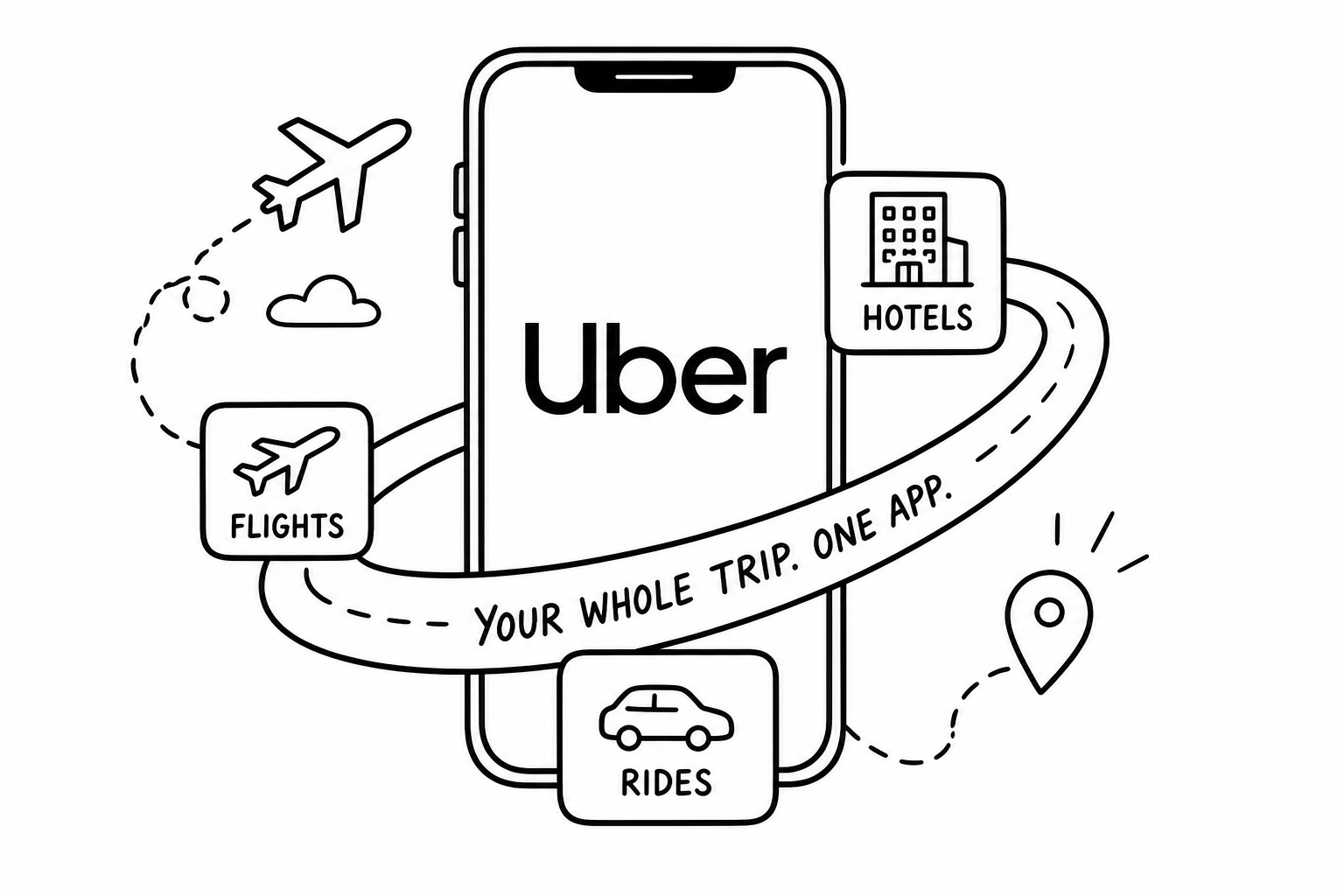
The mechanism is a formal partnership with Expedia Group, announced April 29 at Uber’s annual GO-GET product event in New York. Through a new Hotels tab, U.S. users can now search and book from over 700,000 properties worldwide drawn directly from Expedia’s inventory. Vrbo vacation rentals are set to follow later this year. What makes the structure worth examining is that it runs both directions — starting in June, Uber rides will also be embedded inside the Expedia app, with travelers receiving push notifications before hotel check-in to book rides at a discount for the duration of their stay. This is not Uber absorbing travel. It is two platforms attempting to own adjacent moments of the same journey simultaneously.
The partnership also carries a layer of institutional history that shapes how to read it. Uber CEO Dara Khosrowshahi led Expedia for twelve years before taking the top job at Uber in 2017. The companies are not strangers to each other’s logic. That shared institutional memory matters because it suggests this integration was built with a detailed understanding of where each platform’s leverage actually sits — and where the gaps between them have been costing both companies users.
For years, travel has been fragmented across platforms. Flights booked in one place, hotels in another, ground transportation handled separately once a trip begins. Each step exists as a discrete transaction, disconnected from the rest. Uber’s strategy is to collapse that fragmentation into a single environment — one where discovery, booking, and execution happen in sequence without leaving the app. The structural advantage Uber brings to this is something Expedia never had: it already owns the moment of physical transition. The airport pickup, the hotel drop-off, the late-night ride across an unfamiliar city. By layering booking on top of movement, it can connect planning to execution in a way traditional travel platforms cannot.
There’s also a frequency play underneath this. Most people don’t book hotels often, but they open Uber regularly. Embedding travel booking inside a high-frequency app lowers the friction of discovery and gradually shifts behavior over time. The loyalty incentives accelerate that shift — Uber One members receive at least 20% off a rolling list of 10,000 hotels and earn 10% back in Uber Credits on every booking. The goal is not immediate replacement of existing platforms. It is slow absorption of user habits, with the subscription tier doing the conversion work.
This move also reflects a broader pattern across tech: platforms expanding horizontally to capture adjacent moments of user intent. The more needs a single app can serve, the harder it becomes to leave it. What started as ride-hailing became delivery, then payments, then travel coordination. Each layer reinforces the next, and the exit cost for users rises with every integration.
But there’s a structural tension here. Travel is not just a logistics problem — it’s a trust and pricing problem. Users are conditioned to compare options, optimize for cost, and validate decisions through reviews. For Uber to succeed in this space, it has to do more than integrate inventory. It has to convince users that staying inside its ecosystem doesn’t mean surrendering visibility or control. That is where execution will determine whether this becomes a meaningful shift or just another feature. If Uber can connect its mobility data to smarter recommendations — suggesting where to stay based on how people actually move through cities — it begins to differentiate in ways that matter. If it simply replicates existing booking experiences inside its interface, it competes on convenience alone, which is a race it won’t win against platforms that have been doing this longer.
Why It Matters
The deeper play is about the boundary between planning and movement disappearing entirely — and the platform that closes that gap standing to redefine where travel actually begins. This isn’t Uber adding a feature. It’s Uber and Expedia making a joint claim on a larger category, one where the asset isn’t inventory or logistics but continuity — the seamless line between deciding to go somewhere and actually getting there. Whether users follow depends on whether that continuity feels like a genuine improvement or just two companies trying to keep them from opening a third app. The difference between those two things is what determines whether a partnership becomes infrastructure or just an integration that looked good in a press release.