
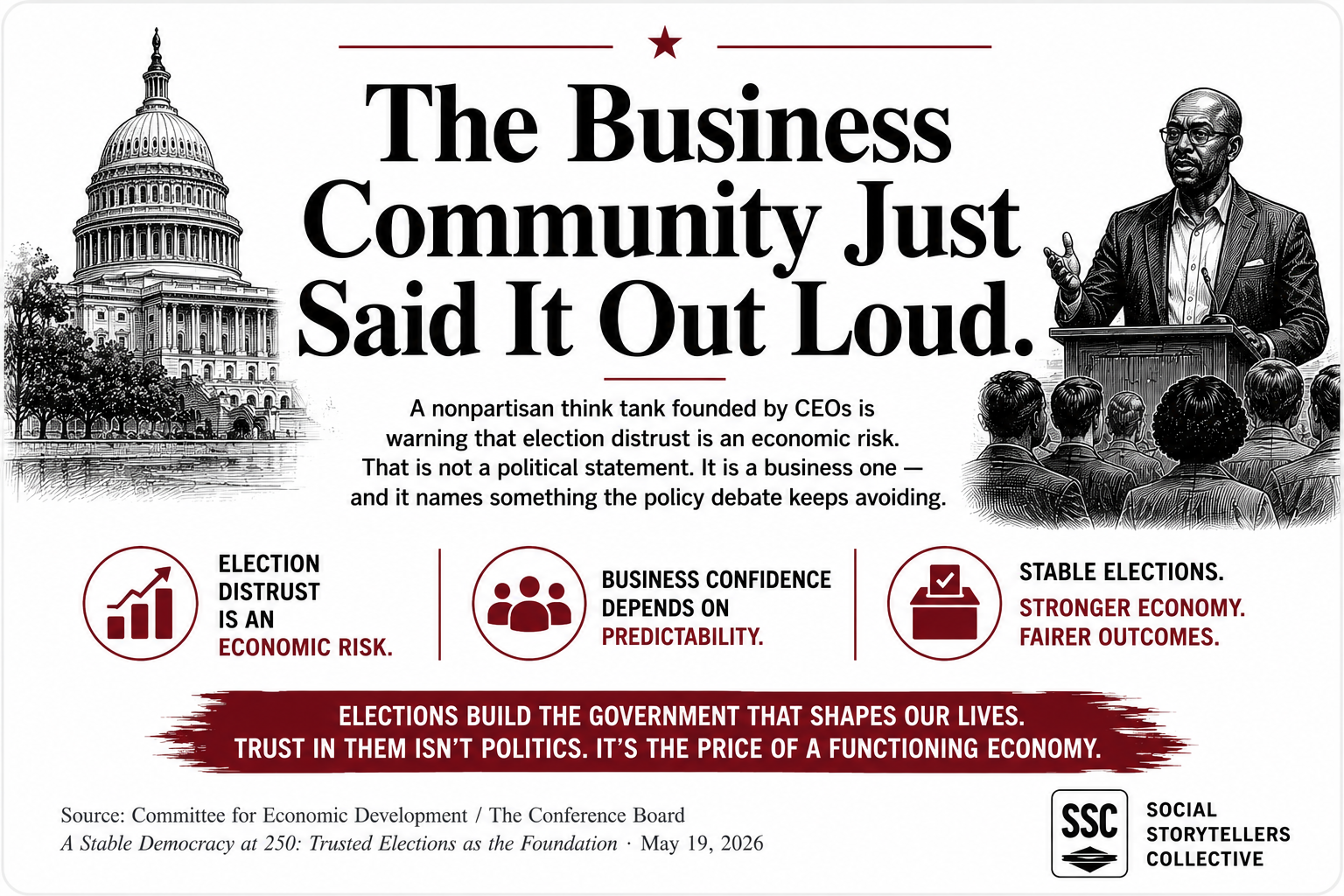
Not a political statement. It is a business one — and it names something the policy debate keeps avoiding.
Structural Reality · Systems & Policy
The Committee for Economic Development is not a democracy advocacy organization. It is a nonpartisan, business-led think tank founded in 1942 by the CEOs who helped develop the Marshall Plan for post-war Europe. Its trustees are chief executives and senior leaders from more than 30 industries representing over 4 million employees. When it releases a report, it is speaking on behalf of the people who run the American economy — not the people who campaign in it.
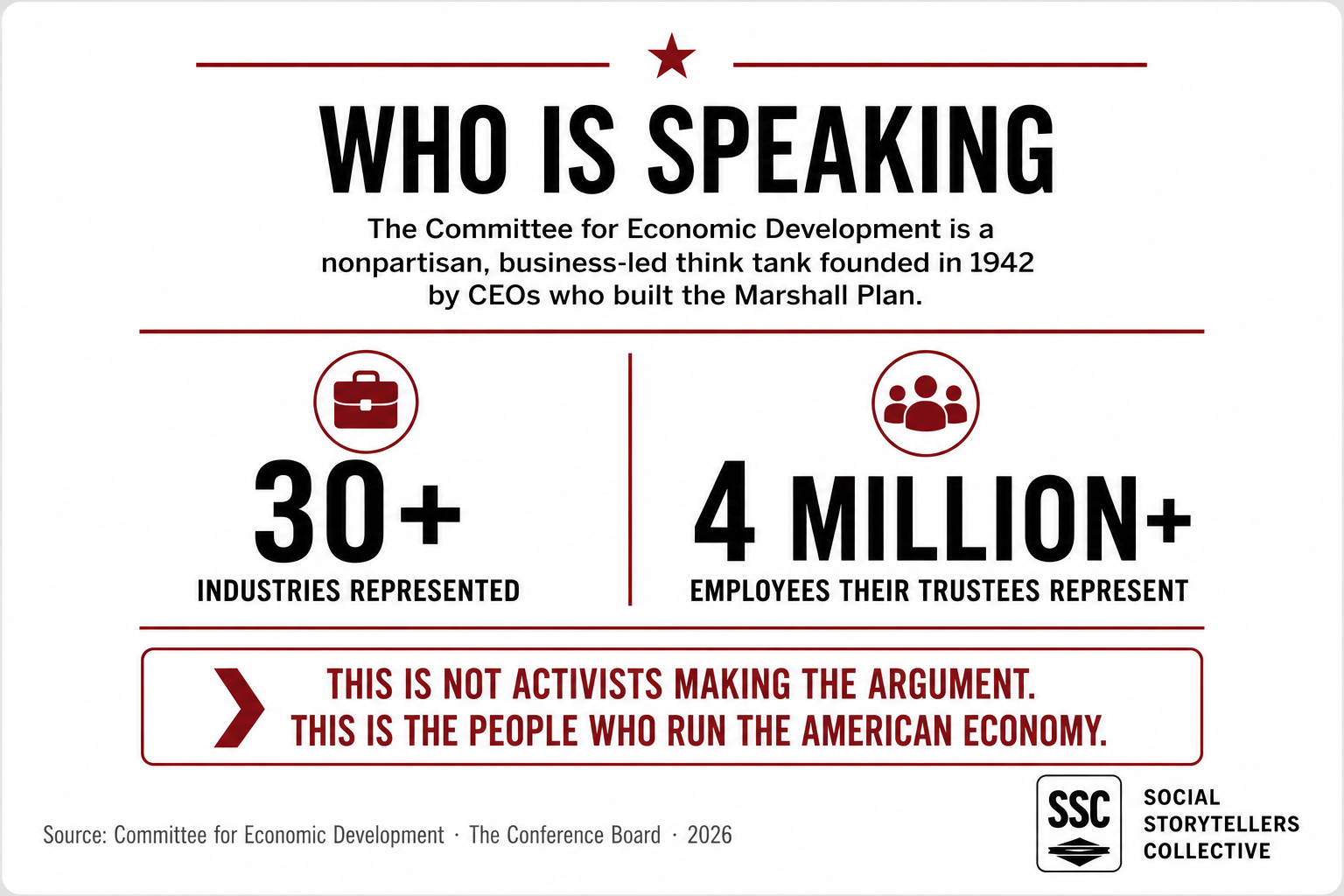
On May 19, 2026, CED released A Stable Democracy at 250: Trusted Elections as the Foundation — a report warning that growing distrust in elections poses a direct threat to business confidence and economic stability. The source matters as much as the finding. This is not activists or academics making the argument. This is the institutional voice of American business saying that democracy is not a values question — it is an infrastructure question. And when infrastructure fails, the cost does not distribute evenly.
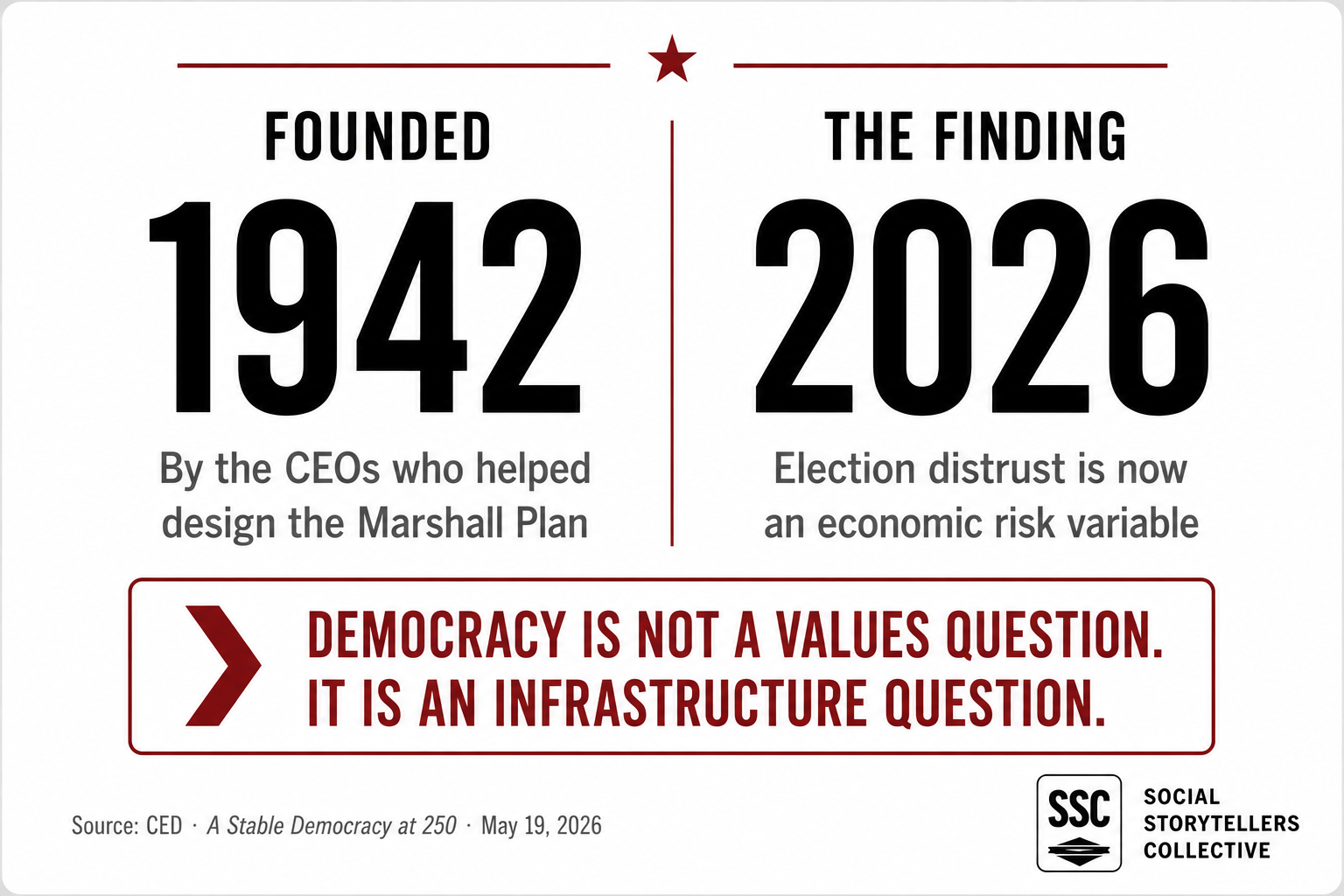
The economic argument is specific. Business confidence depends on predictability — the ability to plan, invest, hire, and operate inside a stable regulatory and political environment. When the legitimacy of elections is in doubt, that predictability erodes. Contracts get harder to enforce when the government enforcing them lacks public legitimacy. Foreign investment becomes more cautious when political instability is a measurable risk. Supply chains, regulatory frameworks, and long-term capital allocation all depend on the assumption that the mechanisms producing policy are functioning and trusted.
But the economic consequences of democratic instability do not land equally. Large corporations with diversified global operations, access to legal resources, and the ability to relocate capital have buffers that small businesses, workers, and communities do not. When election distrust produces policy chaos, regulatory uncertainty, or civic disengagement, the people with the least institutional cushion absorb the most disruption. The CED report is making the case for stable elections from the top of the economy looking down. The workers, small business owners, and communities at the bottom of that same economy have been living the consequences of that instability without the language to name it as an economic problem. The report gives them that language — from a source the policy world cannot easily dismiss.
The CED is also calling on CEOs to actively disseminate accurate information about voting and elections to their employees and networks. That is a significant ask. It also signals that the institutional trust required for democratic stability is now something corporations are being recruited to help rebuild — because the institutions that historically held that trust have weakened, and someone has to fill the gap. That the business community has arrived at this conclusion in 2026 is worth noting. That it took this long is worth noting too.
The 2026 midterms are the immediate horizon. The 250th anniversary is the symbolic backdrop. The CED report lands in the same week the Caesar Rodney statue is being restored to Freedom Plaza — another decision about what gets centered during a nationally coordinated moment of self-definition. One story is about which symbols get restored. The other is about whether the mechanisms that make self-governance possible are still trusted enough to function. The business community chose to speak about the mechanisms.
The people who will feel the consequences of election distrust most acutely are not the ones in the corner offices whose confidence CED tracks every quarter. They are the ones whose wages, housing, healthcare access, and economic mobility depend on the government those elections produce. The institutions with the most power to shape that environment are finally saying so out loud. The question is whether saying it is enough — or whether it requires the kind of structural investment in civic infrastructure that the report recommends but cannot mandate.
Sources: Committee for Economic Development / The Conference Board · A Stable Democracy at 250: Trusted Elections as the Foundation · May 19, 2026.
SSC covers systems, policy, and the structural forces shaping economic and civic life in America.