More than 8,000 immigrant students have disappeared from Houston-area schools between 2025 and 2026, according to local reporting, with some districts experiencing enrollment declines of up to 25%. The shift is not tied to a single policy change or administrative decision, but to a broader environment of heightened immigration enforcement that is altering family behavior. The absence is measurable, but its causes are distributed across fear, displacement, and economic necessity.
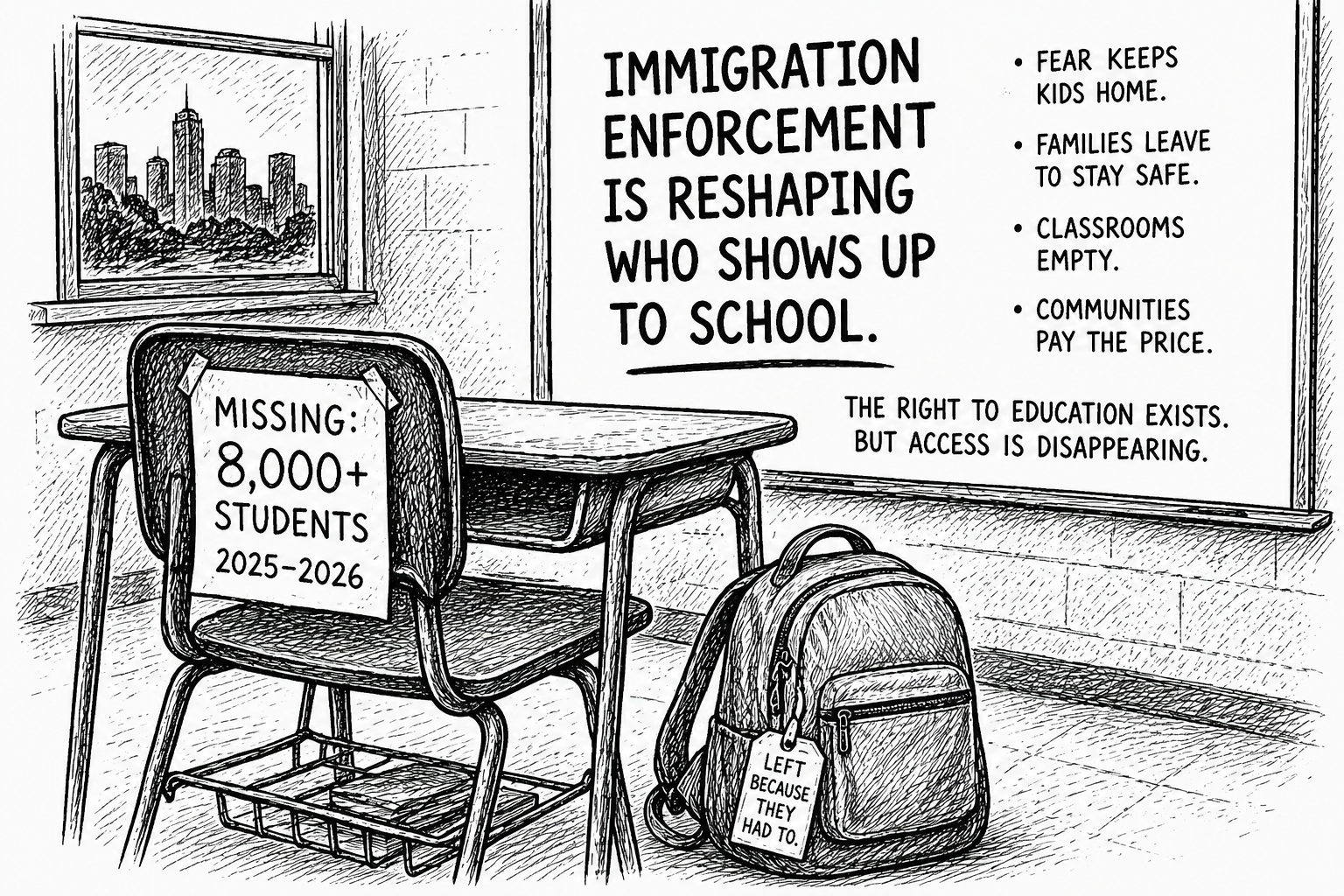
The decline reflects a convergence of enforcement practices and community response. Federal immigration policies have intensified in recent years, increasing the likelihood of detention and deportation for undocumented individuals. In response, some families have withdrawn children from school to avoid exposure, while others have left the region entirely. Districts like Aldine, Humble, and Channelview have seen some of the most significant changes, particularly in newcomer and bilingual programs.
What is unfolding is a form of indirect policy impact. Immigration enforcement is not formally designed to regulate school attendance, yet it is producing outcomes that reshape educational access. Schools operate on assumptions of stability—consistent enrollment, predictable funding, and continuity of services. When students disappear in large numbers, those assumptions begin to break down, affecting staffing, resource allocation, and program viability.
There is a structural contradiction embedded in the system. Public education in the United States is legally accessible regardless of immigration status, yet the conditions surrounding that access are becoming more restrictive. The right to attend school exists in principle, but the ability to exercise that right is constrained by external pressures. This mirrors broader patterns in which formal access is maintained while practical barriers increase.
The implications extend beyond individual students. School funding formulas are often tied to enrollment, meaning that declining student populations can lead to budget reductions, staff layoffs, and program cuts. Communities that were already navigating resource constraints are now facing additional pressure, amplifying disparities between districts. The impact is cumulative, affecting both those who leave and those who remain.
Historically, shifts in school enrollment have been driven by demographic changes or economic migration. The current moment differs in that it is driven by policy-induced fear rather than opportunity or mobility. This introduces a level of unpredictability that schools are not designed to manage, complicating long-term planning and community engagement.
The broader pattern is one of systemic spillover. Policies targeting one domain are producing effects in another, revealing how interconnected social systems have become. Education, in this case, is absorbing the consequences of immigration enforcement, reshaping who participates and who is left out. The disappearance of students is not an isolated event, but a signal of how access can be altered without being formally revoked.