Houston approved a $39 million agreement with the The Harris Center for Mental Health and IDD to operate a 24/7 homeless services facility in EaDo with up to 222 beds. The center is expected to serve approximately 750 people annually and includes case management, food access, mental health services, and on-site security. The scale signals expansion, but the design reveals a deeper shift.
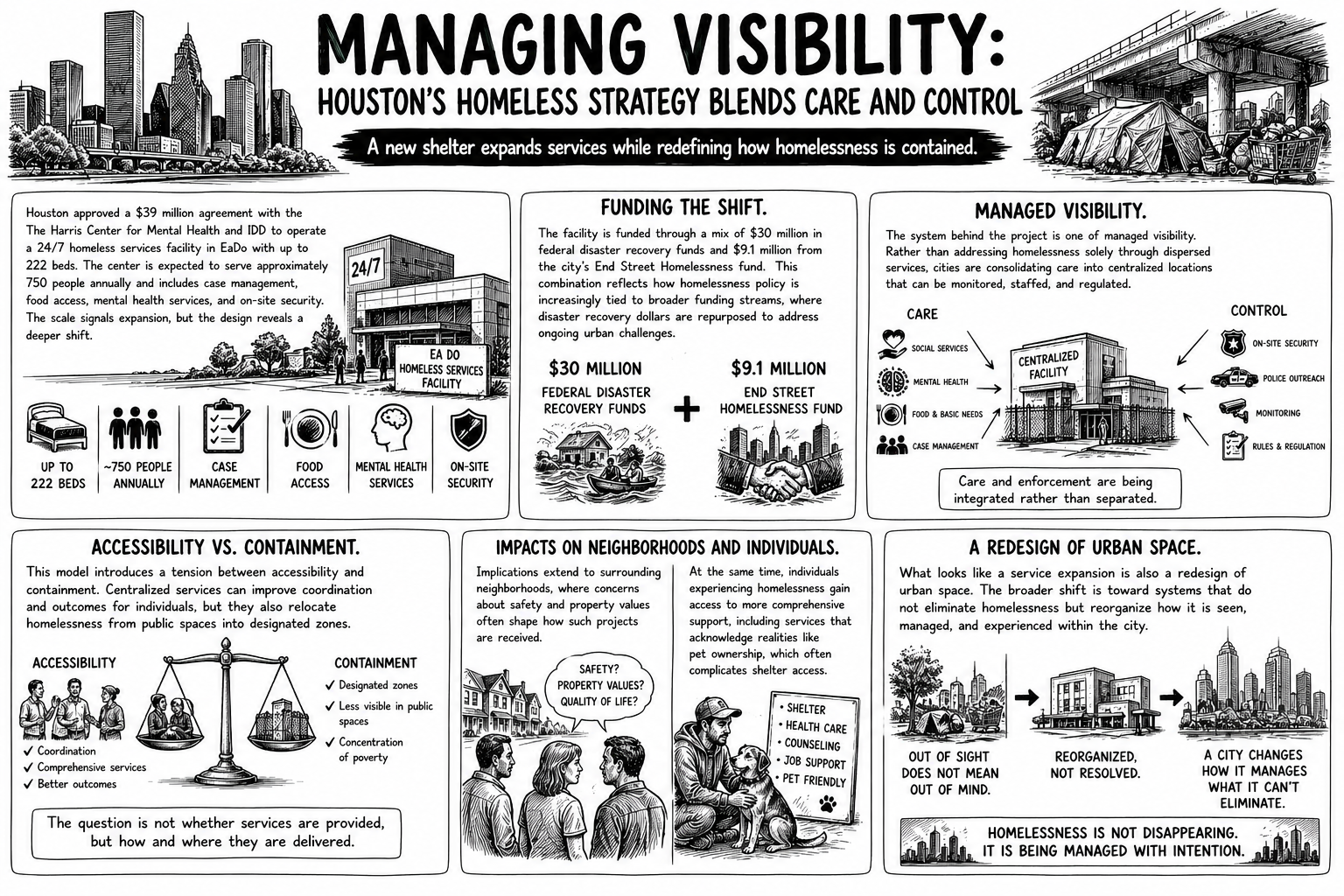
The facility is funded through a mix of $30 million in federal disaster recovery funds and $9.1 million from the city’s End Street Homelessness fund. This combination reflects how homelessness policy is increasingly tied to broader funding streams, where disaster recovery dollars are repurposed to address ongoing urban challenges.
The system behind the project is one of managed visibility. Rather than addressing homelessness solely through dispersed services, cities are consolidating care into centralized locations that can be monitored, staffed, and regulated. The inclusion of police outreach alongside social services indicates that care and enforcement are being integrated rather than separated.
This model introduces a tension between accessibility and containment. Centralized services can improve coordination and outcomes for individuals, but they also relocate homelessness from public spaces into designated zones. The question is not whether services are provided, but how and where they are delivered.
The implications extend to surrounding neighborhoods, where concerns about safety and property values often shape how such projects are received. At the same time, individuals experiencing homelessness gain access to more comprehensive support, including services that acknowledge realities like pet ownership, which often complicates shelter access.
What looks like a service expansion is also a redesign of urban space. The broader shift is toward systems that do not eliminate homelessness but reorganize how it is seen, managed, and experienced within the city.