
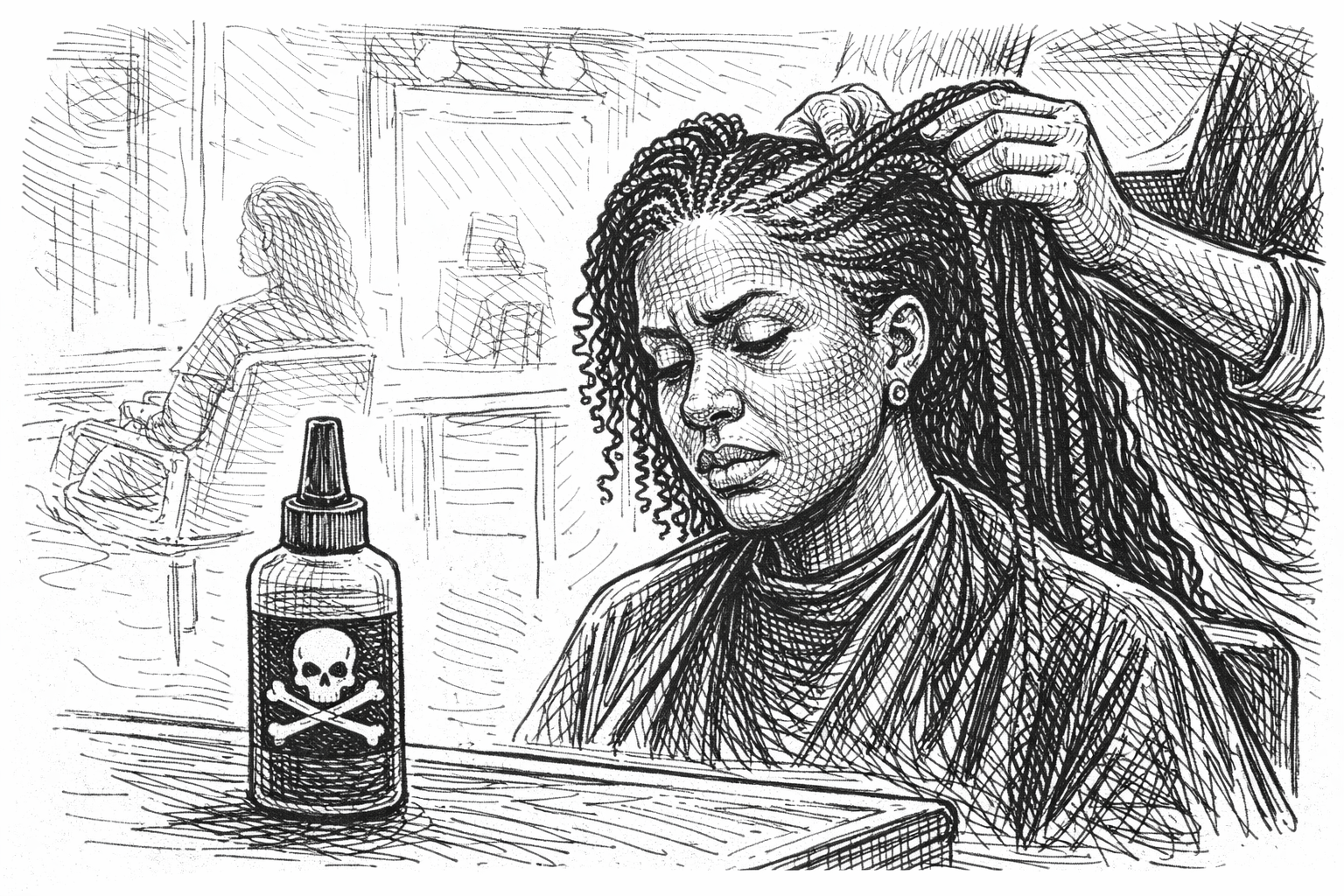
The last time I sat in a braiding chair, I didn’t think about what was in the hair. I thought about how long it would last, whether the color matched, and whether my scalp could handle another six hours of tension. That’s the calculus most Black women run — practical, aesthetic, economic. We are not thinking about flame retardants. We are not thinking about pesticides. We are not thinking about the chemicals pressed against our scalps for weeks at a time because no one told us we needed to.
That’s the problem.
Two studies published in early 2026 found that hair extensions — products used by an estimated 70% of Black women in any given year — are saturated with hazardous chemicals. A peer-reviewed study by scientists at the Silent Spring Institute analyzed 43 samples of synthetic and human hair extensions and detected 933 unique chemical signatures across 169 distinct chemicals. More than 80% of the samples contained chemicals linked specifically to breast cancer. At least one substance tied to cancer or reproductive harm appeared in 91% of all samples tested. Separately, a Consumer Reports investigation found lead in 29 brands of extensions currently on the market.
I read those numbers and I thought about Harris County.
Black women in Harris County — where Houston sits — die in childbirth at rates that should be a public health emergency. They walk into hospitals experiencing complications and are sent home. They describe pain that gets minimized, symptoms that get dismissed, instincts that get overridden by providers who have already decided, in some quiet and unexamined way, that their bodies require less urgency. The maternal mortality crisis for Black women in Texas is not a mystery. It is the result of a healthcare system that has never been designed with Black women’s survival as a central value.
The hair extension findings live in that same system. Black women already experience disproportionately higher rates of aggressive breast cancer and uterine fibroids. They use more hair products, more frequently, than any other demographic group. And the products marketed to them have consistently been shown to carry a higher chemical burden than those marketed to the general population. The thread connecting all of it is not bad luck. It is a structural indifference to what happens inside Black women’s bodies — whether that indifference shows up in a hospital room or in the absence of a federal safety standard for a $14 billion industry built almost entirely on Black women’s patronage.
The regulatory failure is not accidental. The Biden administration’s FDA had moved to ban formaldehyde — a known carcinogen found in many hair straighteners — from personal care products. Since Trump returned to office, the FDA missed that deadline. The EPA proposed loosening restrictions on the same chemical. The message to Black women, delivered quietly through bureaucratic inaction, is that their exposure is not a priority. It has never been a priority. The studies just keep confirming what Black women already suspected and were never given the institutional backing to act on.
Some states are trying to move. A bill in New Jersey would prohibit certain harmful chemicals in synthetic hair products. The federal Safer Beauty Bill Package contains provisions directing the FDA to regulate synthetic braids and extensions. But federal momentum is stalled, and in the absence of oversight, the industry continues operating as it always has — building a billion-dollar market on Black women’s dollars while absorbing none of the health costs.
For the women in the chair and the braiders working alongside clients for years, the navigation is exhausting. Relaxers fell out of favor when formaldehyde became widely known. Extensions were supposed to be the safer alternative. Now extensions are under scrutiny. Gels, edge control, glues, oil sheen — the list of everyday products shown to carry hazardous chemicals keeps growing, and there is no clear safe option. The burden of that uncertainty falls entirely on the consumer, which in this case means almost exclusively on Black women.
I keep coming back to the braiding chair. To the hours. To the care that goes into protective styling — the intention behind it, the community of it, the way it connects generations of Black women who learned from each other how to tend to what grows from their heads in a world that has always had opinions about it. That care deserves protection in return. What these studies confirm is that it is not getting it — not from the industry profiting from it, and not from the government with the authority to require it.
Why This Matters Hair is never just hair for Black women — it is cultural identity, professional calculus, personal expression, and economic decision all at once. But this story is inseparable from a larger one: that Black women’s bodies have never been treated as worthy of the same protection, urgency, or care that the system extends to others. The maternal mortality crisis in Harris County and the chemical exposure crisis in hair extensions are not separate issues. They are the same pattern, playing out in different rooms. An unregulated industry harming the consumers it depends on. A regulatory system that keeps finding reasons not to act. And Black women, once again, left to manage a risk they did not create — while the institutions with the power to intervene look the other way.