
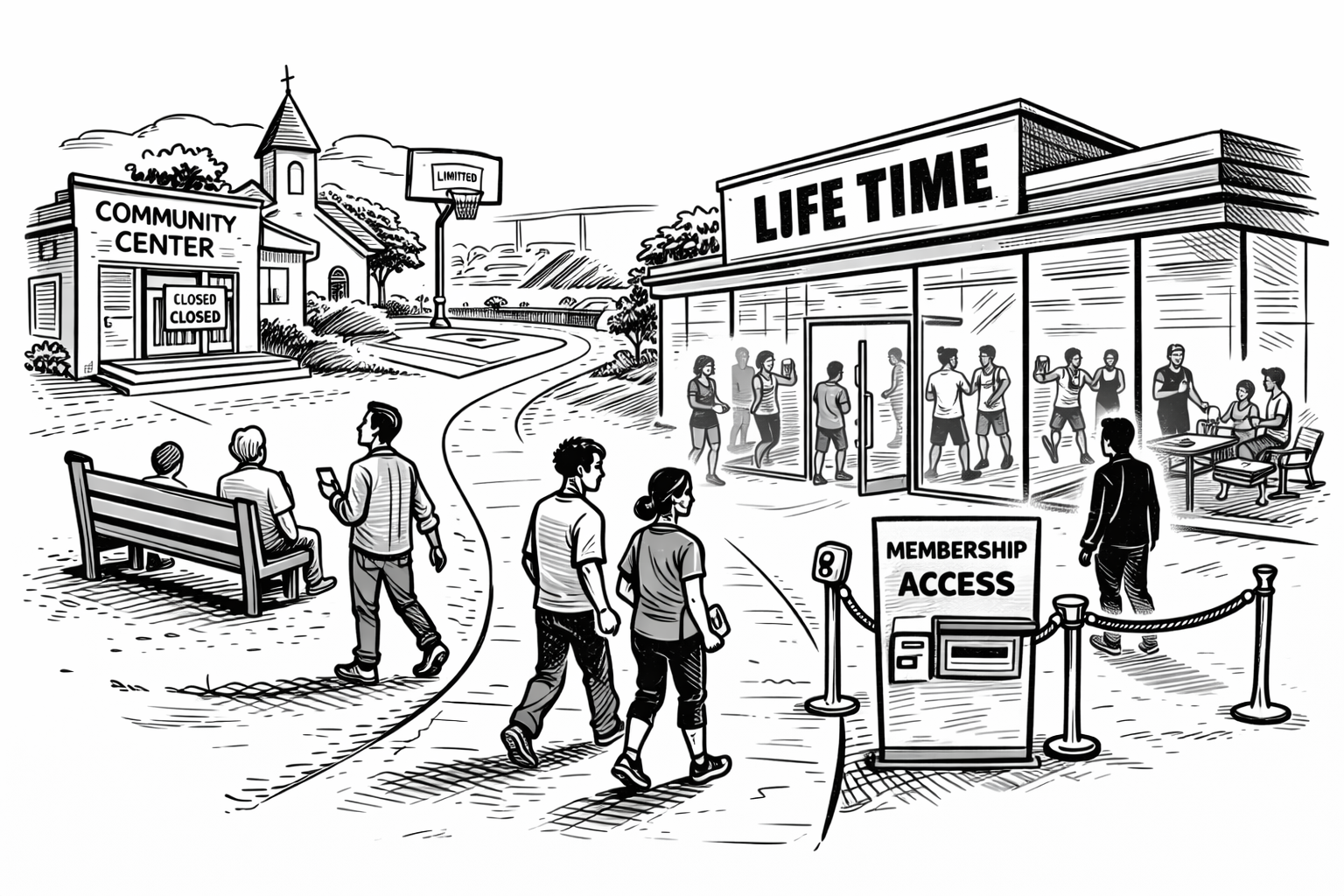
The average gym membership costs $69 a month. That number tells you almost nothing about what you’re actually buying.
Somewhere between the $10-a-month chains and the $300-a-month luxury clubs, a quiet restructuring is underway — and the middle is losing. What’s emerging isn’t just a high-low divide. It’s a stratified system where each price point delivers a fundamentally different version of what fitness feels like, who it’s for, and what it’s actually selling. That restructuring didn’t happen by accident. It maps almost exactly onto how consumers are recalibrating spending across every category of daily life: more selective, more value-conscious, and increasingly unwilling to pay a middle-tier price for a middle-tier experience.
At the premium end, Life Time and Equinox have spent years defining what luxury fitness means — bundled experiences that include not just equipment, but classes, recovery, environment, and design. Now a new entrant is coming for that space directly. Club Studio, backed by LA Fitness parent company Fitness International, is positioning itself as a high-end competitor to both — combining five boutique studio modalities, luxury recovery amenities, and spa-level design under one roof. With 15 locations currently open nationwide, the brand is targeting 50 locations by fall 2026, with planned expansion into New York, Los Angeles, and Houston. Locally, a $4 million renovation is already underway at the LA Fitness on Yale Street, slated to become a Club Studio — bringing that model directly into the Heights and Midtown corridor. The mid-tier isn’t just being competed against. It’s being converted into something else entirely.
At the lower end, the story is just as significant — and the numbers are harder to ignore. EōS Fitness closed 2025 by surpassing two million members, expanding its national footprint by more than 20% in Q4 alone. Starting at $9.99 a month with amenities that include pools, saunas, cinema-style cardio theaters, and group fitness classes, EōS is redefining what budget actually means. It put $13 million back into existing locations in a single quarter while simultaneously opening new sites across multiple states — a signal that growth is being driven not just by expansion, but by a model that aligns with how people are actually spending right now. When price and access align this cleanly, demand doesn’t just increase — it concentrates.
I know the model firsthand. When I first moved to Houston, the 24-hour access was the selling point — I joined EōS to supplement my Life Time membership because it fit my schedule. What I didn’t anticipate was that the Allen Parkway location had become something else entirely. Houston gym-goers have a name for it: Club EōS. Packed from 6am to midnight with influencers, tripods, luxury cars in the parking lot, and a social energy closer to a nightclub than a gym. Finding equipment meant waiting. Finding parking meant circling. What looks like overcrowding is also a signal — when a model works this well, it fills every available hour.
What I also didn’t anticipate was finding myself there at 2am — sleep-deprived, working through grief while my brother was dying from ALS — because the gym had become my therapy, and 2am was the only hour the floor was actually mine. EōS gave me access when I needed it most. But access and experience are not the same thing. That distinction is something I explored more fully in Learning to Stand Where My Brother Stood — how loss reshapes not just identity but the spaces you depend on to hold yourself together. The 24-hour promise is real. What happens inside those hours depends entirely on when you show up — and why.
Chains like LA Fitness that have occupied the middle ground for years are now squeezed from both directions. I still keep my LA Fitness membership active — they’re in most major markets, and the convenience is real. But that’s increasingly the only argument for them. Without the recovery programming and boutique experience of the premium tier, or the price advantage and expansion momentum of the value tier, the middle position is becoming harder to defend. Convenience gets you in the door. It doesn’t keep you there. And when consumers are making more deliberate trade-offs with every dollar — as they are across housing, groceries, and every other category of spending — “fine” is no longer a sufficient answer.
What the premium spaces are selling goes beyond fitness. There’s an unspoken layer of status built into the environment — clean, controlled, and intentionally elevated in ways that signal something about lifestyle and discipline. But more than that, they function as one of the last reliable third spaces in everyday life. When I first moved to Houston, it wasn’t a bar, a workplace, or a social network that helped me find my footing — it was Life Time. It was where I found my rhythm, where I started recognizing faces, and where the city began to feel navigable. In a place where I didn’t know anyone, the gym became a point of connection — and where I found my tribe. That kind of shared space is rarer than it used to be. What makes its disappearance easy to miss is that the platform or the place still exists — it’s the coherence that quietly leaves.
Over time, that connection turned into something more structured. What started as the occasional class became a weekly routine, and eventually a daily one. Not because I made a dramatic commitment, but because the environment made consistency easier. The same people showed up. The same instructors led. And when I missed a session, it didn’t go unnoticed. Someone would ask why I wasn’t there. That’s when it shifted. The gym stopped being a place I went to and became a system I was part of. Accountability wasn’t something I had to generate on my own — it was built into the experience.
That’s the part of the model that often goes unexamined. The real product isn’t the equipment or even the class itself — it’s the accountability structure those classes create. Club Studio is building directly around this insight: five boutique studio rooms under one roof, structured programming as the core product rather than the add-on. The bet is straightforward. If participation is built into the design, members are more likely to extract value — and more likely to stay. Because once people are embedded in a routine with others, retention isn’t driven by motivation alone. It’s driven by expectation.
What’s emerging is a fitness economy where every tier solves for something and sacrifices something. Pay less, and you navigate crowding. Pay more, and you’re expected to use more to justify it. Choose a structured model, and you trade flexibility for built-in consistency. That pattern isn’t unique to fitness — it’s showing up across the economy wherever costs have forced consumers to make sharper choices. Growth is consolidating in places where price and access meet in a way that feels sustainable. The middle, wherever it exists, is getting harder to hold.
The question isn’t which tier is better. It’s whether you’re choosing the one that actually matches how you live — and whether you’re using the part of the system that creates real value. Because in today’s fitness economy, you’re not just paying for a workout. You’re paying for access to a structure, a space, and in some cases, a community that only works if you step fully into it.