
Part of Society, Economy & Wellness — an ongoing series examining how economic pressure reshapes labor, compensation, and access across industries.
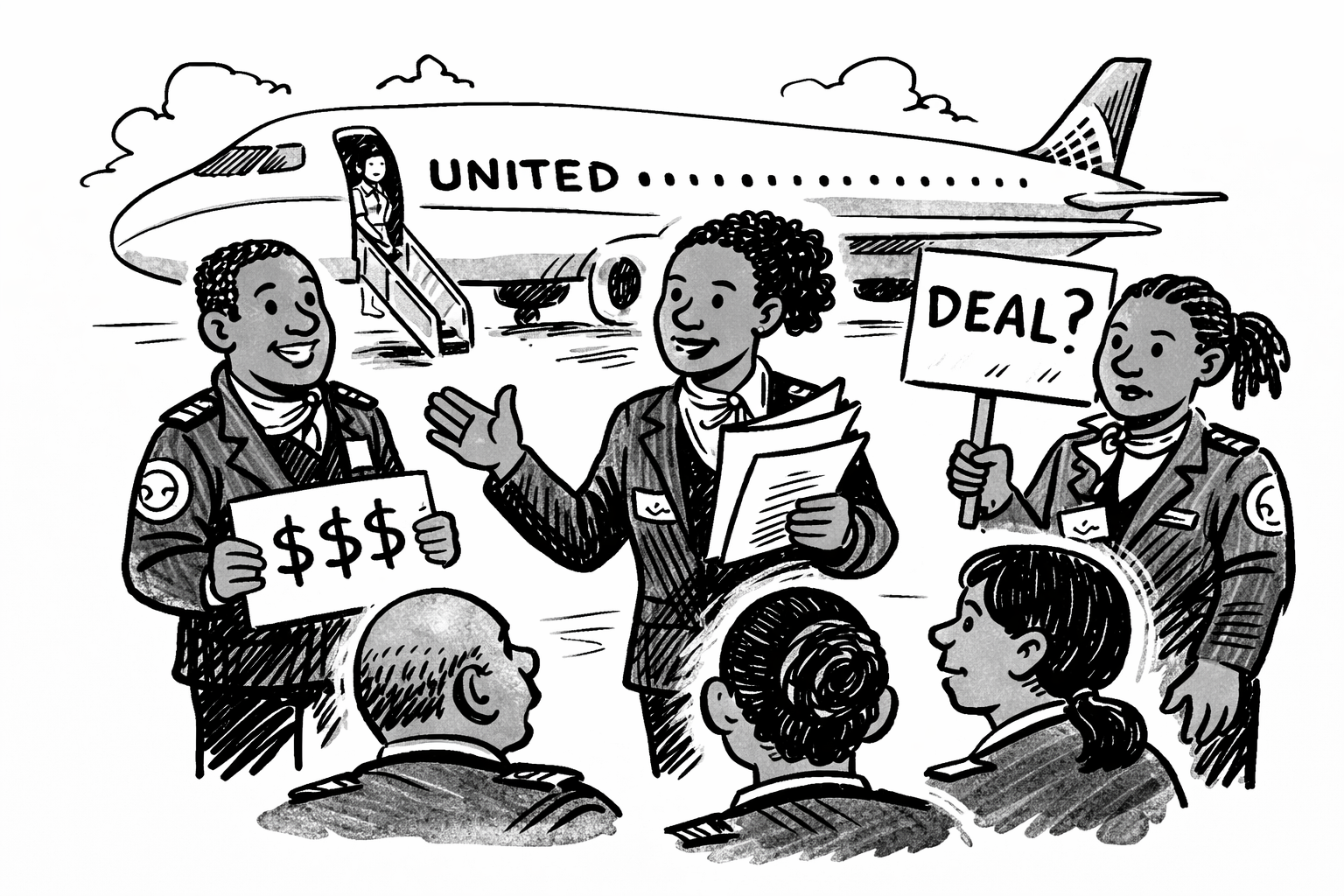
United Airlines has reached a tentative agreement with its flight attendants — a deal that, if approved, could make its roughly 30,000 attendants the highest-paid in the industry. The proposal includes immediate raises, long-term pay increases that could push top hourly rates to $100, boarding pay, and a $740 million pool in retroactive compensation and bonuses. It is the kind of package that signals not just a contract update, but a recalibration of how airlines value frontline labor.
But the distinction matters: the agreement is not final. The full tentative agreement will be presented to union leadership on April 1, and full details are expected to be made public April 3. Assuming leadership approves, voting among flight attendants will take place between April 23 and May 12. Until that vote closes, none of the headline outcomes are guaranteed. The viral framing — that United “has made” its attendants the highest-paid — skips over the only step that ultimately determines whether the deal exists at all: worker approval.
There’s also a piece of context most coverage has buried: this is the second attempt. A previous tentative agreement was rejected by the membership in July 2025, with 71% of the 92% of eligible voters who cast ballots voting against it. The union’s position at the time was that the first deal didn’t go far enough to address years of sacrifice after the airline returned to profitability. That rejection forced both sides back into federally mediated talks — and the contract that emerged from those sessions is the one now seeking ratification. Understanding that sequence reframes the headline: this isn’t a company being generous. It’s a company that got pushed.
What’s driving this moment is years of delayed leverage finally consolidating. Flight attendants haven’t received raises in roughly six years — a pay freeze that held even as travel demand rebounded and airline profitability returned faster than compensation did. One of the central pressure points has been boarding pay — the longstanding gap where attendants are on duty but not compensated. Closing that gap is less about a perk and more about redefining what counts as work. The new agreement also includes “sit pay,” compensating attendants for extended gaps between flights — another category of labor that previously didn’t register on the payroll.
There is also a competitive layer beneath the headline. Airlines are no longer just competing on routes and pricing; they are competing on labor standards. When one carrier moves, others are forced to respond. If this deal is ratified, it doesn’t just raise United’s costs — it raises the baseline expectation across the industry, particularly for unionized workforces negotiating their own contracts. The timing is notable: United is the last major U.S. airline to finalize a post-pandemic contract with its cabin crew members. That position wasn’t just a negotiating disadvantage — it was a signal that flight attendants were watching what everyone else secured before deciding what to accept.
This dynamic connects to something SSC has been tracking across sectors: the gap between operational recovery and worker compensation. In When the Economy Slows, we examined how working-class households absorbed economic instability while institutional recovery moved faster than wage growth. The airline industry is a case study in that same compression — profits recovered, labor costs didn’t follow. The $740 million retroactive pool isn’t a bonus; it’s an acknowledgment of the distance between those two lines.
The numbers tell part of the story. A six-year pay freeze, followed by a rejected contract and a second round of mediated negotiations, followed by a $740 million retroactive package — that sequence reflects how long wages remained static relative to operational recovery. And the move toward higher hourly ceilings suggests airlines are preparing for a labor market where retention, not just recruitment, is the constraint.
It also connects to a broader conversation SSC has been following in The AI Resume Screen — specifically, how labor leverage shifts when employers hold structural power over hiring and compensation systems. Flight attendants, like many frontline workers, had limited ability to act on that leverage during the pandemic. What’s changed isn’t just the contract terms; it’s who has the credibility to say no. The 71% rejection last summer was a demonstration of that.
Why this matters
This isn’t just about flight attendants. It’s about how labor markets reset after disruption. For years, workers absorbed volatility while companies stabilized. Now, in sectors where demand has clearly returned, that imbalance is being renegotiated — not quietly, but contract by contract. If approved, this deal becomes less about one airline and more about a signal: frontline labor, once treated as a fixed cost, is being repositioned as a competitive variable.
And that shift rarely stays contained to one industry.