
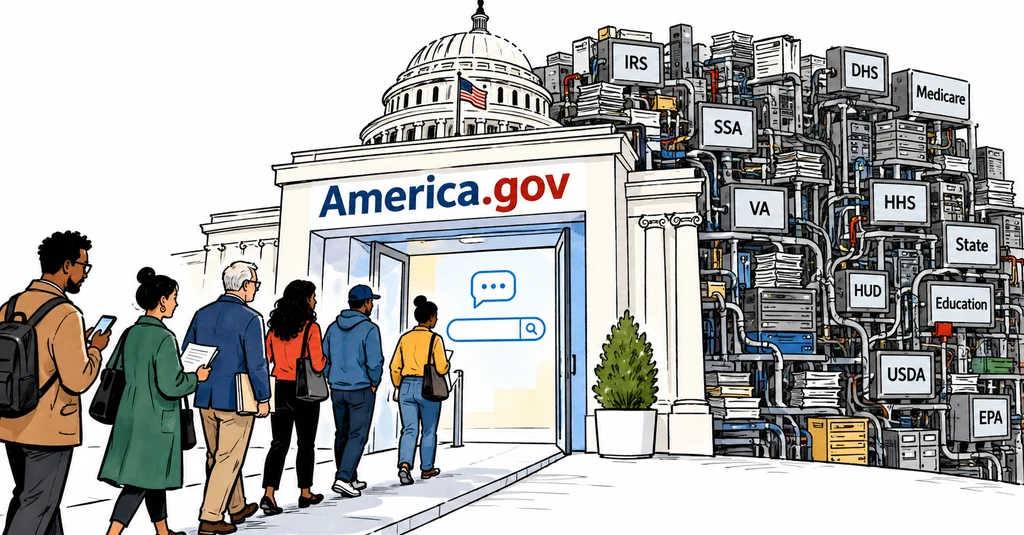
The federal government wants Americans to stop navigating agencies and start asking one AI assistant for help. A better front door could make government easier to use, but it cannot by itself reconcile the rules, databases and eligibility systems operating behind it.
The federal government has a new front door. On Tuesday, the Trump administration launched America.gov, an AI-powered portal designed to help people navigate federal information without figuring out which agency, program or website owns their problem. The General Services Administration says the system pulls from more than 29,000 government websites, giving users a conversational interface for questions about benefits, passports, Medicare and other services. For now, much of that experience is informational. The administration’s plan is considerably more ambitious: eventually, people should be able to authenticate themselves, submit information and complete government transactions without leaving the system.
That sounds like a user-interface problem finally getting a modern solution. Government services have historically been organized around agencies rather than the people trying to use them. Someone who knows what they need may still have to determine which department administers it, find the correct website, understand government terminology and navigate a separate application process. America.gov reverses that logic. The user describes the problem first; the system is supposed to figure out where the answer lives. The harder problem begins after America.gov identifies the right door.
One Door Does Not Mean One System
Former Veterans Affairs technology chief Marina Nitze, who helped drive the consolidation that became VA.gov, pointed to a problem familiar to anyone who has tried to modernize government services: simplifying the interface does not automatically simplify the bureaucracy underneath it. Programs can use different definitions, eligibility rules, verification methods and databases. A person may still have to provide information one agency already possesses because another program cannot access or recognize it.
The administration itself appears to recognize part of that challenge. President Trump’s executive order requires participating agencies to integrate services with America.gov, establishes Login.gov as its authentication system and calls for common standards covering interoperability, security, reliability and design. It also says individual agencies retain control over their records and statutory responsibilities rather than placing everything into one centralized federal database.
The Stakes Rise When AI Starts Doing Things
Today, America.gov can answer questions without requiring an account. The consequential phase arrives when the assistant begins acting on those answers. Nextgov reports that future versions are expected to let users verify their identities and transmit documents to agencies, while the administration says people will eventually be able to complete federal transactions directly through the portal.
That changes the standard America.gov has to meet. Giving someone the wrong link is inconvenient. Misinterpreting an eligibility requirement, mishandling personal information or incorrectly routing an application can affect someone’s health coverage, retirement benefits or access to another federal service. The executive order therefore says agencies retain their adjudicatory authority—the AI interface is not supposed to become the entity that independently decides whether someone qualifies.
There is considerable promise in putting a conversational layer over a government built around thousands of separate digital destinations. For someone who does not know which agency to call or what bureaucratic terminology to search, simply being able to describe a problem in ordinary language could remove a genuine barrier.
But America.gov will ultimately be judged by what happens after the chatbot gives an answer. Twenty-nine thousand websites can be placed behind one interface. Twenty-nine thousand sets of rules, databases and institutional processes cannot be consolidated nearly as quickly. The new front door may be the most visible part of the government’s AI experiment. The plumbing behind it will determine whether it actually works.