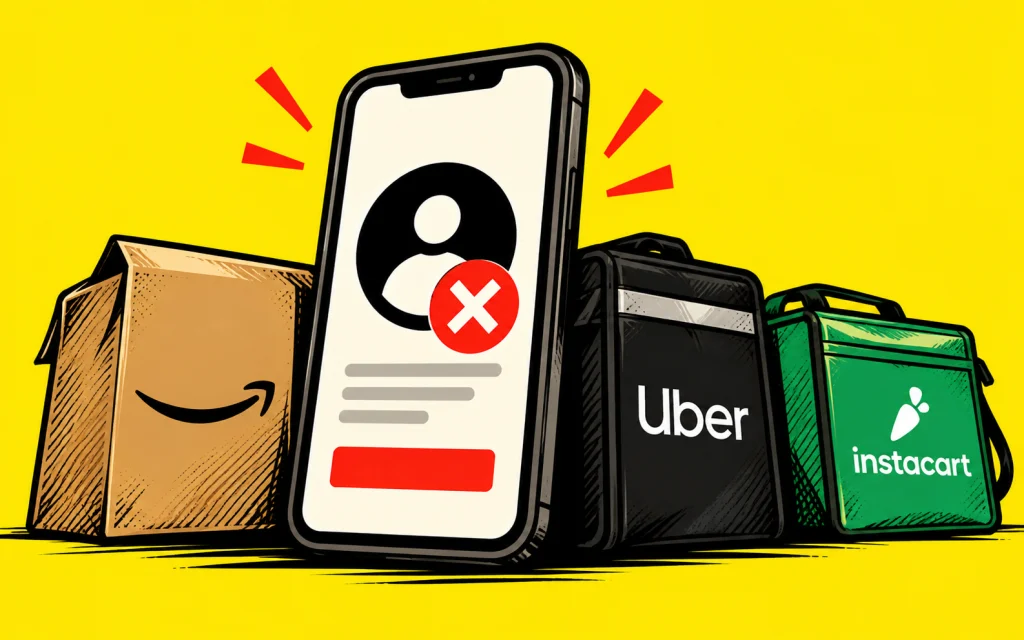
Amazon, Uber and Instacart are suing to block a law requiring companies to justify removing delivery workers from their platforms. The fight raises a bigger question about who controls a gig worker’s livelihood.
Imagine opening an app to start your workday and discovering you can no longer log in. No deliveries, no customers and no way to earn money through that platform. For workers who depend on delivery apps to pay their bills, losing account access can mean losing a significant source of income.
New York City wants to make that harder to happen without explanation. Amazon, Uber and Instacart would rather challenge the rules in court.
The three companies filed a federal lawsuit Wednesday seeking to block a city law scheduled to take effect in January. The measure would prohibit delivery platforms from removing workers without just cause, such as misconduct or poor performance, or a legitimate economic reason.
The law also establishes procedures for workers to challenge deactivations and potentially recover lost earnings if the city determines they were wrongfully removed.
Here’s where the fight gets interesting. These companies largely rely on independent contractors rather than traditional employees. That arrangement gives workers flexibility, but it can also leave them without some of the job protections associated with conventional employment.
A delivery worker might technically be running an independent business, yet the platform controls access to customers, assignments and the opportunity to earn money.
Who Gets to Decide When the Work Ends?
The companies argue that New York is interfering with their contractual rights and ability to maintain safe platforms. Instacart says the restrictions could make it harder to remove workers involved in fraud, harassment or other misconduct, potentially putting customers and legitimate shoppers at risk.
Those concerns deserve consideration. Delivery platforms need ways to respond quickly to dangerous behavior, and the law allows immediate action in cases involving egregious misconduct.
But worker protections address a different problem: what happens when an account is terminated unfairly, and the person who lost access has little practical ability to challenge the decision?
The companies have reason to believe their challenge could succeed. Earlier this year, Uber and Lyft obtained a court order temporarily blocking a similar New York City law covering ride-hailing drivers. A federal judge raised concerns about restrictions on the companies’ contractual rights and their ability to manage platform safety.
Now the delivery industry is testing those arguments again.
The outcome could influence how other cities regulate gig work. Millions of Americans earn income through platforms that can determine whether they remain eligible to accept assignments, often without the same formal protections available to employees.
That creates an unusual employment relationship. Workers are told they operate independently, but the companies retain substantial control over whether they can continue earning.
New York’s law doesn’t guarantee anyone a permanent job. It asks companies to establish a legitimate reason before taking away access to work and gives workers a process to contest that decision.
Whether courts allow the city to impose those requirements remains unresolved. But the underlying question is difficult to ignore: If a platform can effectively end someone’s livelihood, shouldn’t that person have a meaningful opportunity to challenge the decision?