Why Dollar Stores Expanded Where Grocery Stores Left
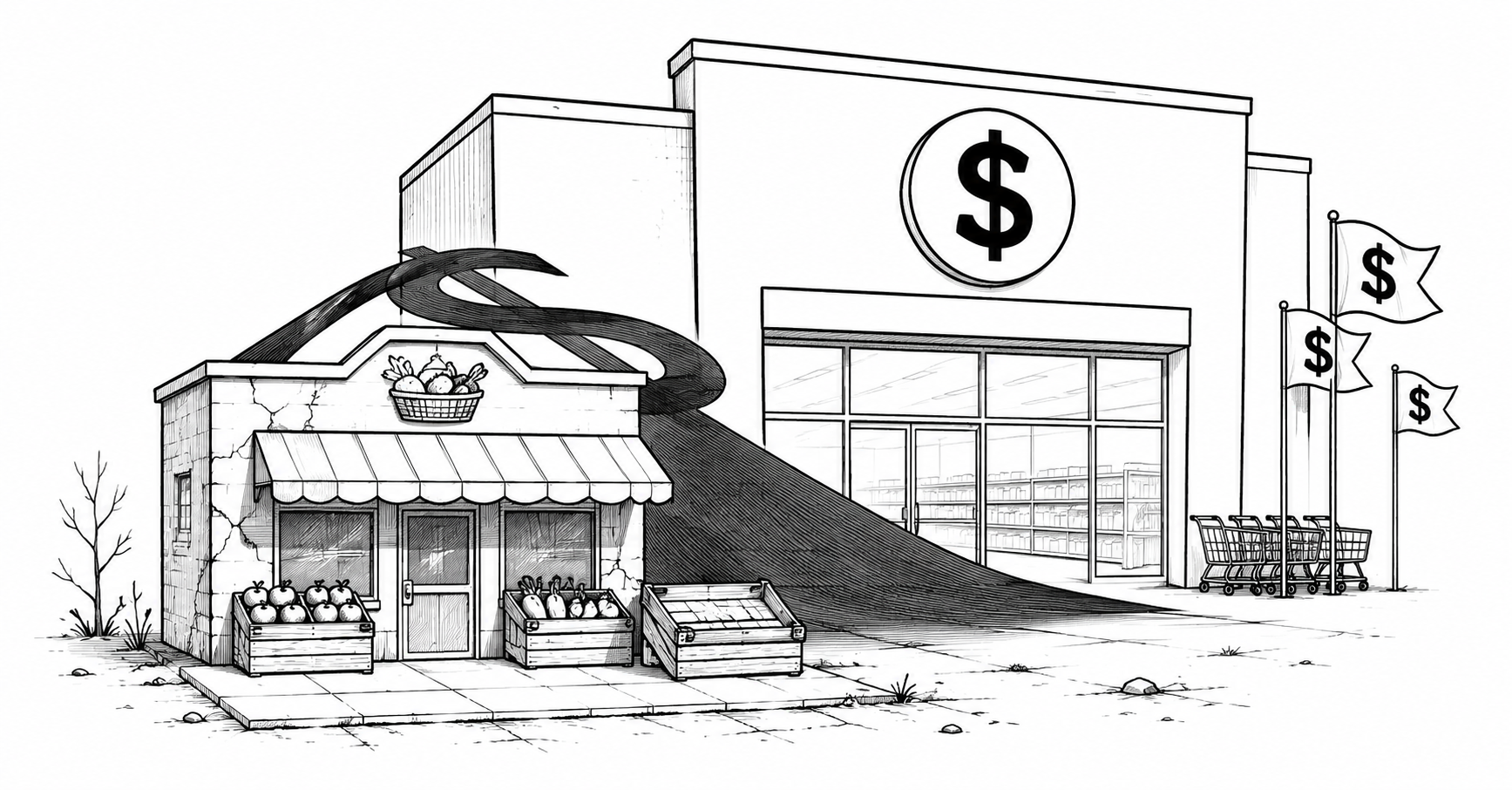
Dollar stores didn’t move into food deserts. They created them. The distinction matters because one is a market response and the other is a market strategy.

The framing of the dollar store and food desert story has been consistently backwards. The conventional narrative positions dollar stores as a symptom of economic distress — filling the void left by grocery stores that abandoned low-income neighborhoods. The evidence suggests the relationship runs in the other direction.
The Institute for Local Self-Reliance, which has tracked dollar store expansion for years, documented the mechanism precisely: dollar stores do not simply move into food deserts. They help create them. By entering neighborhoods with cheap real estate and significant concentrations of low- and moderate-income residents, dollar stores siphon off the sales volume that grocery stores need to remain viable. Once a dollar store enters an area, research published in the peer-reviewed literature found that the area is more likely to remain without access to a supermarket. When communities lose grocery stores and replace them with dollar stores, shoppers buy approximately 4 to 7% less fresh produce — a decline that is significantly steeper for low-income households.
The geographic targeting is deliberate. Dollar store chains specifically identify zip codes with low-income residents in communities of 20,000 people or less and strategically place stores on high-traffic thoroughfares, knowing that many residents do not own cars. Dollar General, Family Dollar, and Dollar Tree have collectively expanded to more than 36,000 locations across the country, concentrating in neighborhoods that are predominantly Black or Brown in urban areas — a pattern that experts and advocates have described as a retail version of the redlining that shaped American housing.
Milwaukee is the current case study in what happens at the end of this cycle. Since mid-2025, three major chains have shuttered locations across the city: Aldi closed its 5301 N. Hopkins St. location in January 2026 and plans to close another in spring 2026. Sentry Foods closed its 6350 W. Silver Spring Drive store in January 2026. Kroger-owned Pick ‘n Save closed five stores in summer 2025. Milwaukee’s poverty rate stands at 22.8%. The city launched an emergency response in February 2026, with Mayor Cavalier Johnson outlining interventions to stabilize food access — while acknowledging the proposals were not long-term solutions.
Family Dollar announced plans to close nearly 1,000 stores by the end of 2025, including approximately 600 Family Dollar locations and 30 Dollar Tree stores. The closures stand to disproportionately affect the exact communities the stores had moved into — communities where the grocery stores that once provided fresh food closed years earlier, in part because the dollar stores made them financially unviable.
The USDA defines a food desert as a low-income area more than one mile from the nearest supermarket in urban areas, or more than ten miles in rural areas. Approximately 17.1 million people — 5.6% of the U.S. population — live in low-income, low-access census tracts. That number is the floor, not the ceiling, of a food access pattern that plays out at the intersection of retail economics, racial geography, and policy choices about what kind of commercial infrastructure communities are allowed to protect.
Cleveland passed a measure in 2022 permanently preventing discount stores like Family Dollar, Dollar General, and Dollar Tree from opening within two miles of each other. More than 75 cities and towns have defeated dollar store projects recently. The policy tools exist. The question is whether communities with poverty rates like Milwaukee’s 22.8% have the political infrastructure to use them before the stores that helped create the problem announce they are leaving.
— SSC News Desk | Social Storytellers Collective
Free, daily structural analysis like this lands in your inbox every weekday morning. Subscribe: https://246481934.hs-sites-na2.com/newsletter