
Will Anderson Jr.’s three-year, $150 million extension — including $134 million guaranteed — did more than reset the non-quarterback market. A’ja Wilson’s three-year, $5 million deal made her the highest-paid player in the WNBA. On the surface, these are two separate stories across two leagues with different economics. Beneath that surface, they converge at a single point: both deals were negotiated by Black women agents at Klutch Sports Group. That alignment is not incidental. It marks a shift in where power sits inside the business of sports.
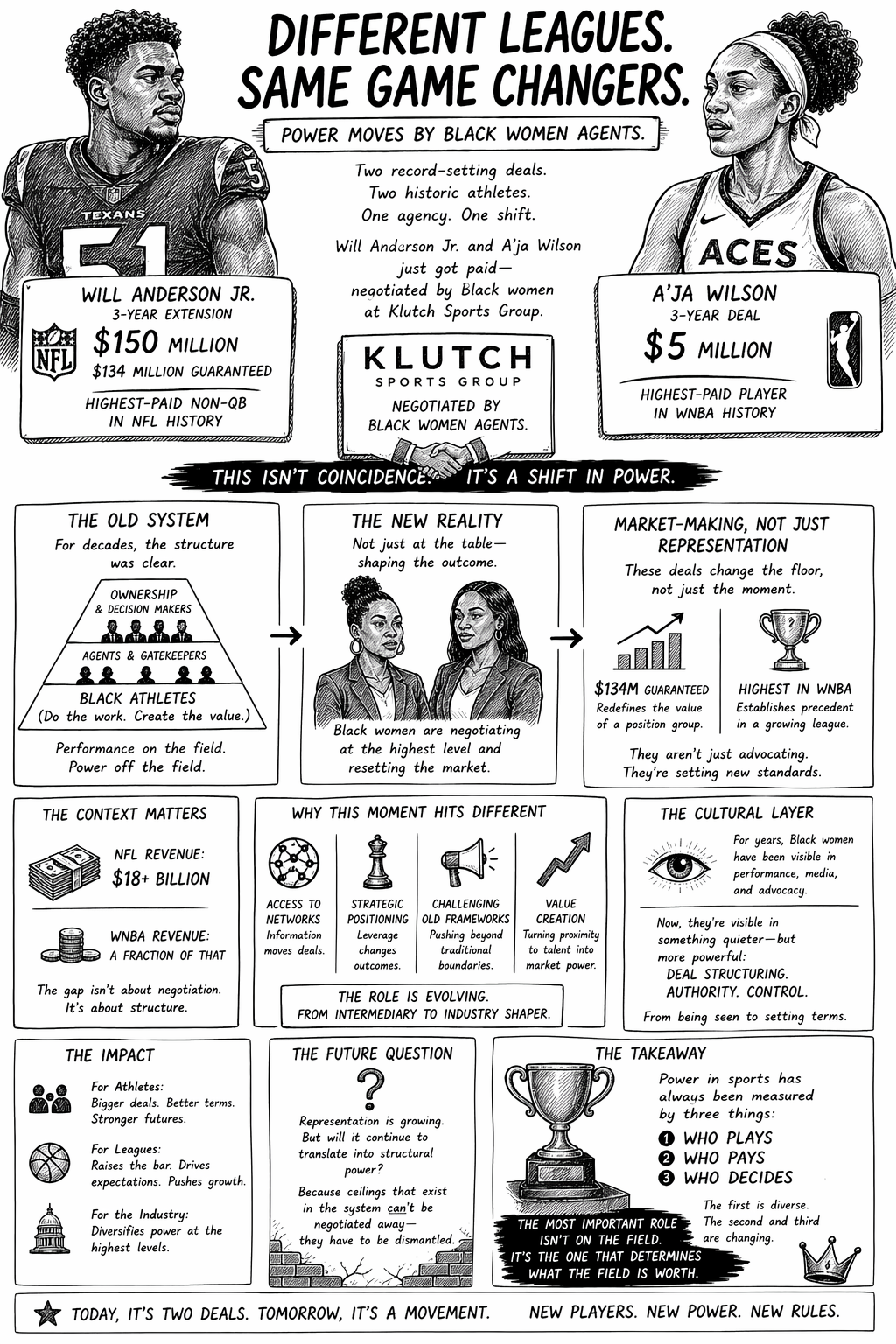
For decades, the structure of professional sports has been clear. Black athletes have dominated performance on the field and court, while dealmaking — contracts, endorsements, ownership pathways — has remained concentrated elsewhere. The agent class, in particular, has historically functioned as a gatekeeping layer between labor and capital. What is changing now is not simply who participates in that layer, but who is beginning to shape outcomes within it. These negotiations are not symbolic wins. They are instances of market-making.
The distinction matters. Representation alone does not alter a system. Leverage does. When an agent secures $134 million guaranteed in a non-quarterback NFL contract, they are not just advocating for a client; they are redefining the floor for an entire position group. When an agent negotiates the highest salary in the WNBA, they are not just closing a deal; they are establishing precedent in a league still defining its economic boundaries. In both cases, Black women are not adjacent to value creation. They are directly structuring it.
Klutch Sports Group has built its model around this idea — that proximity to elite talent can be converted into negotiating power if the agency is willing to challenge traditional frameworks. What makes this moment distinct is not just Klutch’s presence, but who is executing at the highest level within it. Black women operating as lead negotiators in a male-dominated, relationship-driven industry signals more than diversification. It signals access to the networks, information, and strategic positioning that determine outcomes.
And yet, the contrast between the two deals remains instructive. Anderson’s $150 million extension and Wilson’s $5 million contract exist within entirely different revenue ecosystems. The NFL generates more than $18 billion annually. The WNBA, while growing, operates on a fraction of that scale. The disparity is not a reflection of negotiation quality. It is a reflection of structural constraints — media rights, sponsorship distribution, and historical investment patterns that continue to define what is possible. Representation can influence terms within a system, but it does not automatically expand the system itself.
That tension is where the story deepens. If Black women are now helping to set market value in sports, what happens when they encounter ceilings that are not negotiable at the individual level? The answer is that the role itself begins to evolve. Agents are no longer just intermediaries. They become strategic actors in shaping league dynamics, pushing for revenue growth, and redefining how value is distributed. In this sense, the presence of Black women at the negotiating table is not the endpoint. It is the beginning of a broader shift in how influence is exercised.
There is also a cultural layer that cannot be ignored. For years, the visibility of Black women in sports has been concentrated in performance, media, or advocacy. Deal structuring — the quiet, technical work that determines financial outcomes — has received far less attention. What this moment surfaces is a different kind of visibility: one tied to authority rather than access. It reframes the narrative from participation to control, from being seen to setting terms.
The significance of these deals, then, is not just in their numbers. It is in what they represent about the direction of the industry. Power in sports has always been measured by who plays, who pays, and who decides. The first category has long been diverse. The second and third have lagged behind. What this week suggests is that those lines are beginning to move — not through symbolic inclusion, but through tangible influence over outcomes.
The question now is not whether representation is increasing. It is whether that representation will continue to translate into structural power. Because in sports, as in any system, the most important role is not the one on the field. It is the one that determines what the field is worth.