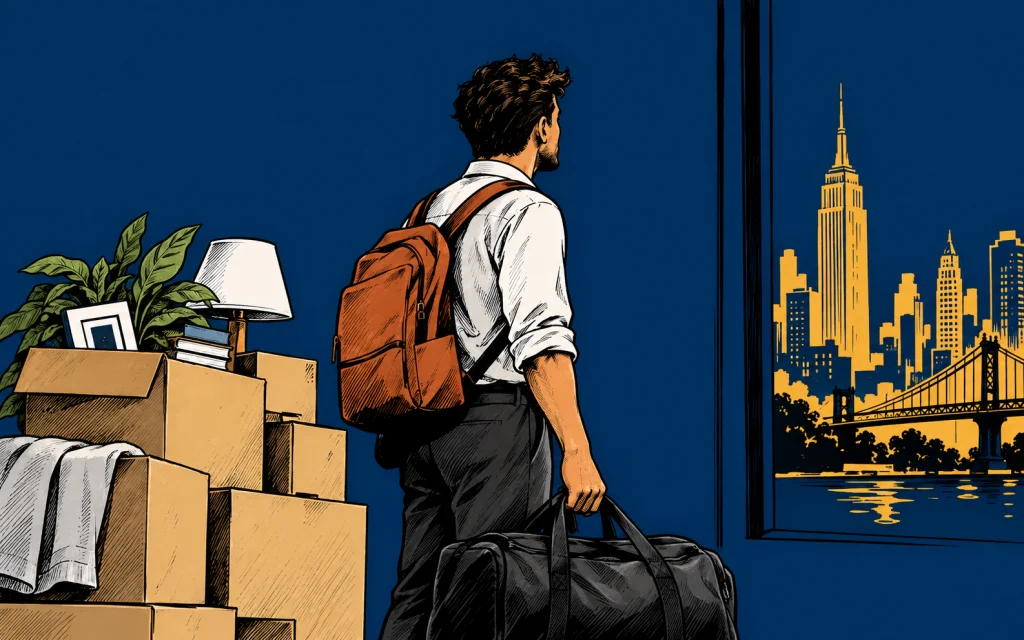
New Yorkers are paying more to stay in the city even as wages, housing quality and everyday affordability make leaving harder to resist.
Christian did not leave New York City because he stopped loving it. He left because remaining there increasingly required him to accept conditions that no longer made financial sense. He lived on West 118th Street near Riverside Drive in Harlem, a prime Manhattan location where access to Riverside Park, transit, restaurants and the broader energy of the city helped justify compromises inside the apartment. He was paying about $3,500 a month for a one-bedroom in a pre-war building, where the appliances were old, the elevator was frequently out of order and what was technically an elevator building regularly became a walk-up. Mice became enough of a problem that he plugged openings around the oven and air-conditioning unit to keep them from entering the apartment. None of those conditions stopped his landlord from raising the rent three separate times during his tenancy. For a while, the location made those compromises easier to rationalize because much of the value of living in New York existed outside his front door. Eventually, however, the price of staying overtook the value of the experience, and moving became less of a lifestyle choice than a financial necessity.
That matters because New York has always asked residents to think differently about home than people in many other American cities. In places where driving structures everyday life, residents often invest heavily in larger homes, yards, entertainment rooms and other amenities because private space becomes the primary place to retreat. New York works differently because much of the value proposition exists beyond the apartment door: the restaurant downstairs, the neighborhood bar, the park, the train, the museum, the coffee shop and the possibility that almost anything can happen within a few blocks. Residents tolerate smaller kitchens, older buildings and less private space because the city itself functions as an extension of the home. Christian understood that tradeoff and, for years, considered the energy of New York worth making compromises for. But that bargain becomes harder to defend when the apartment itself keeps becoming more expensive while the conditions do not improve. The question stops being whether New York is worth paying a premium for and becomes how large that premium can grow before the experience outside the apartment can no longer compensate for what residents are accepting inside it.
The numbers show how dramatically that premium has increased. StreetEasy reported that the median asking rent across New York City reached a record $4,200 in August 2026, while Manhattan’s median asking rent climbed to $4,995, up 5.2% from a year earlier. Rental inventory citywide was also down 7.1% from the previous year, helping landlords maintain leverage even as affordability pressures intensified. The New York City Comptroller reported this summer that rents were roughly 35% above their pre-pandemic level, describing housing affordability as one of the city’s most pronounced economic pressures. Christian’s $3,500 apartment may therefore appear inexpensive compared with today’s Manhattan asking rents, but that comparison misses what tenants actually receive for the money and how quickly rents can consume incomes that have not increased at the same pace. Paying below the citywide median does not necessarily make an apartment affordable when the tenant is also accepting unreliable infrastructure, pest problems and a building that does not consistently provide the amenities incorporated into its price. New York’s housing crisis is increasingly about both how much residents pay and how much compromise that money now buys.
The strain becomes even clearer when the workers who keep the city functioning cannot afford the city they serve. The Guardian reported this month that New York City’s more than 4,500 EMS workers respond to roughly 1.9 million medical and fire emergencies annually, yet an FDNY EMT starts at just $39,386 and earns roughly $59,534 after five years, far below the compensation of firefighters with similar tenure. The report described EMS workers living in shelters, relying on vouchers and food assistance, and leaving the profession as they struggle to support themselves in the city. Those are not abstract affordability concerns; they are signs that people entrusted with some of the city’s most urgent work are being priced into increasingly unstable lives. The consequences extend beyond individual household budgets because ambulance response times for life-threatening emergencies increased from 11 minutes and 21 seconds in fiscal 2025 to 13 minutes and 9 seconds in fiscal 2026, according to data cited in the Guardian’s reporting. A city cannot separate the affordability of housing from the reliability of its workforce indefinitely because EMTs, teachers, service workers, nonprofit employees and other middle-income residents all have to live somewhere within commuting distance of the jobs New York depends upon. When compensation cannot sustain proximity to those jobs, workers either absorb an increasingly difficult financial burden, move farther away or leave altogether. Affordability therefore stops being only a housing problem and starts becoming an infrastructure problem.
Christian’s decision also fits into a broader migration pattern that complicates the idea that people will always find a way to stay in New York. Census estimates show that nearly 114,000 more residents left New York City for other parts of the United States than moved into the city between July 2024 and July 2025. International migration offset much of that loss, but the city’s total population still declined by more than 12,000 during the year. Across the broader New York metropolitan area, net domestic migration produced a loss of nearly 1.3 million residents between 2020 and 2025, the largest domestic migration loss of any U.S. metro area during that period. Those numbers do not mean everyone left because of rent, and New York continues to attract people from around the world for work, culture, education and opportunity. They do show, however, that enormous numbers of residents continue making the calculation Christian eventually made: loving New York is not the same thing as being able to afford the terms required to remain there. A city can remain desirable while still making departure economically rational for people who once assumed they would stay.
Leaving can carry its own emotional cost because New York is unusually effective at becoming part of a resident’s identity. People do not simply rent an apartment in New York; they develop routines around a neighborhood, learn which train car puts them closest to the exit, build relationships with bartenders and restaurant owners, find the corner store that knows their order and become accustomed to a level of density that makes ordinary errands feel social. That is especially true in places like Harlem, where neighborhood identity, history and culture can become part of a resident’s attachment to the city itself. Christian was giving up more than an apartment with old appliances and a broken elevator; he was leaving an ecosystem in which his social life and relationship with the city extended far beyond the walls of his home. Yet there is a point at which the cultural value of New York begins subsidizing poor housing economics, allowing residents to rationalize conditions they might reject anywhere else because access to the city remains so valuable. The danger for New York is not that people suddenly stop appreciating its energy, restaurants, culture or opportunities. It is that the premium required to participate in them becomes high enough that even people who love the city conclude they can no longer responsibly pay it.
That is why the struggles of EMS workers and Christian’s decision to leave belong in the same conversation. One story is about public employees making life-or-death decisions while earning salaries that make living in the city increasingly difficult; the other is about a private resident paying $3,500 for housing whose quality did not keep pace with its cost. Both expose the same underlying pressure: New York increasingly depends on residents continuing to accept an affordability bargain that is becoming harder to defend. The city can remain culturally magnetic while becoming financially exclusionary, and those two realities can coexist for a long time before the consequences become obvious. People will continue moving to New York because there are few places that reproduce its density, ambition and energy, but attraction alone cannot solve the gap between what residents earn and what staying requires. Christian did not leave because another city suddenly became more exciting than New York. He left because the economics finally outweighed the attachment. A city can give people a reason to love it, but if it wants them to stay, it also has to give them a reasonable way to afford it.