
Nigerian airlines have warned they may suspend operations as early as April 20 due to surging jet fuel prices, prompting the government to call an emergency meeting scheduled for April 22. The threat is immediate but the underlying issue is structural — a collision between aviation’s fundamental cost sensitivity and the particular vulnerabilities of an economy where currency volatility and import dependence amplify global price fluctuations into local crises faster and more severely than in markets with more insulated financial infrastructure. Jet fuel accounts for 30 percent or more of airline operating costs under normal conditions. In Nigeria, where that cost is denominated in a currency that has experienced significant devaluation and priced through import channels subject to their own volatility, a global price spike does not land the same way it does in London or Dubai. It lands harder and faster, with fewer institutional buffers to absorb the shock before it reaches passengers and routes.
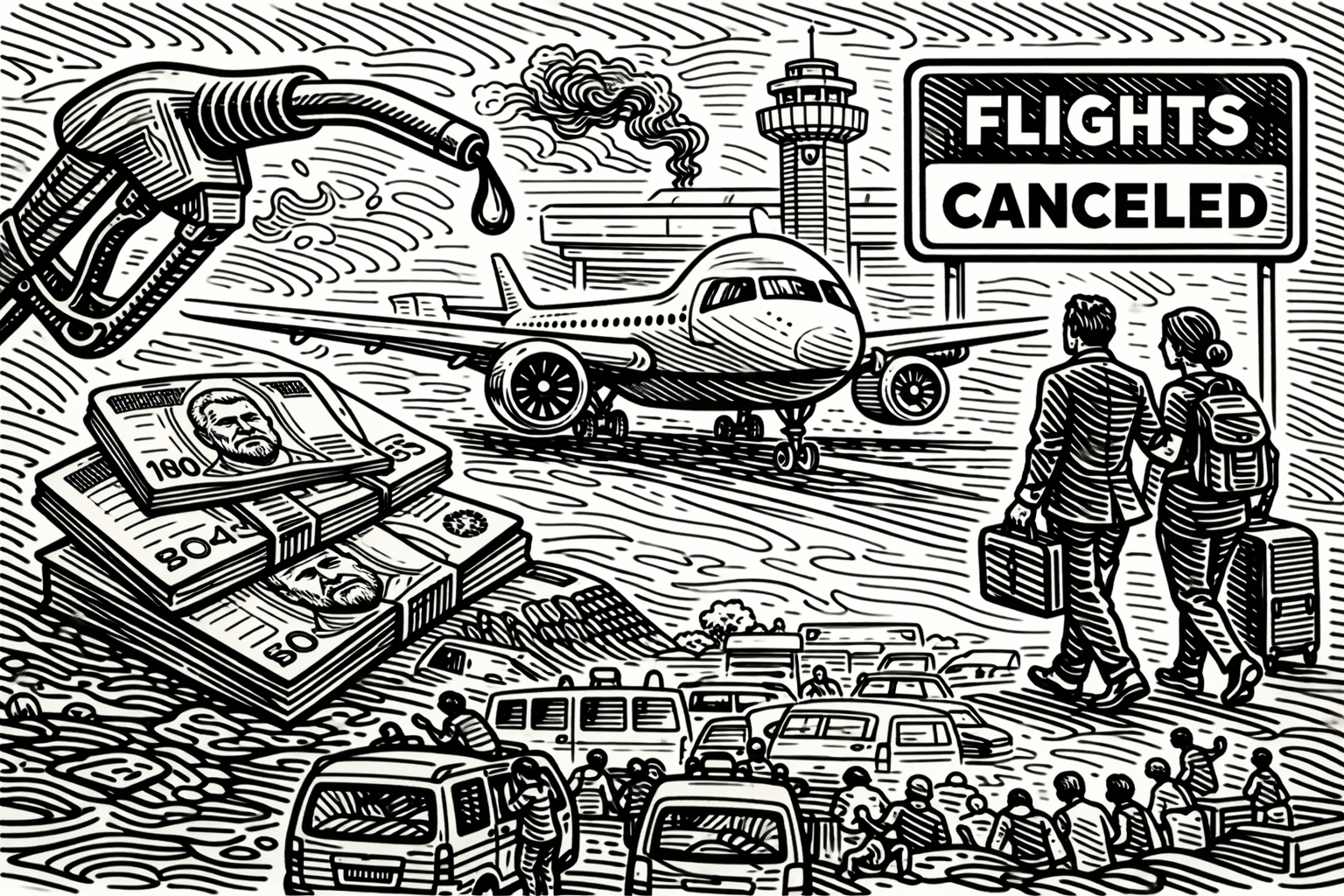
The consequences extend beyond the aviation industry and into the economic fabric that air travel supports. Nigeria’s domestic air network connects cities whose geography and infrastructure make road and rail alternatives slow, unreliable, or inaccessible for large categories of travelers — business travelers, medical patients, families maintaining connections across a country of more than 200 million people spread across significant distances. When flights are reduced or suspended, the effects move quickly into supply chains, commerce, and individual mobility in ways that ground transportation cannot readily substitute. The aviation system is not a luxury layer sitting above the economy. For many of the transactions and movements the Nigerian economy depends on, it is the primary infrastructure.
The equity dimension of the impact is the part most coverage of aviation cost crises underreports. As fuel-driven cost increases translate into higher fares, air travel contracts toward the population that can absorb those fares — concentrating mobility among higher-income passengers while pricing out the lower- and middle-income travelers who were already navigating a stratified system. What was already unequal access becomes more so, and it becomes more so fastest at the moments of economic pressure when the people with the least margin are already absorbing the most. The Nigerian aviation crisis is an acute expression of a pattern that operates globally at lower intensity: energy price volatility does not distribute its consequences evenly, and the communities and countries with the least financial insulation from that volatility absorb the most of it.
Government intervention can provide temporary stabilization — emergency meetings, subsidy mechanisms, coordinated pressure on fuel suppliers — but it cannot eliminate the structural vulnerability that makes the crisis possible in the first place. That vulnerability is not primarily about jet fuel. It is about the degree to which Nigeria’s aviation sector, like many of its economic systems, is exposed to global price movements through import dependence and currency dynamics that domestic policy has limited power to control. Long-term solutions require addressing those structural exposures directly — through currency stabilization, domestic refining capacity, and the kind of regional energy infrastructure cooperation that the AfCFTA framework is supposed to eventually enable but has not yet delivered at the scale the aviation sector needs. Until then, the emergency meeting is the response, and the emergency meeting is not a solution.