
Part of Culture in Motion — examining who defines culture, how it moves, and what it reveals about the moment.
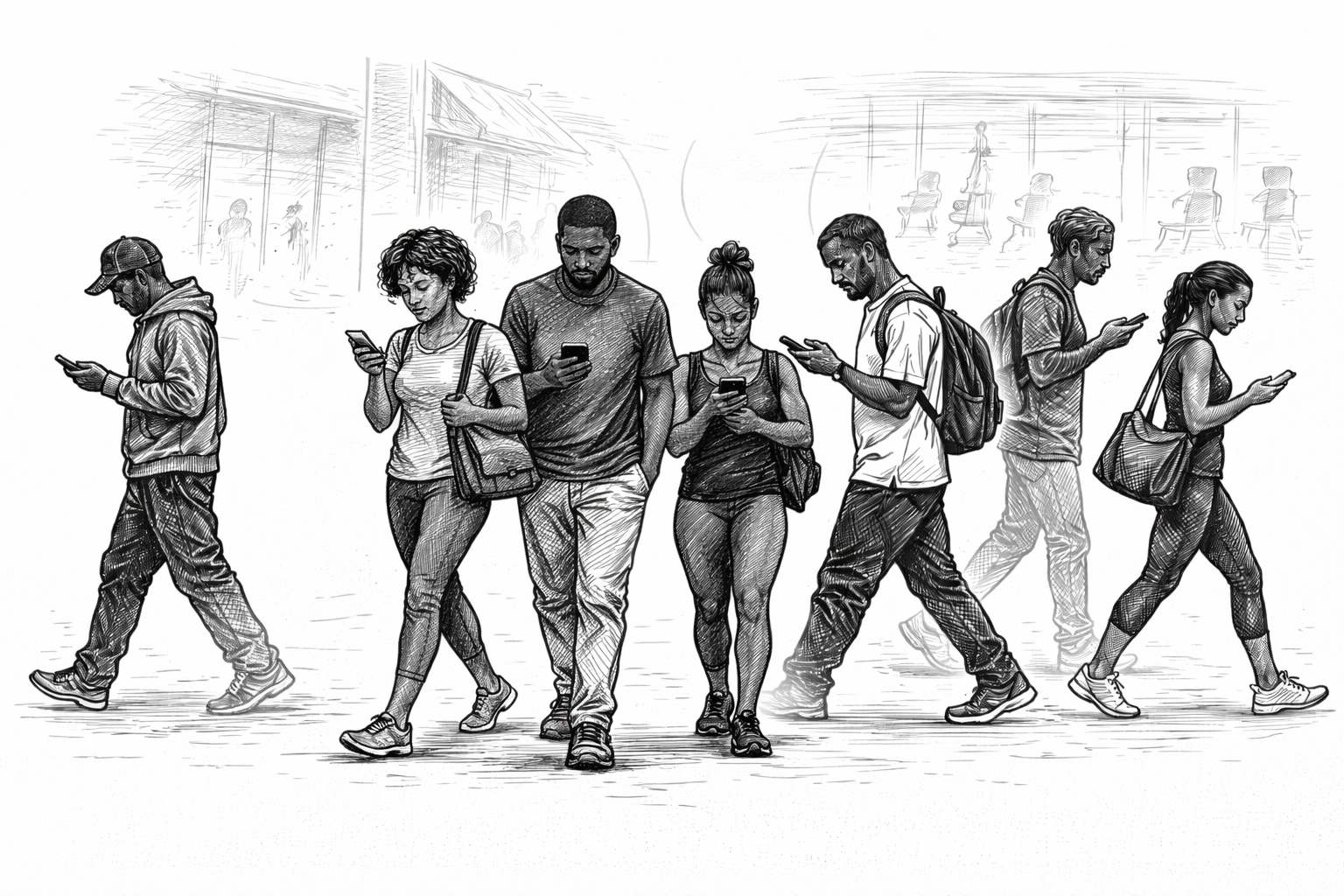
What used to happen in private now happens in public. Doom scrolling was always an individual act — contained to a screen, mostly invisible to the people around you. It lived in quiet moments, late at night or between tasks, where a person could absorb an endless stream of bad news, outrage, and crisis without physically leaving where they were. Doom strolling is the evolution of that behavior. It is what happens when the same mental state moves into the world — when people carry the feed with them into sidewalks, airports, gyms, and grocery stores, physically present but mentally elsewhere.
You can see it once you start looking. People walking while half-reading notifications, stopping mid-stride to process something that just came through, moving with a low-level urgency that doesn’t match their surroundings. The body is in motion but the attention is fragmented, constantly pulled back into the phone. According to Pew Research Center, more than 70% of Americans say following the news leaves them feeling stressed, and a majority report feeling overwhelmed rather than informed by news consumption. That emotional residue doesn’t stay confined to the screen. It travels — shaping how people move, how they engage, and how present they are capable of being in the spaces they physically occupy.
As those environments adjust, they begin to accommodate distraction rather than interaction. Coffee shops designed for solo work. Gyms where people pause between sets to check notifications. Airports filled with travelers pacing while refreshing updates that may or may not change anything. The expectation is no longer full presence but partial attention — where being out in the world no longer requires being mentally available to it. The algorithm no longer just competes with your time at home. It competes with your attention everywhere, and it is increasingly winning.
There is a structural layer to this shift that makes it harder to dismiss as a simple habit problem. For many people, staying connected is not optional. Work communications, schedule changes, financial updates, and social coordination all live inside the same device delivering stress and overload. The ability to fully disconnect — to move through space without interruption — is increasingly tied to stability, income, and control over one’s time. Doom strolling, in that sense, is not only a behavioral pattern. It is a class signal. The worker who can leave their phone in their bag during a walk in the park and the worker who cannot are not navigating the same relationship to public space.
But there is a dimension of this shift that most cultural commentary on doom scrolling and doom strolling consistently misses — and it is the dimension SSC is most positioned to name. For Black Americans, the news feed is not a neutral stream of general information. It is a specific kind of exposure. Every shooting, every policy announcement, every Supreme Court argument, every executive order carries a particular weight when the community being discussed is yours. The accumulation of that exposure — the continuous documentation of your community’s vulnerability, loss, and ongoing negotiation for basic recognition — produces a specific form of fatigue that researchers have begun studying under the term racial battle fatigue. Doom strolling, for Black news consumers, is not just distraction bleeding into physical space. It is the body trying to keep moving while absorbing content that is, at a high frequency, about the price of being Black in America.
As SSC covered in The Trust Gap and Why Stories Are Missing, the relationship between Black communities and the media systems that cover them has always been fraught. Black readers navigate not just the news but the framing of the news — who is centered, whose death is described with dignity, whose suffering is contextualized and whose is not. The decision to put down the phone, to doom stroll less, to disconnect from the feed for a walk is not simply a wellness choice in that context. It is a negotiation with a system that demands emotional engagement with content designed for a general audience while the costs of that content fall specifically on you.
The environments adjusting to accommodate distraction are also adjusting in ways that are not equally accessible. The wellness industry’s response to doom scrolling — digital detox retreats, phone-free social events, structured unplugging — is available to a specific demographic. For communities navigating economic precarity, caregiving responsibilities, and the specific civic obligation to stay informed during a political moment that is actively targeting their rights, the luxury of disconnection is not evenly distributed. As SSC examined in The New Fitness Economy Is Tiered and the HYROX pieces, the systems being built to address wellness gaps are consistently built for the people with the most resources to engage them. Doom strolling is the general phenomenon. Who bears its weight unevenly is the specific story.
Why This Matters
Doom strolling is not just about distraction. It marks a cultural shift in how presence itself is being defined — where physical movement no longer guarantees engagement and being outside no longer means being disconnected. If doom scrolling changed how people think, doom strolling is changing how they exist in shared space, turning everyday movement into an extension of the feed. The question is not simply whether people should unplug. It is whether the systems shaping their attention will ever allow them to feel like they can — and whether the communities absorbing the most concentrated dose of that feed’s weight will ever be offered a structural response rather than a wellness product.