
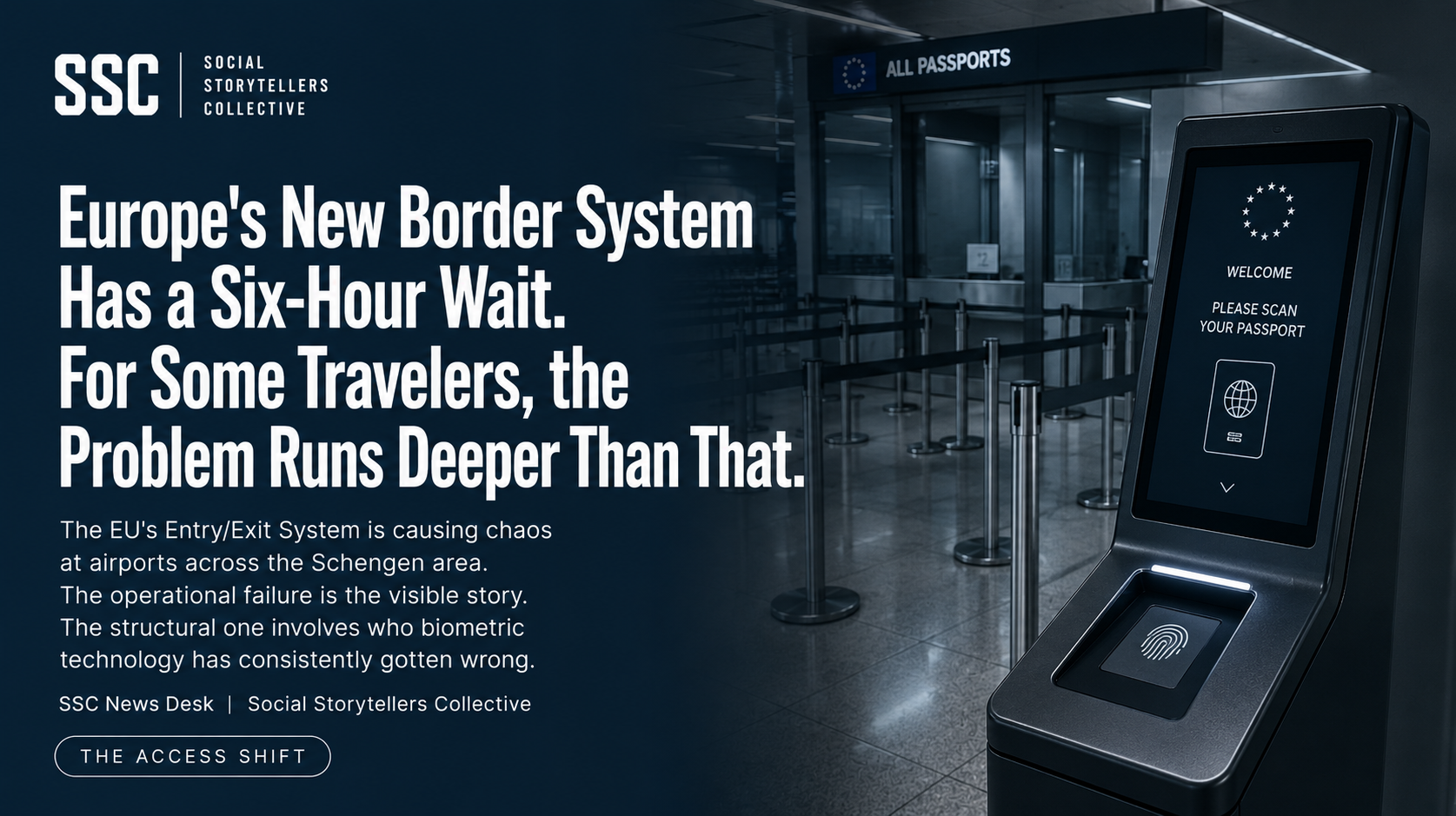
The European Union’s Entry/Exit System went fully live on April 10, 2026, and within hours airports across the Schengen area were in crisis.
Passengers faced waits of up to three hours at border control, missed flights, and spent thousands finding their own way home. The chaos was immediate, widespread, and, according to the aviation industry, entirely predictable.
Since the system’s partial rollout in October 2025, wait times have reached seven hours at Lisbon, five to six hours at Geneva, and three hours or more at peak periods across Madrid, Barcelona, Paris CDG, Prague, and other major hubs. Aéroports de Paris, which manages both Charles de Gaulle and Orly, has formally requested a suspension of EES through the summer peak season, with its deputy CEO stating the airport would not be opposed to implementation being postponed until after summer 2026. A joint letter from ACI Europe, Airlines for Europe, and IATA called for critical issues to be urgently resolved, warning of severe disruptions if they are not.
The system replaces manual passport stamping with digital biometric records — fingerprints and facial images — collected from every non-EU traveler entering the Schengen Area for a short stay. The EU frames it as a security upgrade, a more efficient and accurate border management tool. The aviation industry has been less convinced, and the first weeks of full implementation have validated their concerns. What the coverage has largely not addressed is the question underneath the operational failure: whether a system built on facial recognition technology is equally accurate for every traveler it is processing.
The answer, based on a substantial body of independent research, is no. Research by scholars Joy Buolamwini, Deb Raji, and Timnit Gebru found that facial recognition algorithms misclassified Black women nearly 35 percent of the time, while achieving near-perfect accuracy for white men. A NIST study examining 189 facial detection algorithms found that Black and Asian people were up to 100 times more likely to be misidentified than white people, with the highest error rates concentrated among Black women. These are not edge cases or outlier findings. They are the consistent output of a decade of independent research on facial recognition accuracy across demographic groups.
The EU has stated that biometric data collection reduces racial profiling by removing human subjectivity from border checks. The research literature suggests the opposite problem — that algorithmic systems trained predominantly on lighter-skinned faces replicate and in some cases amplify the bias they were designed to correct, at scale and with the institutional authority of an automated system behind them. A border officer who makes a subjective judgment can be questioned. An algorithm that flags a mismatch presents as objective fact.
The practical implications for Black and Brown travelers are not hypothetical. A system that operates with a 35 percent error rate for Black women at a border crossing is not a more equitable process than the one it replaced. It is a less accountable one. When an automated system produces a false mismatch, the traveler bears the burden of resolving it — in an airport, under time pressure, in a foreign country, with a missed flight as the immediate consequence. Airport and airline groups have warned that mandatory registration through the summer travel season could push wait times to four hours or more at the busiest hubs. For travelers whose biometrics are processed less accurately by the system, those wait times are not the only risk.
The operational chaos of EES’s rollout will likely be resolved. Airports will adapt, kiosks will multiply, processing times will improve, and the seven-hour queues in Lisbon will become a footnote. The structural question — whether a biometric border system built on technology with documented racial accuracy gaps is an equitable tool for managing movement across one of the world’s most traveled regions — will not resolve itself with better infrastructure. It requires a different set of questions than the ones airport operators and aviation industry groups are currently asking. They are asking how to make the system faster. The question worth adding is whether it is equally reliable for everyone it is making wait.
Social Storytellers Collective covers race, identity, access, and structural inequality. Read more at socialstorytellerscollective.substack.com