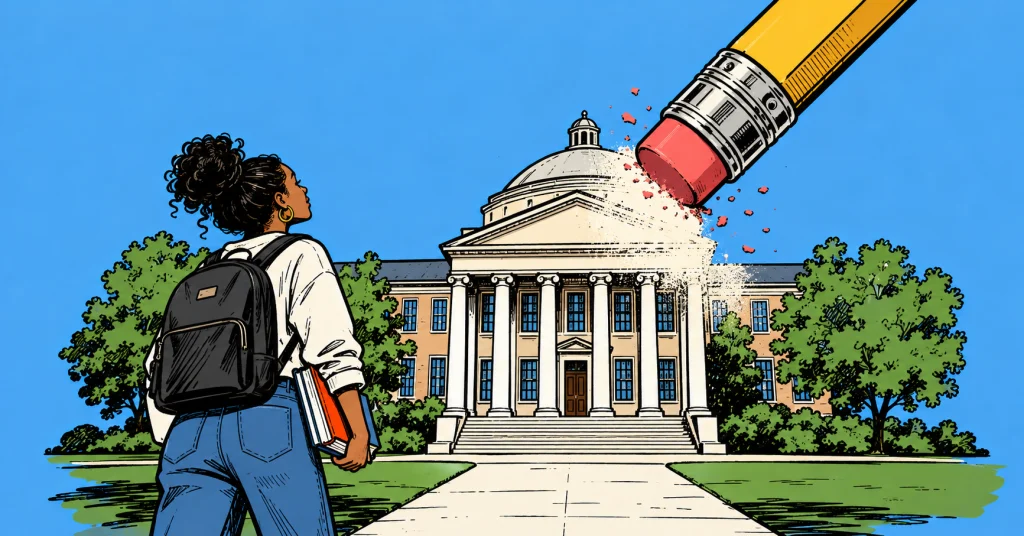
The University of North Carolina at Chapel Hill keeps its access to federal funding after resolving a series of civil rights investigations. But the agreement imposes new limits on admissions, scholarships and campus programs, offering a clearer picture of how federal enforcement is changing higher education.
A high school senior writing a college essay might describe growing up in poverty, being the first in the family to apply to college or overcoming obstacles that shaped their ambitions. An admissions officer might weigh those experiences alongside grades and test scores. At the University of North Carolina at Chapel Hill, a new federal agreement now spells out, in more explicit terms than ever, how far race can enter that process, and the answer is not at all.
The settlement announced by the U.S. Department of Justice on Oct. 19 closes 18 active Education Department civil rights investigations and an 18-month Justice Department compliance review opened in April 2025. UNC remains eligible for federal funding, with no financial penalty and no admission of wrongdoing. In exchange, the university agreed to sweeping changes that reach well beyond the admissions office, covering undergraduate, graduate and professional programs, financial aid, scholarships, student benefits and campus operations, along with new measures addressing antisemitism. Assistant Attorney General Harmeet K. Dhillon said the Civil Rights Division “commends UNC for its cooperation,” while Assistant Secretary of Education Kimberly Richey said the administration is “holding schools accountable for antisemitism.”
What UNC Agreed To
UNC holds a unique place in this debate. It was one of two universities at the center of the 2023 Supreme Court decision that sharply restricted race-conscious admissions. That ruling changed the law but left colleges to figure out how to pursue broad access within it. This agreement removes much of that room. According to the Justice Department, UNC must adopt a color-blind admissions system and may not use race, analyze racial data or adjust its admissions process to change the racial makeup of its student body. It can’t disfavor applicants who decline to disclose their race, consider race when selecting admissions staff or partner with bridge and pipeline programs that weigh protected characteristics.
The ban on analyzing racial data may prove the most consequential term. Colleges have long tracked the demographics of their applicants and admitted students to understand who they’re reaching and who they’re missing. Without that analysis, it becomes much harder for UNC, or anyone else, to see whether access is narrowing. The limits on pipeline partnerships matter too. Universities rely on recruitment programs, summer bridge programs and targeted outreach to connect with students from communities where few go to college. Some focus on income or academic preparation rather than race, and the agreement raises practical questions about which ones can continue as they are and which will need to be rebuilt.
Prohibiting unlawful discrimination is not the same as eliminating every effort to address unequal access. Supporters of the administration’s approach argue that colleges should award opportunities without regard to race, period. Critics counter that universities need lawful ways to respond to long-standing gaps in educational opportunity. The same tension is now headed to the Supreme Court again, this time over selective middle school programs in Montgomery County, Maryland, a sign that the fight over race and admissions is moving to younger students. How UNC carries out its agreement will help define what these competing principles mean on an actual campus.
Washington Becomes a Permanent Presence
The settlement doesn’t end the government’s role once it’s signed. Within 30 days, UNC must appoint a Merit & Civil Rights Administrator to carry out the agreement, and it must create a Title VI Coordinator position. Every quarter, the university must send federal officials its antisemitism and race discrimination complaints. The agreement runs through Dec. 31, 2028, which means UNC will have to keep proving its compliance for more than two years.
The antisemitism provisions are extensive. UNC must extend its nondiscrimination policy to explicitly cover Jewish and Israeli students, investigate complaints promptly, require antisemitism training for students, faculty and staff, involve law enforcement when warranted and discipline student groups that engage in discriminatory conduct. It must also prohibit face masks that conceal a person’s identity. Protecting students from harassment is a legal obligation for any university that takes federal money. The harder question is how UNC will enforce these rules while protecting lawful expression and applying discipline evenly to students across political and religious lines.
Access Is Now Negotiated One Campus at a Time
UNC’s decision also shows how much leverage federal funding carries. Universities depend on Washington for research grants, student aid and much more, and that money has become a pressure point. SSC has reported on how Harvard’s federal research funding fell 19.5% even as its endowment soared, and how universities are cutting jobs even as their endowments grow. Against that backdrop, a deal that keeps funding flowing offers stability, even if it requires changes administrators wouldn’t have chosen on their own.
That leaves campus leaders with a difficult choice. Rejecting an agreement can mean prolonged legal fights and financial uncertainty, while accepting one can lock in obligations that shape campus policy for years. Students, faculty and staff then live with the results of negotiations they had little part in. As The Washington Post reported, UNC’s settlement follows similar agreements between other major universities and the Trump administration, suggesting that negotiated deals, rather than new laws or court rulings, are becoming a main way national higher education policy gets made.
For students, the effects will show up in ordinary places: application instructions, scholarship eligibility, student organization rules and the programs that help them prepare for college and succeed once they arrive. The settlement closes UNC’s investigations, but it opens a long period of compliance. The national question is whether UNC’s terms become the blueprint for other campuses trying to balance access, civil rights protections and the federal money they can’t afford to lose.
Reporting sources: U.S. Department of Justice, The Washington Post