
Part of Culture in Motion — examining who defines culture, how it moves, and what it reveals about the moment.
This is the second piece in a three-part look at how fitness culture is being reshaped. The first, “The Gym Became a Competition. And Then a Market,” examined how HYROX standardized fitness into something measurable, sellable, and scalable. “The Gym As A Content Studio,” published on The Silent Work, documented what that shift looks like from inside the room. This piece asks what it produces.
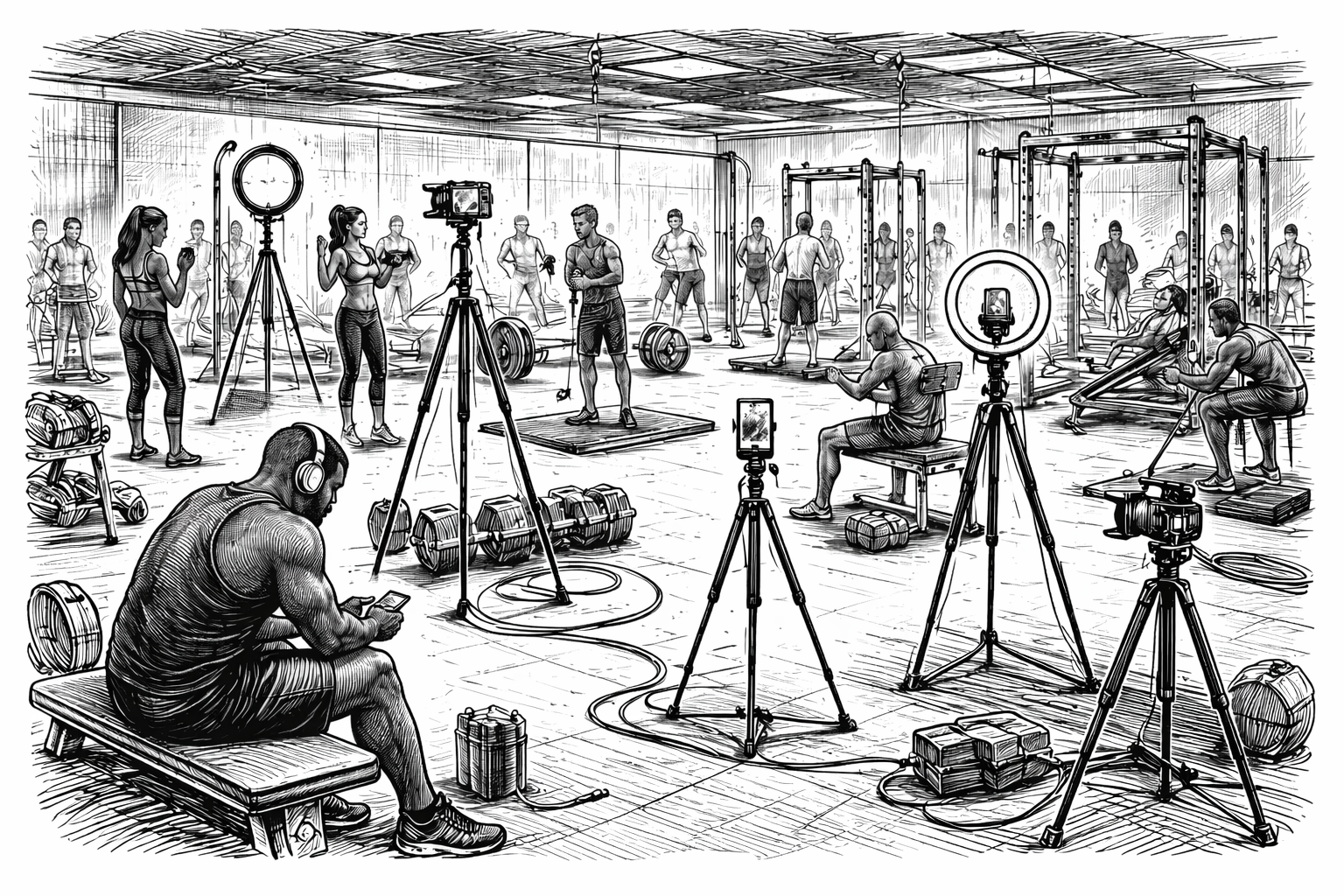
The observation is already on record. Eight tripods. People adjusting angles between sets. The quiet game of trying to stay out of someone else’s frame. What I noticed in that room on The Silent Work was real — the gym has become a content studio, and most people inside it are navigating two simultaneous experiences of the same space. That part of the story has been told.
What hasn’t been fully examined is what the visibility economy produces over time — not just for creators, but for the culture of the space itself, and for the people inside it who never intended to perform for anyone.
The first thing it produces is a second scoreboard. As covered in The Gym Became a Competition. And Then a Market, HYROX introduced one scoreboard to fitness — output, time, placement, measurable progress. The visibility economy introduced another: attention, reach, engagement, the metrics that tell you whether anyone noticed. These two scoreboards do not always reward the same behavior. A heavy, ugly set that represents genuine progress might not translate on camera. A movement that looks clean and fluid might not be where the actual work is happening. Most people move between both within the same session without fully registering when they’ve crossed from one into the other.
The second thing it produces is a reshaping of the physical environment — not just the social one. The fitness influencer economy is now estimated at more than $20 billion globally. That number doesn’t stay abstract. It shows up in how gyms are designed — the cool, low lighting built for content, the open floor plans that accommodate tripods without disrupting traffic flow, the mirror placement that serves both form-checking and framing. As SSC covered in The New Fitness Economy Is Tiered, the gym has always been a designed environment. What’s changed is what the design is now optimized for. Club Studio location in Houston — 20,000 square feet with a dedicated HYROX training space — is one version of that optimization. A gym built around a race format and aesthetic intentionality is also, by design, a gym built for documentation.
The third thing it produces is a quiet renegotiation of what the space is for. The gym has always carried an element of performance — the mirror, the shared floor, the implicit social dimension of training alongside other people. That was never invisible. What’s different now is that the performance no longer stays in the room. It extends outward into feeds and timelines, into an economy where attention has measurable value and visibility can be converted into income, sponsorship, and opportunity. When that extension becomes structural — when gyms are designed for it, when programming is built around it, when brands depend on it — the person who just wants to train quietly is navigating a space that was not optimized for them.
That person is worth naming. Not because content creation is wrong — it isn’t, and many creators genuinely expand access to fitness in ways that matter — but because the communities with the most practical relationship to physical health, the ones using the gym as a tool rather than a platform, are often the same communities least represented in the visibility economy that now shapes what fitness looks like publicly. The image of fitness that circulates — what bodies are featured, what aesthetics are rewarded, what kinds of effort get amplified — is increasingly determined by a content infrastructure that has its own logic, its own incentives, and its own definition of what counts.
I am still in the room. Still running the intervals, still tracking recovery, still getting stronger in ways that are measurable and real. But the room is doing more than one thing at the same time. And the more clearly I see what else it’s doing, the more deliberately I have to choose what I’m there for.
Why This Matters
The gym was supposed to be one of the last genuinely private disciplines — somewhere effort existed for its own sake, witnessed only by the person doing it. That privacy is not gone, but it is no longer the default. When the space is designed for documentation, when the economy rewards visibility, and when the culture of the room shifts to accommodate both, the person training quietly is making a countercultural choice without necessarily knowing it. The question isn’t whether fitness culture will keep moving in this direction. It will. The question is what gets lost when private discipline gets fully absorbed into the attention economy — and whether the communities with the most to gain from fitness infrastructure are the ones the visible version of it is actually built to reach.