
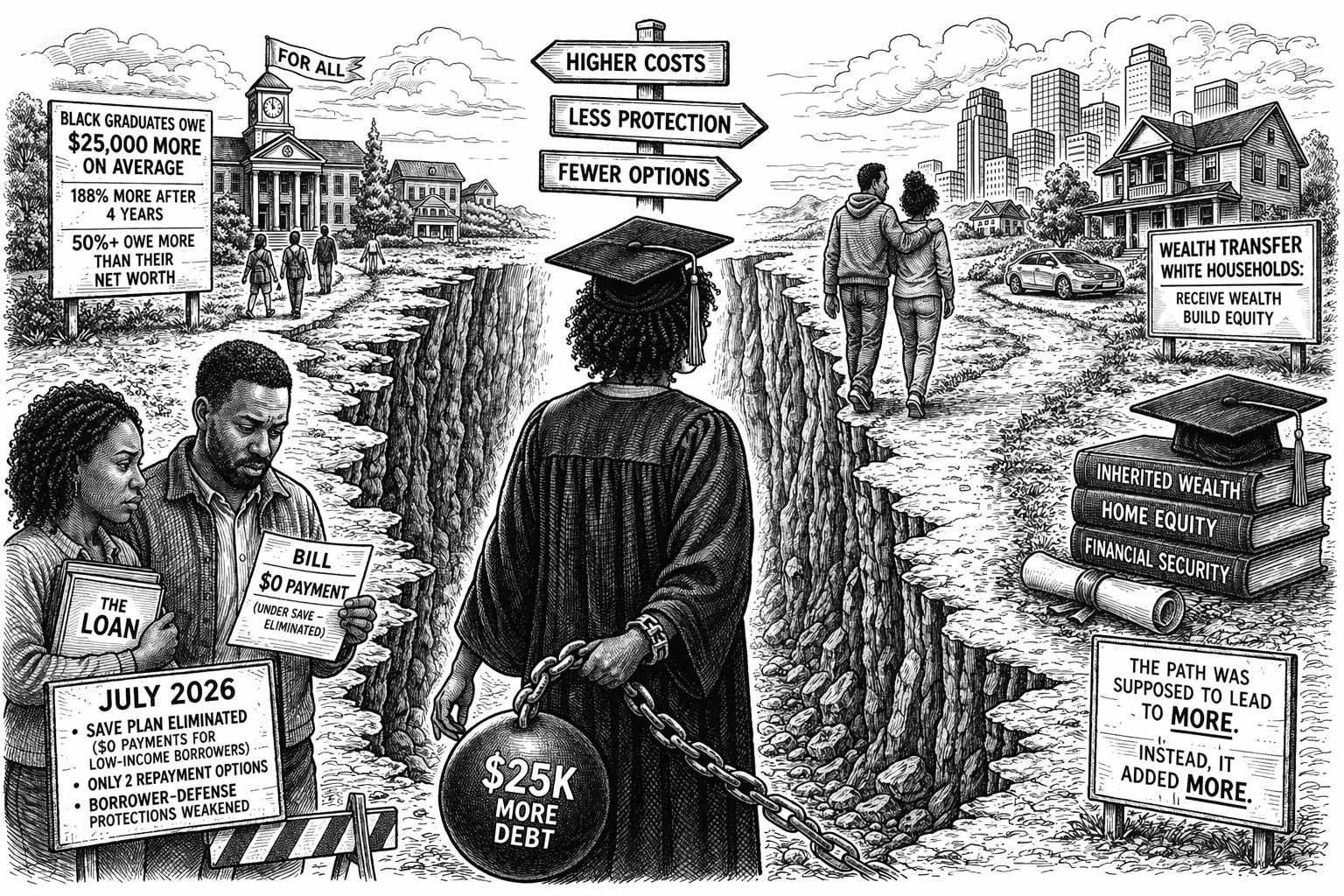
The student loan crisis in America is frequently discussed as a universal problem — rising costs, unmanageable debt, a system that promises economic mobility and often delivers financial constraint. The data tells a more specific story. Black and African American college graduates owe an average of $25,000 more in student loan debt than white college graduates. Four years after graduation, Black students owe an average of 188% more than white students borrowed. Over 50% of Black student borrowers report that their net worth is less than they owe in student loan debt.
That gap is not a function of borrowing more carelessly. It is a function of arriving at the financial aid office with less — less family wealth to draw on, less parental income to leverage, less inherited equity from a homeownership history that was systematically denied. Different patterns of intergenerational transfers contribute to nearly three-quarters of Black borrowers’ student loan balances being higher today than when they were originally taken out. After college graduation, white households typically receive wealth transfers from family to help purchase homes. Black households transfer their increased post-college income to help their family. The debt doesn’t just compound financially. It compounds the racial wealth gap it was supposed to help close.
The policy environment is making this worse in concrete ways. Starting July 1, 2026, new borrowers must choose between two repayment options — a standard fixed-payment plan and the Repayment Assistance Plan, which caps payments at 1-10% of discretionary income. The SAVE plan — the most affordable income-driven option, under which many low-income borrowers paid $0 per month — is being eliminated. The administration is also moving to restrict borrower-defense regulations that allowed students defrauded by predatory institutions to have their debt discharged. Black students are disproportionately targeted by for-profit and predatory institutions — the exact category of institution the borrower-defense program was designed to protect them from.
The proposed cuts to Pell Grants in the reconciliation bill add another layer. The bill eliminates federal Direct Subsidized loans, which do not accrue interest while undergraduate students are in school, and substantially cuts Pell Grants that more than 6.8 million low-income students rely on. Pell Grant recipients are more than twice as likely as other students to have loans and are disproportionately borrowers of color. The students who most need affordable access to higher education are being asked to pay more for it, through debt structures with less protection, in a job market that is already closing its entry-level doors.
As SSC covered in The Job Market Isn’t Crashing. It’s Closing. and AI Isn’t Replacing Workers Yet — But It’s Already Closing the Door on New Ones, the economic environment waiting at the end of the credential is already harder to navigate than it was five years ago. The student loan system is now adding to that weight on the front end, at the point of entry, for the students least positioned to carry it.
Why This Matters
Higher education has been sold to Black families as the path through a system that otherwise blocks their economic mobility. The student loan system is now a mechanism that extracts wealth from the people it was supposed to elevate — charging more, forgiving less, and dismantling the protections that existed for students who got exploited along the way. The July 2026 repayment changes are not abstract. They will hit Black borrowers first, hardest, and with the least cushion to absorb the impact.