
The pattern has been consistent for decades. Institutions acknowledge slavery. They mourn the cruelty. They name it as a moral failure of another era, distance themselves from the worst actors, and move forward. What they almost never do is identify their own structural role inside the system — the legal permissions they granted, the theological cover they provided, the authority that made expansion and extraction not just possible but righteous.
This morning, Pope Leo XIV broke from that pattern.
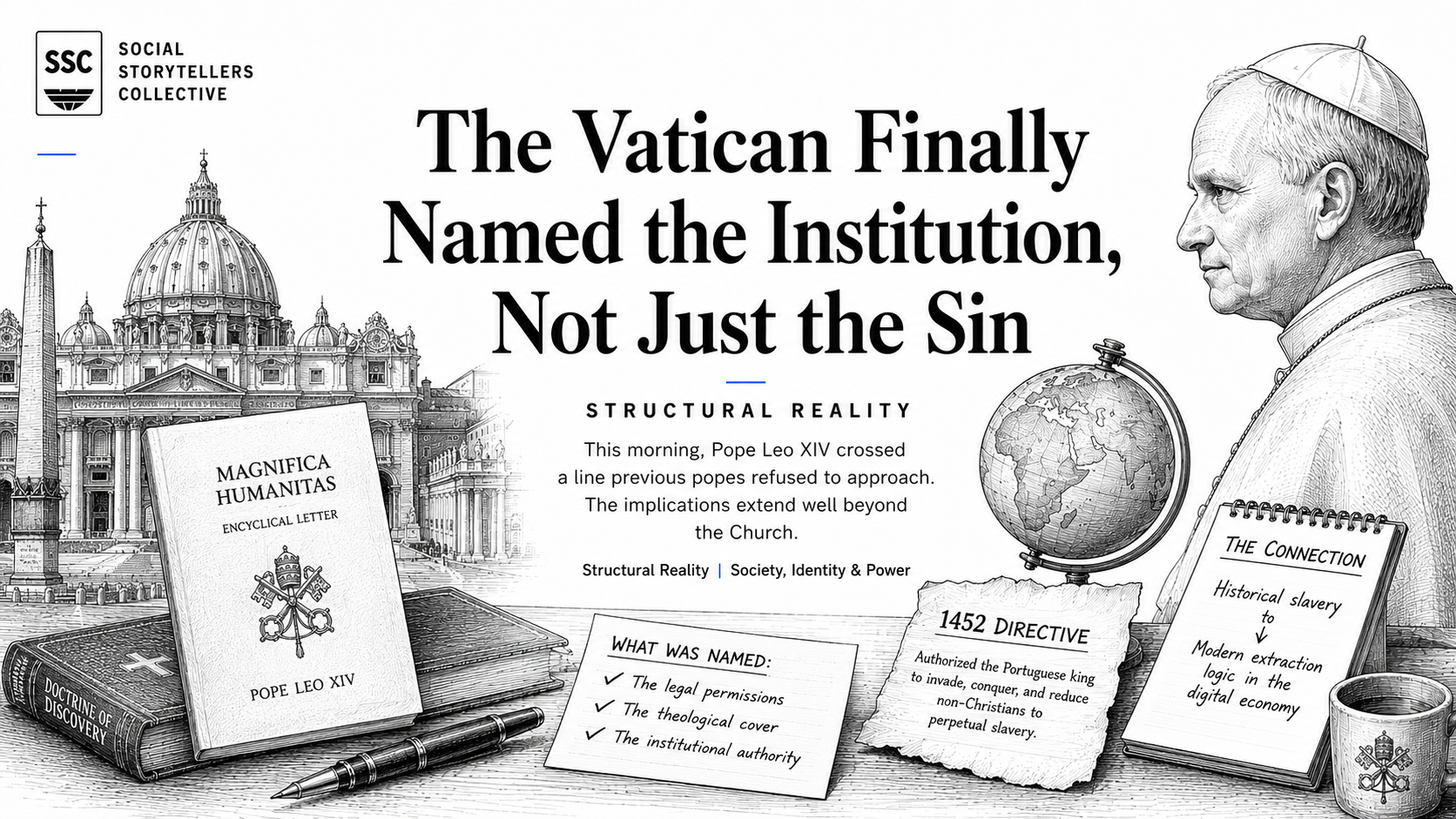
In Magnifica Humanitas, released today at the Vatican, Leo issued the first acknowledgment by any pope of the Holy See’s direct role in legitimizing slavery — not Christians behaving badly in a vacuum, but the institution itself granting European colonial powers explicit religious authority to subjugate and enslave non-Christians. A 1452 directive authorized the Portuguese king to invade, conquer, and reduce non-Christians to perpetual slavery. That directive became part of the Doctrine of Discovery, the theological framework that justified colonial expansion across Africa and the Americas. Previous popes apologized for individual believers’ participation. Leo named the architecture. That distinction is not semantic. It is the entire argument.
Leo is the first U.S.-born pope in history, and his own family lineage includes both enslaved people and slave owners. That proximity pulls the apology out of the realm of distant institutional gesture and into something more complicated — a reckoning delivered by someone who carries the contradiction inside his own bloodline.
The more important story is not the apology itself. Institutions apologize constantly now. What makes this moment different is the framing. Leo moved closer to naming the system than mourning its victims from a comfortable distance. That pressure — to name the system rather than the symptom — is not isolated to religion. Universities, museums, governments, and technology companies are all facing versions of the same demand. Silence reads as positioning. Deflection reads as strategy.
The encyclical made a connection that deserves direct attention. Leo linked historical slavery to modern extraction logic in the digital economy — labor conditions and mineral procurement networks underpinning AI infrastructure. The argument is not metaphorical. It is that the logic of extraction did not end. It migrated. The asymmetry between who benefits and who absorbs the cost of progress remained largely intact. The language changed. The structure often did not.
Black Catholic activists and scholars pushed for precisely this kind of acknowledgment for decades — not generic regret, but a direct reckoning with the institutional role the Church played in authorizing colonial human trafficking. This moment is not the Vatican getting ahead of anything. It is the Vatican finally responding to pressure that has been building for a very long time.
Institutions are increasingly being judged not by their present-day diversity statements, but by what histories they are finally willing to formally name — and by how long it took them to say it once the pressure became impossible to absorb quietly.