
Part of The Access Shift — an ongoing series examining how access is being quietly reshaped across American life.
For years, the “stripper index” has circulated as one of the more unconventional ways to read the economy. The idea is simple: when people have less disposable income, one of the first places it shows up is in strip clubs. Spending slows, tips get smaller, the big spenders disappear — and all of it happens before the data ever reflects a downturn. It has never been a formal metric, but it has held cultural weight precisely because it tracks behavior in real time, without filters, reports, or delays.
The signal is still there. It’s just become harder to read. Dancer and influencer Vulgar Vanity described working South by Southwest in Austin this year: “I walked into a completely empty club and didn’t make any money at all.” She noted that regular customers who used to tip generously have stopped tipping entirely or are giving less than half of what they once did. She is not an outlier. Las Vegas strip clubs have seen a 12% drop in earnings, and individual dancers across the country are reporting income declines of 30% or more compared to 2019. On the surface, this reads like a familiar story — economic contraction showing up in discretionary spending before it becomes visible in official data.
But that explanation is no longer complete. Because what the stripper index historically captured was not just spending — it was visibility. Strip clubs functioned as environments where discretionary income was expressed openly, where cash moved in real time, and where behavior could be observed without mediation. When that environment changes, the signal changes with it, even if the underlying behavior does not disappear.
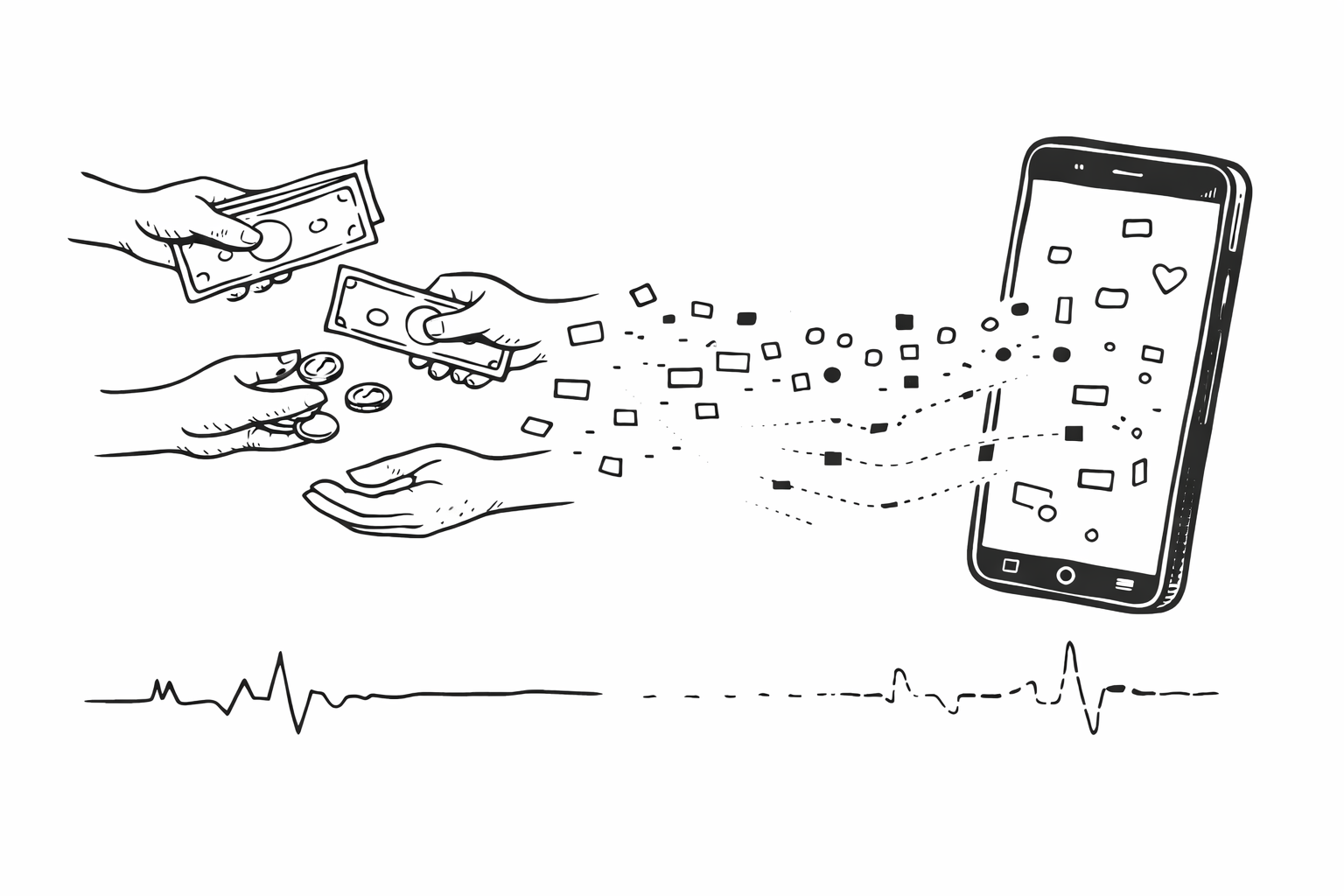
Spending has not simply declined. It has been redistributed into spaces that are less visible and more controlled. A growing share of adult entertainment consumption now exists on digital platforms, where transactions are private, recurring, and invisible to anyone outside the exchange. Subscription-based content, direct payments, and platform-mediated interactions have shifted both demand and labor away from physical spaces. The same consumers who once spent publicly are now spending privately — often at comparable levels, but without the visibility that once made those patterns readable. The absence of visible spending gets misread as a lack of spending altogether, even when activity continues elsewhere.
There is also a generational dimension to this transition. Younger consumers are more comfortable with digital intimacy and less attached to traditional nightlife spaces. Increased surveillance, location tracking, and social visibility have made private consumption more appealing than public spending. As SSC tracked in What Doesn’t Make It Into the Cart, economic pressure tends to reshape behavior quietly — not through dramatic stops, but through small redirections that aggregate into a pattern before anyone names it. The stripper index is experiencing that same quiet redistribution.
This is where the story extends beyond nightlife. Economic indicators depend on what can be seen, measured, and aggregated. When spending moves into fragmented, privatized, platform-controlled environments, those indicators lose clarity. The systems designed to track behavior are not equipped to follow it into spaces that weren’t previously central to economic analysis. That gap — between where behavior is and where measurement looks — is growing across sectors, and the stripper index is one of the earliest examples of it becoming visible. It connects directly to what SSC examined in When the Economy Slows: the people who feel economic pressure first are rarely the ones whose experience gets captured in the headline numbers, and by the time the data catches up, the story is already further along than it seems.
Why This Matters
The stripper index has always been less about strip clubs and more about access to information. It worked because it captured unfiltered behavior in a visible environment. As that environment disappears, the signal does not vanish — but it becomes harder to detect, and easier to misread as calm when what’s actually happening is concealment. What changes is not only how people spend, but who can see it, track it, and interpret what it means. In an economy where more transactions are private and mediated through platforms, the earliest signs of change may no longer appear where we expect them. And by the time they do, the story is already further along than it seems.