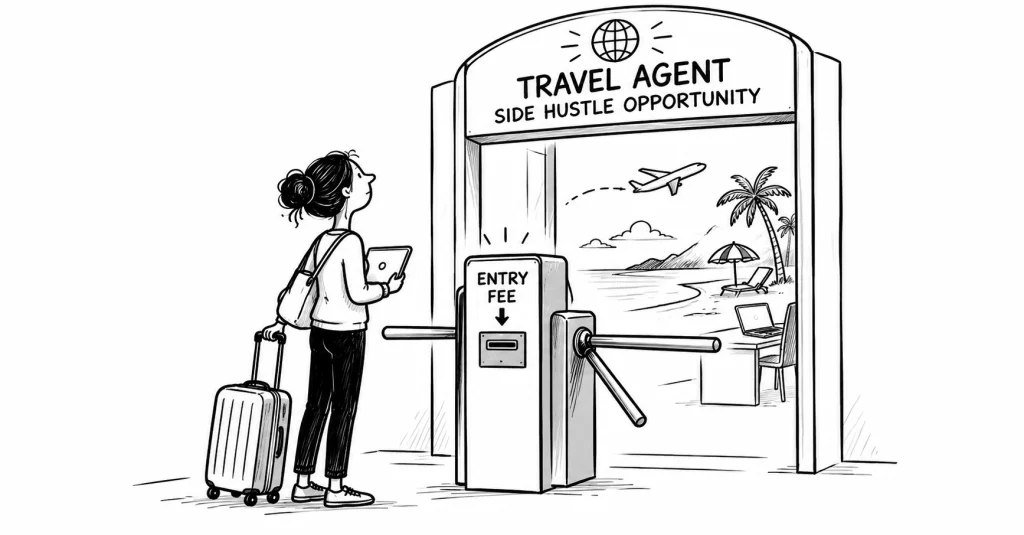
Travel-agent opportunities are spreading through social media with promises of flexible income. Some recruits are discovering that earning money can begin with paying someone else first.
The side hustle was supposed to lower the barrier to earning extra money. In parts of the online travel-agent economy, that barrier now comes with a monthly fee. Social media posts increasingly promote the chance to become an independent travel adviser from home, with discounted trips, flexible hours and commission income. Reporting by The Guardian's Sarah Marsh examined models in which new recruits pay to join and then pay recurring fees for access to booking platforms, training and business tools. At InteleTravel, recruits described a sign-up cost of about £150 and monthly fees of £30 to £40, while agents keep roughly 70 percent of the 10 percent commission suppliers pay on a booking. Several former participants said they earned so little that the fees themselves became difficult to recover.
Flexibility Has Become a Product
The appeal is easy to understand. Workers are facing higher household costs while many employers remain cautious about hiring, and a business that can supposedly be started with a phone and a laptop offers something traditional employment does not: control over hours and, in theory, unlimited upside. The travel industry adds an aspirational layer to the pitch. The worker is not simply selling a service, and the marketing often surrounds the opportunity with images of resorts, cruises and discounted vacations.
But the economics change when participation requires recurring payments. Instead of a company paying workers for their labor, the worker begins as a customer of the company's platform.
The Risk Moves Downward
That structure does not automatically make an opportunity illegitimate. Independent contractors across many industries pay for software, licensing, advertising, professional memberships and training. The relevant question is who carries the risk. If a new travel adviser pays monthly fees before landing a single client, the platform collects revenue whether the adviser succeeds or not, while the adviser earns only after making sales.
That reverses part of the conventional employment relationship. A traditional employer carries the cost of recruiting, training and equipping workers before any revenue arrives. In a fee-based independent model, some of those costs shift to the person trying to break into the business. A slow month therefore lands differently on each side: the platform still collects its fee, and the adviser absorbs the shortfall.
Side Hustles Are Expanding Because Main Jobs Are Not Enough
That dynamic matters more as secondary work is marketed as a normal part of household financial planning. Workers are routinely encouraged to monetize their evenings, weekends, hobbies, spare bedrooms, cars, social followings and professional networks. The side hustle is no longer presented only as entrepreneurial ambition; it is often presented as a response to ordinary financial pressure, which makes the quality of the opportunity more important.
A worker trying to close a $300 monthly budget gap cannot judge an opportunity by its commission rate alone. The real calculation includes fees, unpaid prospecting time, marketing costs, cancellations and how long it takes to build a client base large enough to generate repeat business. A side hustle can produce revenue and still leave the worker with very little profit.
The New Labor Market Has More Doors — and More Tolls
Digital platforms have dramatically lowered the cost of starting some businesses. They have also created a growing category of work in which people pay for access to the possibility of earning, and that distinction deserves more scrutiny as households look for income outside conventional employment. Some of these models also reward recruiting. The Guardian reported that PlanNet Marketing pays representatives for signing up new members and for growth in their "downline," and that the company's own income disclosure puts average annual earnings across its base at about $40.
The question is not whether independent travel advisers can make money. Some clearly do. It is how many people enter expecting straightforward supplemental income, how much they spend before they earn it, and whether the business model depends mainly on successful travel sales or on a steady supply of new people willing to pay for access. The modern side hustle promises independence from an employer, but for some workers, the first step toward that independence is becoming somebody else's customer.
Source: Sarah Marsh, "Online marketing: the travel agent side hustle that took us nowhere," The Guardian, October 3, 2026, https://www.theguardian.com/money/2026/oct/03/online-marketing-the-travel-agent-side-hustle-that-took-us-nowhere