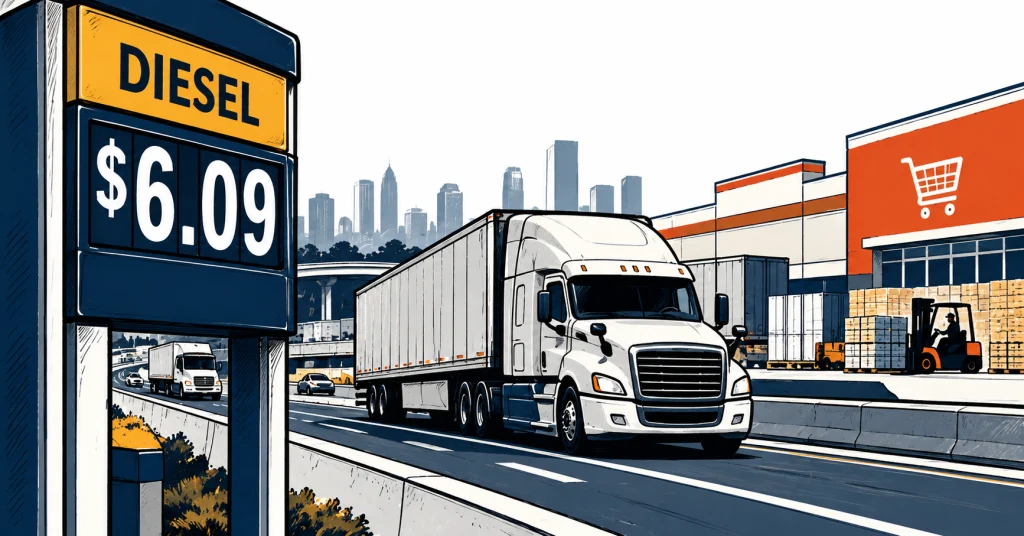
With diesel above $6 a gallon, transportation costs are putting new pressure on retailers, suppliers and household budgets. The effects may reach store shelves long before consumers understand where the added costs originated.
BY WILL DAVISON JR.
OCTOBER 13, 2026
Diesel averaged $6.29 a gallon nationwide in September, according to the U.S. Energy Information Administration’s October outlook. By October 5, the weekly average had eased to $6.199, but that was still nearly $2.49 higher than a year earlier. For a household, expensive fuel is often measured by the cost of filling a vehicle. For the businesses responsible for moving food, clothing, furniture and other merchandise across the country, it is a cost that follows nearly every shipment. The consequences can extend well beyond transportation, creating another source of pressure on retail prices, profit margins and the availability of everyday goods.
The retail industry is already responding. Retail Brew reported that elevated diesel prices are prompting retailers to optimize their supply chains as transportation becomes more expensive. That response introduces a broader economic concern: when moving merchandise costs more, someone must absorb the difference. Retailers can negotiate freight contracts, consolidate shipments, change delivery schedules or accept smaller margins. Suppliers and carriers may face similar decisions. Eventually, some of those costs can be passed along to consumers, although the amount depends on competition, contracts, inventory and how much pricing power a business possesses.
The cost moves before the merchandise does
A product’s journey to a store can involve several transportation stages. Raw materials move to manufacturers, finished goods travel to distribution centers, and trucks deliver inventory to individual stores or fulfillment facilities. Diesel costs can enter that chain repeatedly, particularly when trucking companies apply fuel surcharges or renegotiate rates. A retailer that receives fewer, larger shipments might reduce transportation expense, but it also risks carrying more inventory or running short of certain products between deliveries. Faster shipping, frequent restocking and wide product selection all become more expensive to maintain when fuel prices remain elevated. The adjustments may be difficult for shoppers to identify because they often appear as operational changes rather than a separate charge on a receipt.
The pressure is unlikely to disappear immediately. In its October Short-Term Energy Outlook, the EIA projected retail distillate prices above $6 a gallon during October and retail diesel prices above $4 through 2027. The agency also reported that East Coast distillate inventories were 32% below their five-year seasonal average in September, pointing to supply constraints that extend beyond an individual retailer’s purchasing decisions. Those forecasts do not establish what any particular store will charge for merchandise. They do, however, suggest that businesses planning inventory, distribution and pricing may need to account for elevated transportation expenses over a longer period.
The pressure is not distributed equally
Large retail chains generally have more options for responding to expensive freight. They can spread shipments across extensive distribution networks, negotiate with multiple carriers and adjust purchasing volumes. Smaller retailers may lack comparable leverage, particularly if they depend on a limited number of suppliers or serve markets where deliveries are already costly. A neighborhood grocer, independent clothing shop or regional merchant cannot necessarily redesign its distribution system when freight rates increase. Its choices may be limited to absorbing the expense, raising selected prices or ordering less merchandise. That creates the possibility of uneven effects across communities, even when national inflation figures suggest consumers are experiencing the same economy.
Households face a similarly uneven burden. A modest increase in the price of a discretionary purchase may be inconvenient; a comparable increase in groceries, household supplies or other recurring necessities can be harder to manage. The relationship between diesel prices and consumer prices is not automatic or uniform. Retail prices also reflect wages, rent, insurance, tariffs, demand and competition. Some companies may preserve prices by accepting lower margins, while others may use higher operating costs to justify increases. Without retailer-level evidence, it would be inaccurate to attribute a particular shelf-price change solely to diesel. What can be established is that transportation represents another point where higher business expenses can move toward consumers.
The timing adds another complication as retailers prepare for holiday demand. Businesses must decide how much merchandise to order, where to position inventory and whether faster replenishment is worth the additional expense. Those choices affect not only profitability but also the shopping experience, from product selection to delivery expectations. The EIA’s weekly fuel-price data show that diesel remains substantially more expensive than it was a year ago, even after its recent decline. Retail Brew’s reporting identifies how retailers are adjusting to that pressure. The broader story is what happens after those adjustments are made. A more expensive freight network does not guarantee higher prices for every product, but it forces businesses to make decisions whose consequences may eventually be felt by households already managing competing demands on their budgets.