
A new narrative is circulating in global real estate and wealth migration circles: there is another Dubai emerging, this time in the Americas. The city being marketed is Panama City — specifically its Punta Pacífica district, a luxury waterfront enclave built on reclaimed land in a development arc deliberately modeled on Dubai’s own architectural story. The framing is familiar. Rapid skyline growth. Foreign capital inflows. Political instability elsewhere acting as a push factor. And a promise, implicit or explicit, that those who move early will benefit most.
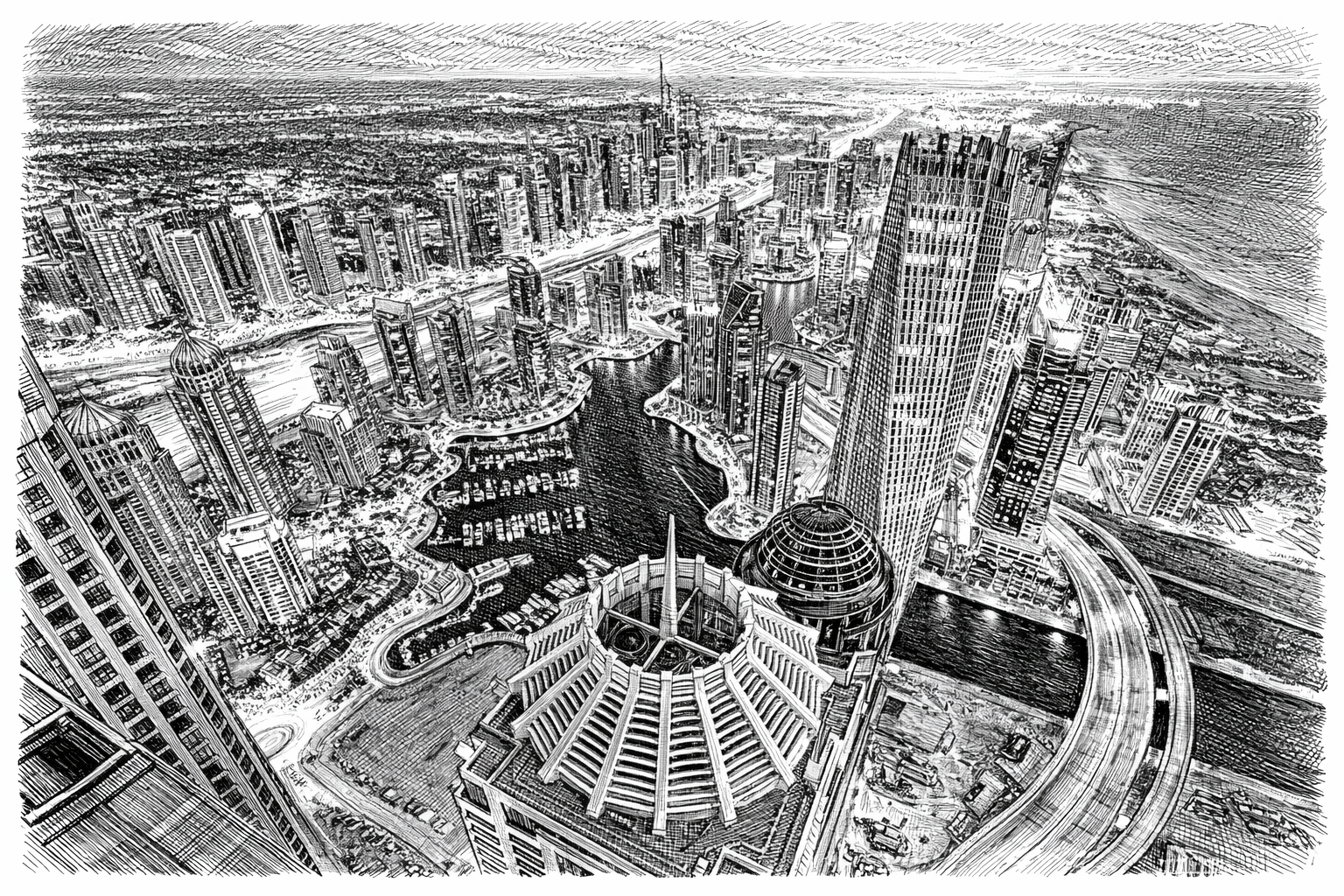
The catalyst is not abstract. The Iran war has shattered Dubai’s reputation as the world’s premier safe haven for global wealth. Expatriates are scrambling to leave. Family offices and wealth managers are reconsidering their Middle East footprint. The capital being displaced is not disappearing — it is relocating. And Panama City, already self-marketed as the “Hub of the Americas,” is actively positioning itself to receive it. High-level discussions are already underway between Panamanian officials and the chairman of Emirates Airlines about establishing a direct flight route between Dubai and Panama City, framed explicitly as a bridge between two global capital ecosystems.
What is being marketed, however, is not just real estate. It is a model. Dubai has become shorthand for a specific kind of urban promise: rapid development, investor-friendly policy, luxury infrastructure, and a perception of safety insulated from regional volatility. That authority was earned — and not only through policy. As SSC examined in Dubai Chocolate Isn’t Just a Treat. It’s a Signal., Dubai has spent two decades building itself into a city capable of redefining global luxury standards from outside the European canon — a cultural signal that travels far beyond real estate or finance. But the underlying model was not accidental. It was built through decades of coordinated state planning, regulatory flexibility, and a willingness to structure entire sectors around attracting and retaining foreign capital. The skyline was the product of the system, not the system itself. And as SSC documented in Dubai’s Tourism Machine Didn’t Stop. It Tightened., what the Iran war exposed is how quickly that system narrows for everyone inside it when the external conditions it depends on become unstable — reducing optionality, concentrating spending, and revealing just how much of Dubai’s model is built on the confidence of people who can leave.
The question is whether Panama City is replicating the visible outcome or the underlying architecture.
Because the distinction matters.
Punta Pacífica has the aesthetics in place — man-made islands, a 70-story JW Marriott tower, a Johns Hopkins-affiliated hospital, luxury shopping, and yacht infrastructure positioned to serve vessels transiting the Panama Canal. The pitch to global investors emphasizes a dollarized economy, zero tax on foreign income, and residency-by-investment programs that parallel Dubai’s Golden Visa structure. On paper, the comparison holds.
But in many of these emerging markets, the influx of foreign wealth is already reshaping local housing dynamics faster than policy can respond. Prices rise faster than local wages. Development prioritizes international buyers over existing residents. Infrastructure expands, but not always in ways that serve the full population. The skyline grows. Access narrows. This is the pattern that consistently gets flattened in the boomtown narrative — growth treated as universally beneficial when in practice it is unevenly distributed, and the same forces that make a city attractive to global investors can make it less inhabitable for the people already living there.
Dubai itself has long operated within that tension. It is a global hub built on openness to capital, but access to ownership, labor protections, and long-term residency has historically been structured in ways that differentiate sharply between who can participate fully and who cannot. Migrant labor built the infrastructure. Migrant labor does not own it. And as SSC examined in Two Different Diasporas, One Flattened Narrative, even the story of who is building financial infrastructure in Dubai — African banks serving continental institutional clients — gets collapsed into a broader narrative of unified global Black wealth that does not reflect the actual mechanics of who those institutions are designed to serve. The same flattening happens with boomtown narratives: the aesthetic of inclusion gets marketed while the structural terms of access remain unexamined.
Exporting the model of Dubai without grappling with those structural realities does not avoid the tension — it imports it under a different geography.
What we are watching is not just migration. It is the movement of capital looking for environments that will accommodate it on favorable terms. Panama City may well succeed in attracting that capital. The more complicated question — the one the marketing materials do not address — is who that growth is designed to serve, and whether the residents who were there before the capital arrived have a place in the city being built around them.
In trying to build the next Dubai, Panama City may be importing not just the skyline, but the access constraints that made Dubai work for some and unavailable to many others.
That is the part of the model that travels quietest — and lands hardest.