
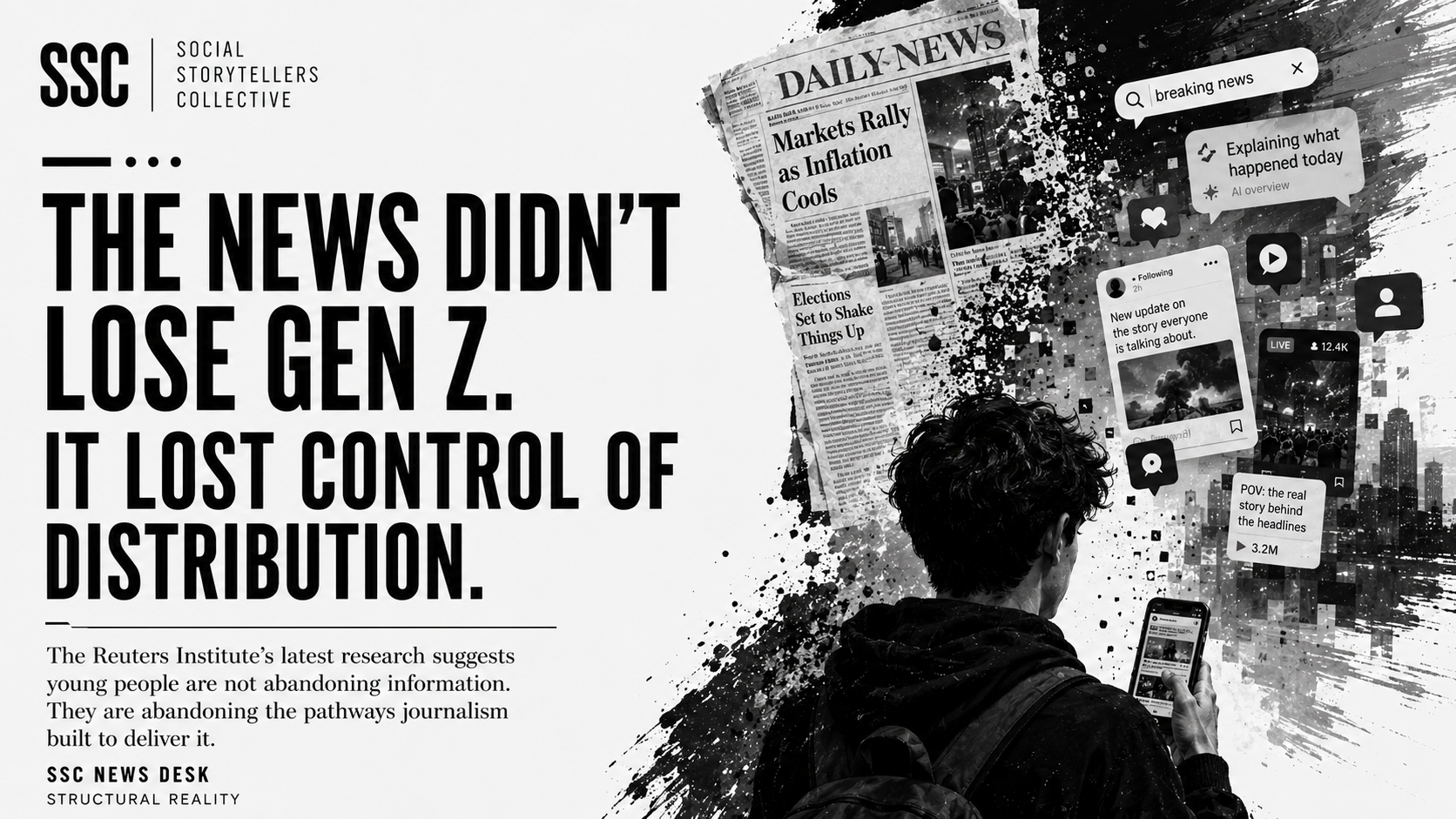
In 2015, 36 percent of adults aged 18 to 24 said news websites and apps were their primary source of news. A decade later that figure has fallen to 24 percent. During the same period, social media’s share as a primary news source nearly doubled, rising from 21 percent to 39 percent. The media industry’s preferred reading of those numbers is that young people are turning away from journalism. The Reuters Institute’s latest report suggests something more precise is happening. Young audiences have not disappeared. They have moved somewhere many news organizations were never designed to follow.
The report, drawing on data from multiple countries and more than a decade of research, argues that today’s 18-to-24-year-olds are best understood as social-first rather than online-first. That distinction matters more than it might appear. Earlier generations adopted digital versions of existing news habits — they moved from newspapers to websites, from television broadcasts to mobile apps. Gen Z largely skipped that transition. For many younger consumers, social platforms are not one destination among many. They are the internet itself. News now competes inside ecosystems designed primarily for entertainment, communication, and community. The information is still there. The architecture around it is completely different.
Only 14 percent of young adults primarily access news by going directly to a publisher’s website or app. By comparison, 40 percent primarily encounter news through social media and 26 percent through search engines. In practical terms, journalism increasingly arrives as a byproduct of other activities — a user opens Instagram to watch videos, TikTok to scroll content, or YouTube to follow creators, and news appears along the way. The audience still encounters information. The publisher no longer controls the environment in which that information lands, which means the publisher no longer controls the relationship.
That loss of control is the real story. For most of the modern media era, news organizations owned both reporting and distribution. A newspaper, television network, or magazine decided what reached audiences and how. Social platforms broke that arrangement by taking ownership of distribution while continuing to rely on publishers to create the content. Artificial intelligence may represent the next stage of the same transition. Reuters found that 15 percent of young adults already use AI tools for news each week, compared with just 3 percent of adults over 55. Younger audiences are not simply finding information through platforms. Increasingly they are asking machines to interpret it for them — which moves the publisher one step further from the moment of contact.
The trust numbers complicate the narrative further. Younger audiences are routinely described as cynical toward journalism, but the gap is narrower than that framing suggests. Trust in news among 18-to-24-year-olds sits at 37 percent, nine percentage points lower than adults over 55 — a gap, but not an abyss. More revealing is where that trust is directed. Fifty-one percent of young people pay more attention to individual news creators than to traditional news brands, compared with 39 percent who prioritize established media organizations. Trust has not vanished. It has become personalized. Younger audiences are placing confidence in people rather than institutions — which is a structural problem for organizations that spent a century building brand equity rather than individual relationships.
What makes the Reuters findings significant beyond media is that journalism is simply the first institution confronting a reality that is moving across every sector. Universities, political parties, religious organizations, and employers are facing versions of the same disruption. The twentieth century rewarded organizations that controlled access to information, credentials, community, and opportunity. The twenty-first century is rewarding those who can earn attention inside systems they do not own and cannot control. The question journalism is failing to answer — how do you build a sustainable relationship with an audience that you no longer have a structural claim on — is the same question every legacy institution is going to have to answer. The audience did not leave recently. They left years ago. Most organizations are still debating whether to believe the data.