
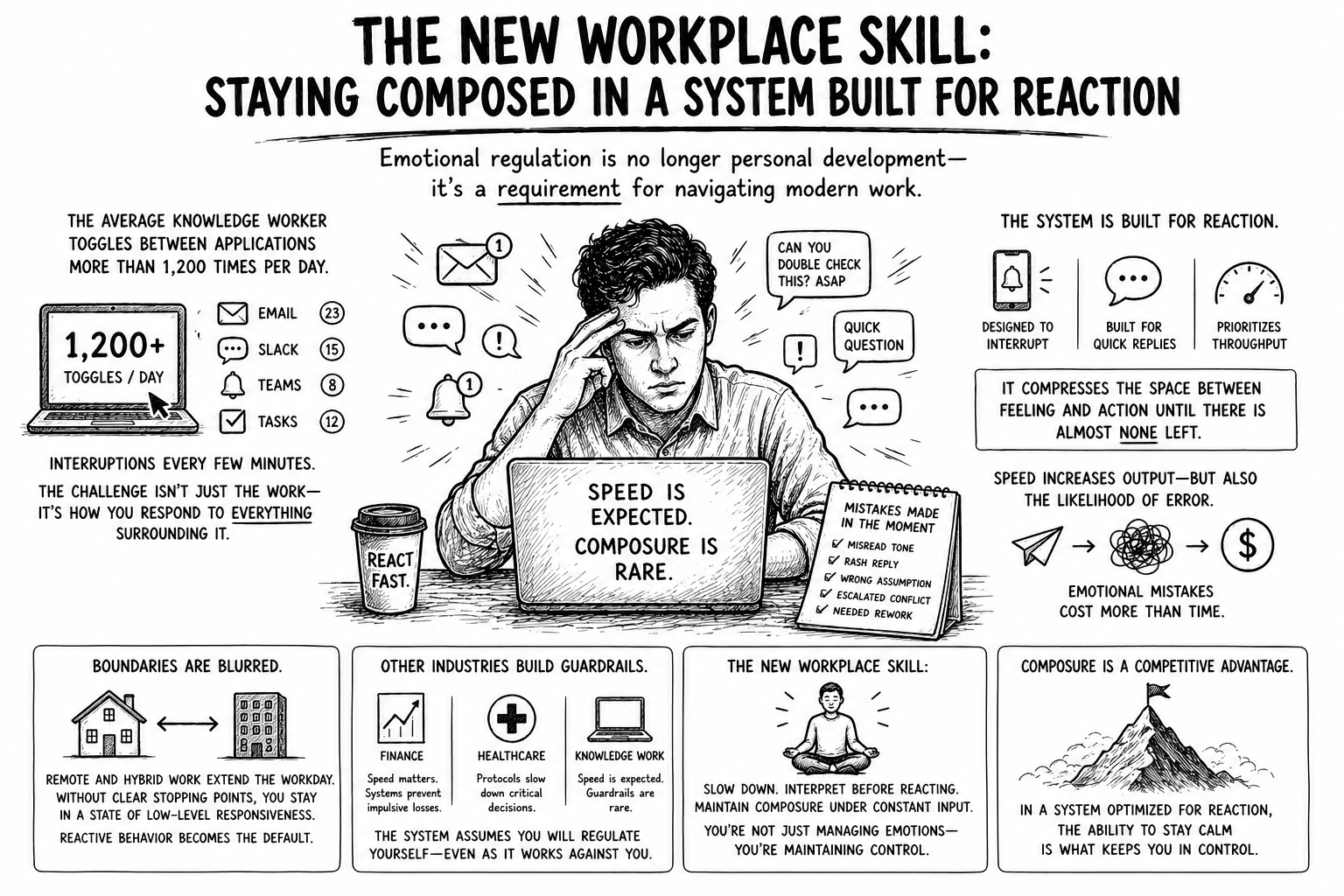
The average knowledge worker now toggles between applications more than 1,200 times per day, with interruptions arriving every few minutes through email, messaging platforms, and task management systems. That volume of input has fundamentally changed the nature of work. The challenge is no longer just completing tasks. It is managing how quickly — and how emotionally — you respond to everything surrounding them.
This shift has accelerated as workplaces have moved into always-on environments. Platforms like Slack and Microsoft Teams compress communication into real time, creating an expectation of immediate response even when the work itself does not require it. The result is a system that rewards speed over interpretation. Workers are not just evaluated on what they produce, but on how quickly they engage, reply, and react. The pressure is subtle but persistent, and it reshapes behavior over time.
The system itself is built for reaction. Notifications are designed to interrupt, messages are structured for quick replies, and workflows prioritize throughput over reflection. In this environment, emotional responses move faster than analysis. A message interpreted incorrectly, a tone misread, or a moment of frustration can escalate into decisions that carry longer-term consequences. The workplace does not create emotion — but it compresses the space between feeling and action until there is almost none left.
This creates a tension between efficiency and judgment. Speed increases output, but it also increases the likelihood of error — particularly in communication. Most workplace mistakes are not technical failures. They are emotional ones: responses sent too quickly, assumptions made without context, conflicts escalated before they are understood. The cost of those mistakes is rarely measured directly, but it shows up in strained relationships, misalignment, and rework that slows the system down later.
The expectation of constant availability compounds the issue. Remote and hybrid work environments have extended the workday without formally acknowledging it, blurring the boundary between professional and personal time. Without clear stopping points, workers remain in a state of low-level responsiveness — never fully disengaged. Over time, this reduces the ability to process information deliberately, making reactive behavior more likely even in situations that require nuance.
Other industries have already encountered this dynamic and built around it. In financial trading, milliseconds determine outcomes, but systems include safeguards that prevent impulsive decisions from dominating. In healthcare, protocols exist to slow down critical actions even under pressure. Modern knowledge work has adopted speed without equivalent guardrails. The system assumes individuals will regulate themselves, even as the environment is designed to make that difficult.
The broader shift is that emotional regulation has moved from being a personal trait to a structural necessity. The workplace now requires individuals to create their own buffers within systems that do not provide them. Those who can slow down their responses, interpret before reacting, and maintain composure under constant input are not just managing their emotions. They are maintaining control within a system that is optimized to take it from them.