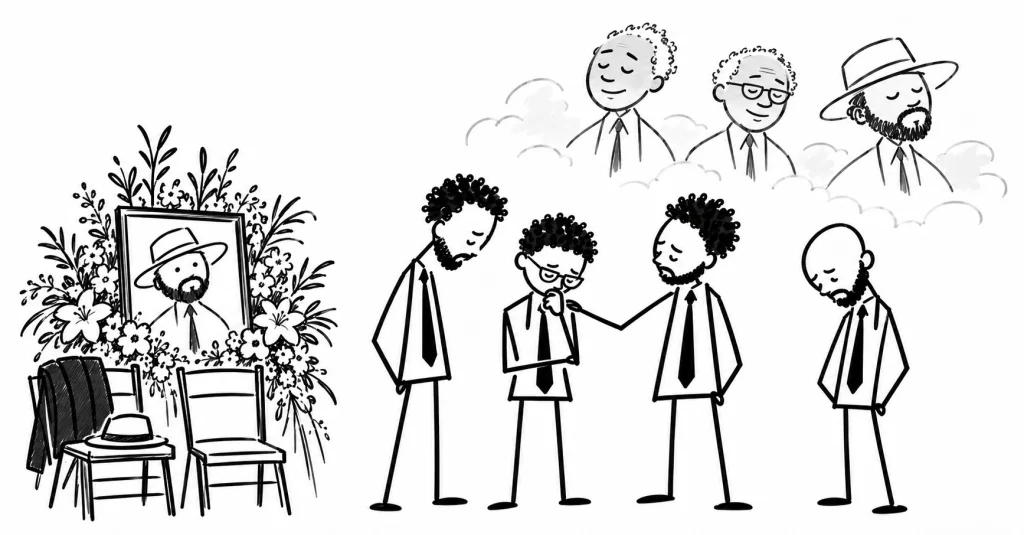
I went to New York to bury my uncle. I came home realizing that my cousins and I had just watched the family hierarchy change in real time.
My grandmother had six sons. For most of my life, that fact meant there was always a layer of men above us — fathers, uncles, brothers — who carried the family history almost by default. They knew who belonged to whom. They remembered the stories before we were old enough to understand them. They knew which cousins had fallen out, which aunt needed checking on, who had moved, who had married, who had stopped coming around and which old family story had been told wrong for twenty years. This weekend, after returning to New York for my uncle’s funeral, the math became impossible to ignore. Of those six brothers, only my father and one of his brothers are left.
Funerals have a way of making family structure visible. People gather who may not have been in the same room for years, and for a few hours you can see the entire system at once: who still anchors the room, who is missing, who has aged, who has quietly moved into a role nobody formally assigned. My cousins and I have always been fortunate to have one another. We grew up with a core group of men around the same age, shaped by many of the same people, carrying many of the same memories. But this weekend, our conversations felt different. Somewhere between the service, the stories and seeing everyone together again, we realized we are no longer simply the sons, nephews and grandsons in the family. We are becoming the men who have to hold the next layer together.
There is no ceremony for that handoff. Nobody gathers the cousins in a room and says the responsibility has moved. It happens through subtraction. One uncle dies, then another. The people who once seemed permanent become photographs, stories and names repeated at repasts. Eventually you look around and understand that the people who preserved the family for you are no longer numerous enough to do it alone. The responsibility moves downward whether the next generation is prepared for it or not.
That responsibility is larger than fatherhood. Having children can continue a bloodline, but lineage is not sustained by biology alone. It is sustained through memory, expectation, presence and repetition. Someone has to teach the younger generation who their people are. Someone has to explain why certain traditions exist, why certain names keep appearing, why family members who rarely speak still belong to one another. Someone has to make the call, organize the gathering, correct the story, keep the photographs and make sure cousins who did not grow up together still recognize one another when they enter a room.
My cousins and I were raised close enough to inherit that foundation almost without realizing it. Many in the generation behind us have not had the same experience. Families are more geographically scattered. Relationships are often more fragmented. Children can know their immediate household well and still have little connection to the larger family that shaped it. That is not always because anyone failed. Mobility, divorce, work, economics and time have changed how families function. But when kinship stops happening automatically, somebody has to decide to build it deliberately.
That may be the part of grief we talk about least. Loss does not only remove people. It redistributes their responsibilities. The uncle who remembered every birthday leaves behind more than an empty chair. The father who kept siblings connected leaves behind work somebody else has to pick up. Family knowledge can disappear in one generation if nobody recognizes that carrying it is a job.
On the way home, I kept thinking about the phrase “changing of the guard.” It sounds ceremonial, almost orderly. What I saw this weekend was quieter than that. My cousins and I simply looked at one another and understood that the line had moved. We are closer to the front now.
What happens next will depend on whether we treat that realization as nostalgia or as instruction. Keeping a lineage intact will require more than remembering the men who came before us at funerals. It will require making sure the generations behind us know one another before another funeral forces them into the same room. We inherited a family that already knew how to belong to itself. Our responsibility now is to make sure that belonging does not end with us.