
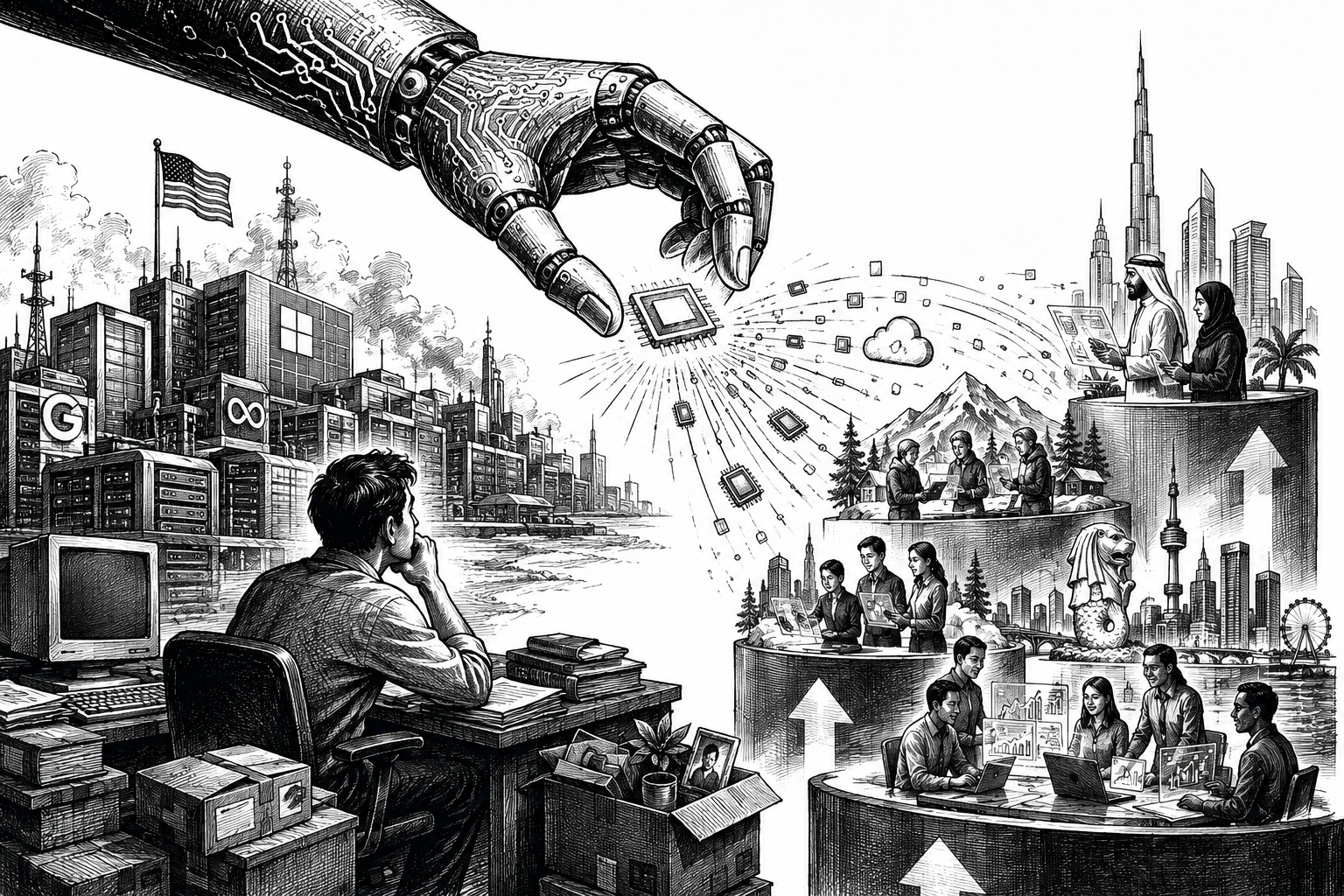
The United States invented the most consequential artificial intelligence systems of the current era. OpenAI, Anthropic, Google DeepMind, and Meta AI are American companies. The largest language models — GPT, Claude, Gemini, Llama — were built here. The infrastructure running them runs largely on American cloud architecture. The capital funding the whole ecosystem is overwhelmingly American.
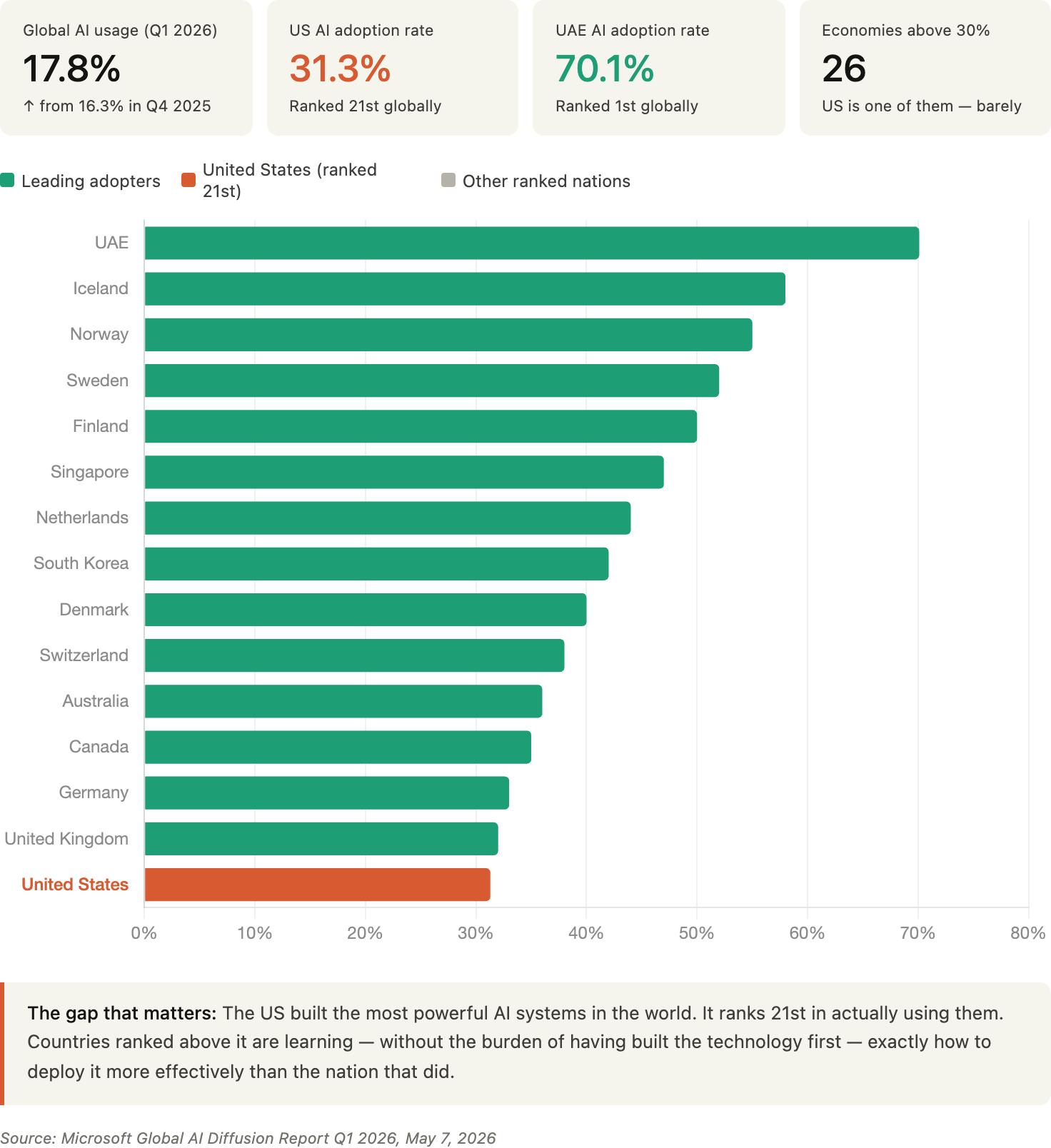
And yet when Microsoft published its Q1 2026 Global AI Diffusion Report this week — measuring actual AI usage among working-age populations across every major economy — the United States ranked 21st.
The UAE leads the world at 70.1% of its working-age population using AI. Iceland, Norway, Sweden, and Finland cluster in the 50-60% range. South Korea, Singapore, and the Netherlands are pulling away from the American pack. The US sits at 31.3% — up from 24th place, but still behind countries that did not build the technology and are simply deploying it more effectively than the nation that did.
That gap is not a vanity metric. It is a productivity gap, a workforce readiness gap, and increasingly an economic competitiveness gap — and it is developing at the precise moment that American companies are restructuring their workforces around AI efficiencies that their own workers are not yet equipped to generate.
What the data actually shows
Microsoft’s Global AI Diffusion Report measures AI usage using a population-normalized metric — the share of working-age adults in each country actively using AI tools in their work and daily lives. Global adoption climbed 1.5 percentage points in Q1 2026, from 16.3% to 17.8% of the world’s working-age population. Among the 26 economies where more than 30% of the working-age population now uses AI, the US is present — but barely, and not distinguished.
The intensity of use matters as much as the adoption rate. Countries leading the rankings are not just using AI more frequently — they are integrating it more deeply into professional workflows, government services, education systems, and business operations. The UAE’s 70.1% rate is not an accident. It reflects deliberate national investment in AI literacy, government-led adoption programs, and a workforce that has been actively prepared for AI integration rather than discovering it on the job.
The US by contrast has approached AI adoption largely through market forces — leaving workers, companies, and institutions to figure out integration independently, at different speeds, with wildly uneven results. The outcome is a country that leads in AI creation and lags in AI deployment.
The coding data complicates the narrative
One finding in the Microsoft report deserves specific attention because it cuts against the dominant narrative. US software developer employment hit a record high of 2.2 million in 2025 — up 8.5% year over year. Early Q1 2026 data shows software developer employment running 4% higher than a year ago. Git pushes — a proxy for code production — increased 78% year over year globally, driven by AI coding tools.
This suggests that at least in software development, AI is currently augmenting employment rather than replacing it. The productivity gains from AI-assisted coding appear to be expanding the total demand for software development work rather than collapsing it. That is the opposite of the story being told by the companies using AI as the public rationale for mass layoffs.
The disconnect is worth naming directly. Companies citing AI efficiency as the justification for workforce reductions are doing so at a moment when the data on AI’s actual labor market impact remains genuinely mixed. The cuts are real. The efficiency gains being used to justify them are not yet uniformly demonstrable.
Why the ranking gap matters
A country ranked 21st in AI adoption while leading in AI development faces a specific economic risk that is not being discussed in the policy conversation. The productivity gains from AI will accrue primarily to workers and economies that can effectively integrate the technology — not to the ones that built it. If the UAE, Norway, and South Korea develop workforces substantially more AI-fluent than the American workforce over the next five years, the competitive consequences extend well beyond technology.
Finance, legal services, healthcare administration, logistics, professional services, education — every sector where AI is projected to drive significant productivity gains is also a sector where the US currently holds competitive advantage. That advantage is not guaranteed. It is a function of workforce capability, institutional readiness, and the speed at which AI integration moves from early adopters to broad deployment.
The US is currently producing AI faster than it is deploying it. And the countries ranked above it in the Microsoft report are learning, without the burden of having built the thing first, exactly how to use it.