
A growing number of job seekers are walking into interviews that aren’t really interviews at all. They’re being assessed by systems—often without being told—evaluated through pre-recorded responses, scored by models they can’t see, and filtered out before a human conversation ever begins. Reporting from Fast Company, drawing on new data from hiring platform Greenhouse, shows just how quickly this shift has taken hold: nearly two-thirds of candidates have now been interviewed by AI, a 13-point increase in just six months. The technology has moved from résumé screening into the interaction itself, quietly redefining what it means to be “considered” for a job.
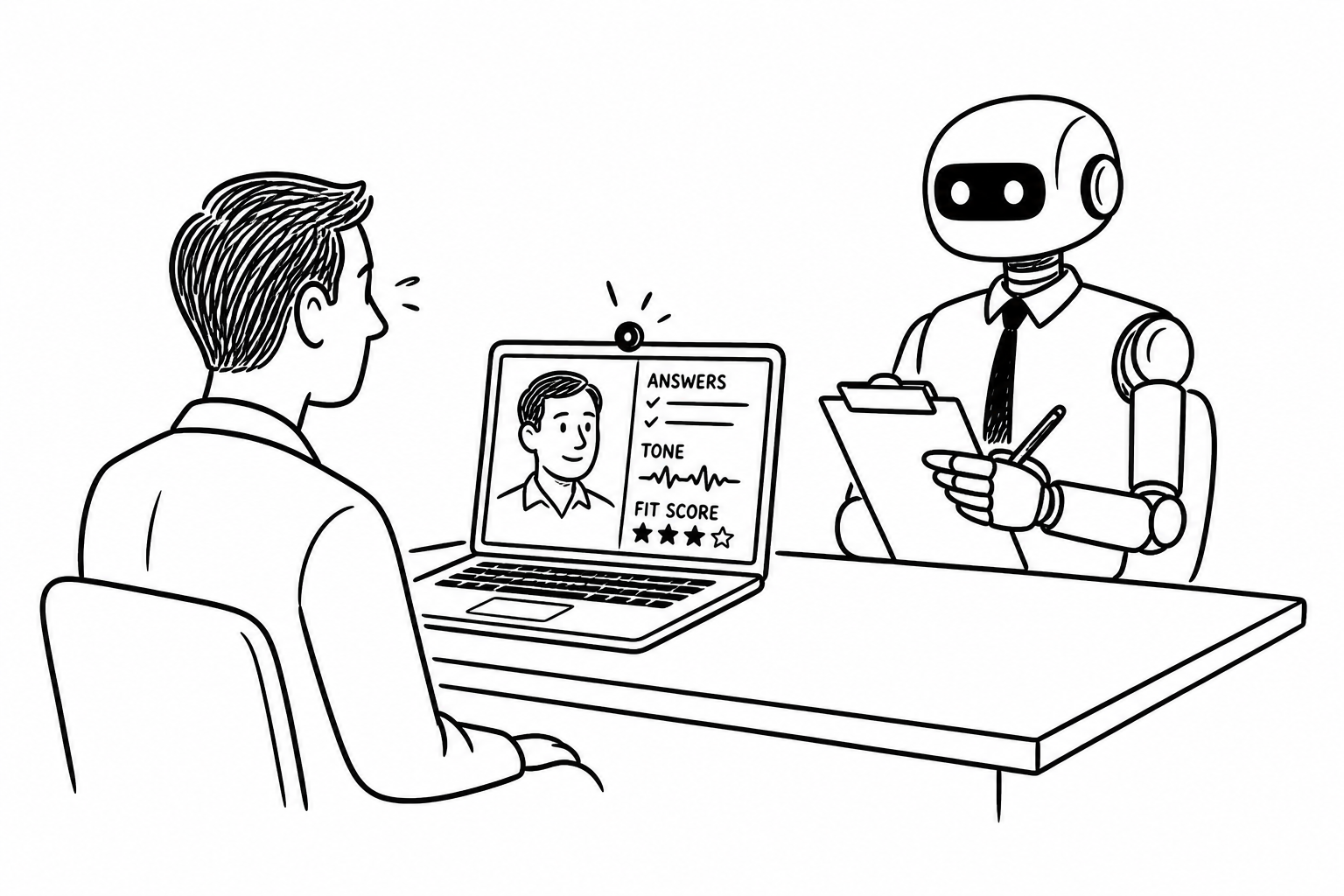
What stands out is not just adoption, but how it’s being experienced. Around 70% of candidates said they were not informed that AI would be part of the hiring process, and roughly one in five only realized it once the interview had already begun. That lack of transparency is shaping behavior. Thirty-eight percent of job seekers say they’ve dropped out of a hiring process that involved AI, and another 12% say they would consider doing the same if given the option. Even in a labor market where securing a role has become more competitive, a meaningful share of candidates are choosing to opt out rather than participate in a system they don’t trust.
The friction isn’t simply about technology—it’s about visibility. Hiring has traditionally been opaque in outcome, but not in process. Candidates may not know why they were rejected, but they could read the room, interpret tone, and engage in real time. AI interviews remove that layer entirely. Decisions are made earlier, faster, and without interaction, shifting the moment of evaluation to a place where candidates cannot respond, adjust, or even fully understand what is being assessed. Only 28% of candidates move forward after AI-led interviews, while more than half report never hearing back at all. The system doesn’t just evaluate—it filters, often silently.
What’s being sold to employers as efficiency is being experienced by candidates as distance. Companies point to consistency, scalability, and the ability to process large applicant pools. And in a hiring environment flooded by AI-assisted applications—where candidates themselves are using tools to generate résumés and apply at scale—that logic is not entirely unfounded. Employers are responding to volume with systems designed to manage it. But that response is creating a feedback loop: more applications lead to more automation, which leads to less human interaction, which leads candidates to apply more broadly to compensate.
The assumption that AI might reduce bias also proves more complicated in practice. More than a quarter of candidates report experiencing bias based on race or ethnicity during interviews, regardless of whether the interviewer was human or AI. Over a third reported age-related bias in both contexts. The technology does not eliminate bias so much as redistribute it—embedding it into systems that are harder to interrogate because their decision-making is less visible. When candidates feel something is off, there is no conversation to clarify it, no interviewer to question, no moment to correct course.
What’s notable is that workers are not rejecting AI outright. Most are not asking for it to be removed from the process. What they are asking for is control—clear disclosure that AI is being used, the option to speak with a human, and assurance that final decisions are not being made without human oversight. That distinction matters. The resistance is not to the presence of technology, but to the loss of agency within it.
Some candidates do report a more positive experience with AI interviews, noting that they can feel more consistent and easier to schedule. For a portion of applicants, especially those navigating time constraints or interview anxiety, the structure can be appealing. But even within that group, the preference tends to hinge on clarity—knowing what the system is doing, how it is being used, and where human judgment still enters the process.
What’s emerging is not just a new hiring tool, but a redefinition of access to work. The interview used to be the threshold—the moment where a candidate could translate credentials into presence, where conversation could alter trajectory. Now, that threshold is moving earlier, into systems that determine who gets that moment at all. The interview hasn’t disappeared. It’s been repositioned—reserved for the candidates who make it through a layer most people never see.
That shift matters because it changes how opportunity is distributed. It places more weight on how well a candidate aligns with a system’s expectations before they ever have a chance to explain themselves. It reduces the role of improvisation, personality, and real-time connection—qualities that don’t always translate cleanly into structured responses or algorithmic scoring. And it introduces a new form of gatekeeping that operates quietly, at scale, and with limited accountability.
The hiring process has always filtered people. What’s changing is where that filtering happens, and how visible it is to the people being filtered. As AI moves deeper into the process, the question is no longer whether technology should be involved, but how much of the decision-making should remain out of view—and what candidates lose when it does.