
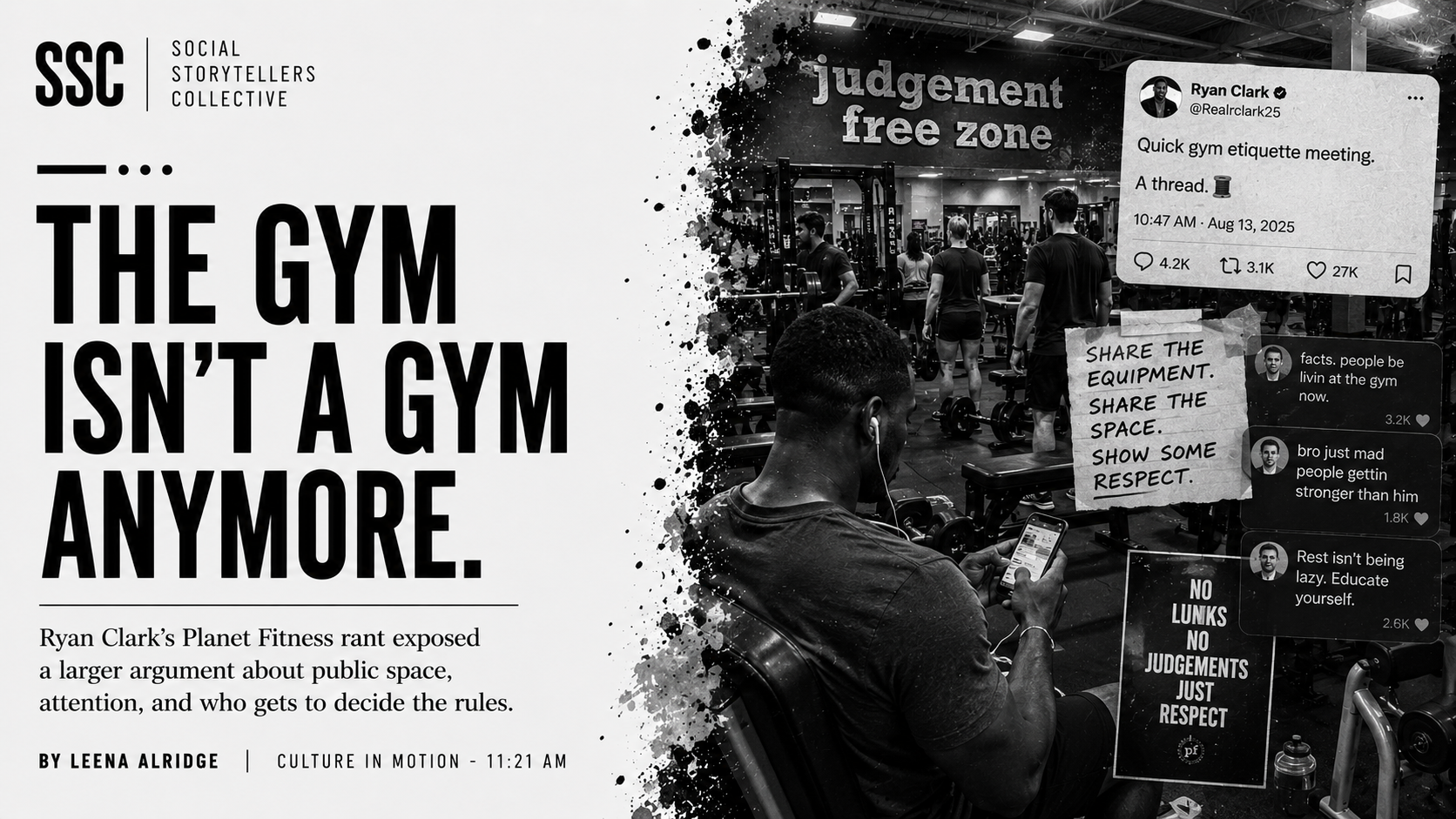
Former NFL player Ryan Clark probably didn’t expect to start a culture war when he posted what he called a “quick gym etiquette meeting” on social media. His complaints were familiar to anyone who spends time in a commercial gym: people sitting on equipment while scrolling their phones, long rest periods between sets, crowded racks, and a growing sense that everyone is operating under different rules. What followed was predictable. Thousands agreed. Thousands disagreed. The debate quickly stopped being about Planet Fitness and became a conversation about how Americans increasingly struggle to share public spaces — and who gets to set the terms when they do.
The argument looks trivial on the surface. One side believes people should move efficiently, finish their sets, and make equipment available for others. The other argues that strength training requires several minutes of recovery between sets and that nobody is obligated to rush because someone else is impatient. Both positions are defensible. Neither is the real argument. The gym used to be understood as a place where people exercised. Today it is simultaneously a fitness center, social space, content studio, workplace extension, and personal refuge. People arrive carrying entirely different expectations about what the space is for — and conflict becomes inevitable when one person’s workout environment is another person’s living room away from home.
The comments reveal something beyond fitness science. People are debating citizenship. Some complained about older members treating the gym like a coffee shop. Others blamed younger members for treating every session like a content production. Some criticized people who sit on machines while texting. Others defended longer rest periods as evidence-based training. What emerges is not a disagreement about etiquette but a collision of values. Efficiency competes with autonomy. Courtesy competes with individual freedom. The equipment may belong to everyone, but everyone arrives with a different definition of what responsible use looks like.
Technology sits at the center of the tension. Smartphones have fundamentally changed how people occupy shared space. Rest periods that once involved staring at the wall now become opportunities to answer emails, watch videos, post content, or scroll. The phone creates the appearance of inactivity even when someone is technically between sets. To the person waiting for a bench, scrolling looks like waste. To the person lifting, it may be exactly how they manage recovery. The same device that helps people track workouts and listen to music also makes them look absent from the shared environment around them — and in a space built on unspoken reciprocity, looking absent carries a cost.
That erosion of unspoken reciprocity is the larger story. Previous generations relied on shared expectations that were rarely articulated — you learned gym etiquette from observation, correction, and social pressure that didn’t require a viral post to function. Today norms are increasingly negotiated in real time through online debate. That is why a straightforward observation from Ryan Clark generated thousands of responses. Americans are no longer arguing only about what behavior is acceptable. They are arguing about who has the authority to define acceptable behavior in the first place. Every shared setting — planes, movie theaters, gyms, sidewalks — is having the same conversation simultaneously and arriving at no consensus.
The debate resonated because it was never really about benches, squat racks, or phone usage. It was about the difficulty of sharing increasingly fragmented public spaces with people who hold fundamentally different assumptions about what those spaces are for. The gym has become a microcosm of a broader negotiation. Everyone believes they are behaving reasonably. Everyone believes someone else is the problem. And everyone is certain that common courtesy has declined — usually in the direction of whoever arrived after them. In an era built around personalization, even the simplest shared spaces are becoming contested ground. Ryan Clark didn’t start that argument. He just gave it a location.