
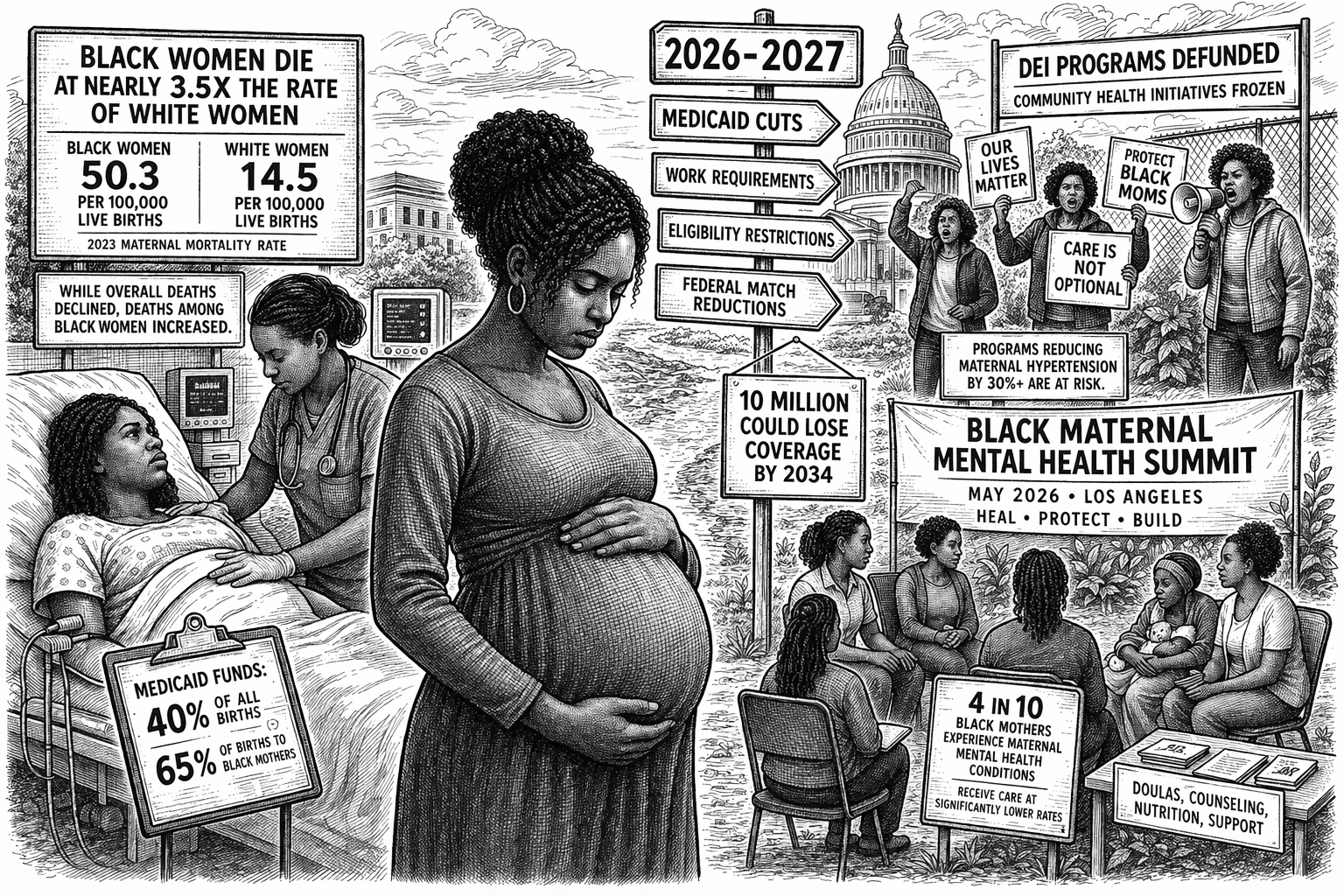
Black women in the United States die from pregnancy-related causes at nearly 3.5 times the rate of white women. The maternal mortality rate for Black women in 2023 was 50.3 per 100,000 live births, compared to 14.5 for white women. While overall maternal deaths declined from 2022 to 2023, deaths among Black women increased. Center for Reproductive Rights These are not abstract statistics. They reflect women who sought care and were dismissed, whose symptoms were minimized, and whose concerns were not taken seriously. Now, the programs that have been measurably reducing those deaths are being defunded.
Medicaid funds roughly 40% of all births in the United States — and 65% of births to Black mothers. The Century Foundation The Medicaid work requirements, eligibility restrictions, and federal match reductions scheduled between 2026 and 2027 will remove millions from coverage. The CBO estimates that 1.3 million people will lose Medicaid coverage by 2026, rising to 5.2 million in 2027 and reaching 10 million by 2034. The Century Foundation For Black women, losing coverage in the perinatal period — before, during, and after pregnancy — is not an inconvenience. It is a direct increase in mortality risk.
The federal anti-DEI policy environment is compounding the impact. Programs designed to reduce racial disparities in birth outcomes — including community-based perinatal care coordination, Black infant health initiatives, and doula access — are being defunded or frozen under executive actions targeting equity-related grants. Advocates report that federal health agency staff are unable to communicate with grantees, leaving organizations that connect pregnant Black women to care, counseling, and nutritional support uncertain about whether funding will continue. Risehealth Programs that had reduced maternal hypertension — a leading cause of pregnancy-related death — by at least 30% are now operating without clarity about their future.
The Black Maternal Mental Health Summit convening in Los Angeles in May 2026 reflects a community-level response to what is being withdrawn at the federal level. Four in ten Black mothers and birthing people will experience a maternal mental health condition — nearly double the rate for all women — yet they receive care at significantly lower rates. Untreated mental health conditions remain a leading driver of pregnancy-related deaths. The Summit is building what the federal government is dismantling. As SSC covered in Medicaid Work Requirements Are Coming and HIV Treatment Didn’t Collapse — But What’s Holding It Up Should Concern You, the communities most dependent on federal health infrastructure are always the first to absorb the cost when that infrastructure contracts.
Why This Matters
The United States already has the highest maternal mortality rate of any wealthy nation. Black women are dying at rates that would constitute a public health emergency if they were experienced across the general population. The federal cuts now underway are not occurring in a vacuum. They are landing on a system that was already failing Black women, at a moment when the programs showing the most measurable progress are being targeted for elimination. The Black Maternal Mental Health Summit in May is worth watching — not just as an event, but as a signal of how communities respond when the institutions responsible for their survival begin to withdraw.