
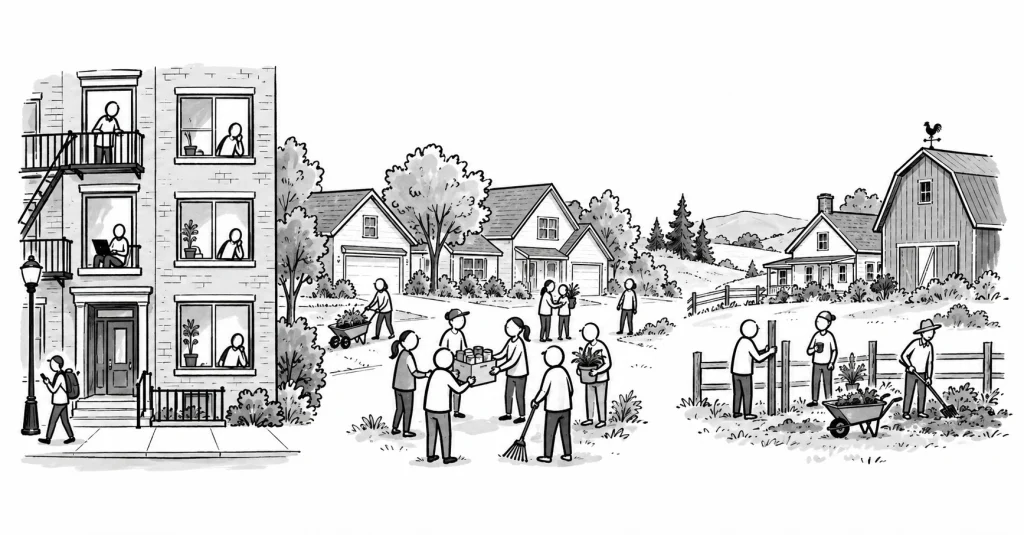
Americans living in cities, suburbs and rural communities participate in civic life at broadly similar rates, but the kinds of participation they choose are not the same. A September 28 Pew Research Center analysis found that 23% of urban adults were classified as “Connectors,” compared with 34% of suburban adults and 30% of rural residents. Connectors volunteer, donate and participate in organizations more often than they engage in political action. Cities, meanwhile, had a higher share of “Spectators,” people who follow the news but participate less in other public activities. The data complicate an assumption that living among more people necessarily means being more connected to them.
Pew’s categories come from a larger July 16 Pew-Knight Initiative report that grouped Americans using 19 measures of political activity, civic involvement, religious attendance and attention to news. Nationally, 9% were Mobilizers, 28% Connectors, 31% Spectators and 31% Outsiders, with rounding and unclassified respondents affecting totals. In the urban-suburban-rural comparison, 33% of city residents were Spectators, compared with 27% of suburban residents and 25% of rural residents. Outsiders, the least engaged group, made up 35% of urban and rural adults and 30% of suburban adults. The findings measure specific behaviors, not loneliness, friendship quality or a person’s sense of belonging.
The differences become clearer when the analysis moves from broad categories to actual activities. Pew found that 31% of suburban adults had volunteered during the previous year, compared with 26% in both cities and rural communities. Participation in a group or organization was reported by 37% of suburban adults, 33% of rural adults and 30% of urban adults. These are not enormous gaps, and the researchers caution that age, income, race and political identity may explain more variation than geography alone. But the pattern raises an institutional question: what kinds of associations, meeting places and volunteer opportunities are available, visible and practical for residents in different settings?
How groups meet also varies. Among adults who belonged to an organization, 63% of rural residents said members interacted mostly in person, compared with 57% of suburban members and 47% of urban members. The corresponding shares saying their groups interacted mostly online were 14%, 20% and 22%. These figures do not prove that face-to-face meetings create stronger relationships or that digital groups are inferior. They do show that the infrastructure of participation is different. Transportation, work schedules, neighborhood turnover, religious institutions and the availability of shared spaces could all be relevant explanations, but Pew’s comparison does not isolate their causal effects.
Religion is one example of an institution that still organizes repeated social contact. Forty-two percent of rural adults said they attended religious services, in person or online, at least monthly, compared with 37% of suburban adults and 33% of urban adults. Politics presents a different pattern: 12% of urban adults reported attending a protest, march or demonstration during the prior year, compared with 8% in suburbs and 6% in rural areas. Rural adults were more likely to display a political sign or bumper sticker, at 19%, compared with 14% of city residents. These contrasts suggest that public engagement cannot be reduced to a single participation ranking. People may be highly active in one arena and almost absent from another.
The survey also has a timing limitation. Its principal data were collected in 2025, and questions about the previous twelve months often covered the 2024 presidential election. Protest activity and political volunteering could look different in the next election cycle. The September 2026 publication is therefore a fresh analysis of earlier survey responses, not a measurement of how communities behaved last week. Nor should the findings be folded uncritically into a story about a national friendship recession: volunteering, following news and attending religious services are forms of engagement, but none directly measures the number or depth of close friendships. SSC has examined changing adult social routines separately; this evidence offers a civic-infrastructure perspective rather than a duplicate claim about loneliness.
The more productive question is what makes participation possible. A city may have more organizations but also longer commutes and less predictable schedules. A rural community may have fewer venues but stronger in-person habits among those already involved. What Pew’s data establish is that participation has multiple forms, and those forms are distributed unevenly across places. For civic leaders, employers, libraries and cultural institutions, the practical challenge is not merely to encourage people to connect. It is to make the time, spaces and opportunities for participation accessible enough that engagement does not depend entirely on where someone lives.