
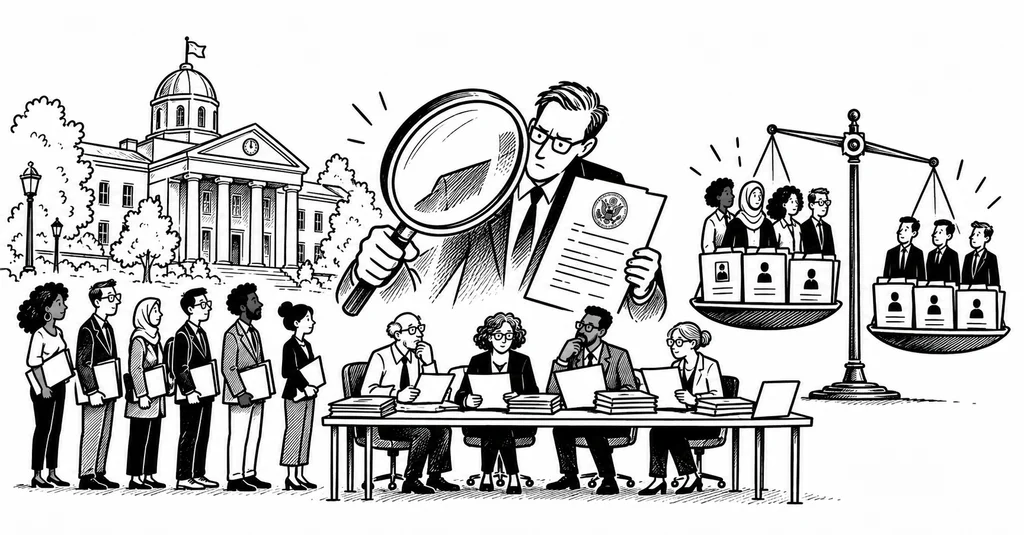
The federal agency has asked a judge to force Harvard to turn over years of hiring and diversity records, turning a dispute over one university into a broader test of how Title VII applies to DEI programs.
The Equal Employment Opportunity Commission has asked a federal judge to compel Harvard University to turn over hiring records, internal diversity documents and applicant data as part of an investigation into alleged discrimination against White, Asian, male and heterosexual workers and applicants. The enforcement action, filed September 29 in federal court in Massachusetts, stems from a commissioner’s charge brought by EEOC Chair Andrea Lucas alleging that Harvard’s recruitment, development and promotion practices may violate Title VII of the Civil Rights Act. The agency says Harvard has not fully complied with an administrative subpoena seeking records stretching back to 2018. Harvard disputes the investigation’s premise and has described the subpoena as overly broad and burdensome, arguing that it is part of a broader federal campaign against the university. No court has ruled that Harvard engaged in the discrimination alleged by the EEOC.
The Investigation Goes Well Beyond a Few Hiring Decisions
The scope of the subpoena shows how broadly the agency is examining Harvard’s employment system. Bloomberg Law reports that the EEOC is seeking documents related to the university’s Office for Faculty Development and Diversity, its Presidential Task Force on Inclusion and Belonging, hiring-committee guidance and interview notes. The agency has also requested names, resumes, cover letters and demographic information for faculty applicants dating back to 2018, along with information about who was hired and who made those decisions. The commissioner’s charge also reaches some student workers and participants in training programs, including programs designed for groups historically underrepresented in medicine. Harvard has asked the EEOC to revoke the subpoena, calling it an impermissible fishing expedition.
The case is part of a broader enforcement strategy under Lucas. The EEOC has publicly warned employers that diversity programs can violate Title VII when employment decisions are made on the basis of race, sex or other protected characteristics, and the agency has sent similar warnings to large employers. It has also filed subpoena-enforcement actions tied to DEI investigations involving other organizations, including Nike and the City and County of San Francisco. The agency describes its approach as applying existing civil-rights law equally to all workers rather than creating a separate set of rules for majority-group employees.
The Legal Ground Under These Cases Has Changed
The EEOC’s enforcement strategy is operating in a different legal environment than it was several years ago. In 2025, the Supreme Court unanimously ruled in Ames v. Ohio Department of Youth Services that majority-group plaintiffs cannot be required to meet a higher evidentiary threshold when bringing Title VII discrimination claims. The Court said Title VII protects individuals without imposing different standards based on whether the person claiming discrimination belongs to a minority or majority group. That decision did not rule that DEI programs are inherently unlawful, but it removed a procedural hurdle that some White, male or other majority-group plaintiffs previously faced in certain courts.
The Harvard dispute also sits in the shadow of the Supreme Court’s 2023 decision striking down the university’s race-conscious admissions program, although the legal questions are not identical. The admissions case concerned student admissions and equal-protection principles, while the current EEOC investigation concerns employment practices governed by Title VII. The agency is relying principally on employment-discrimination law as it examines whether Harvard’s recruitment and promotion efforts crossed from efforts to broaden participation into employment decisions based on protected characteristics. Harvard maintains that it hires on merit and rejects the allegation that its employment practices unlawfully discriminate against White men or other groups.
DEI Is Becoming a Compliance Question
For employers, the Harvard case illustrates how the legal scrutiny surrounding diversity programs is moving from public debate into document requests, subpoenas and employment litigation. Programs aimed at expanding candidate pools, mentoring workers or improving representation are not automatically the same as making hiring or promotion decisions because of race or sex. But the EEOC is increasingly asking employers to show where that line is drawn in practice: who was considered, what criteria were used, how candidates were evaluated and whether protected characteristics affected the outcome.
That makes internal records increasingly important. A company may describe a program as recruitment, belonging or workforce development, while investigators may examine whether the implementation created preferences or exclusions prohibited by Title VII. The dispute at Harvard will initially turn on whether the university must comply with the EEOC’s subpoena, not on a final determination that discrimination occurred. But the information the agency is seeking shows where federal enforcement is heading. Diversity initiatives are no longer being evaluated only by what employers call them or what goals they were designed to achieve. Regulators are examining what those programs actually do when hiring, promotions and other employment decisions are made.