
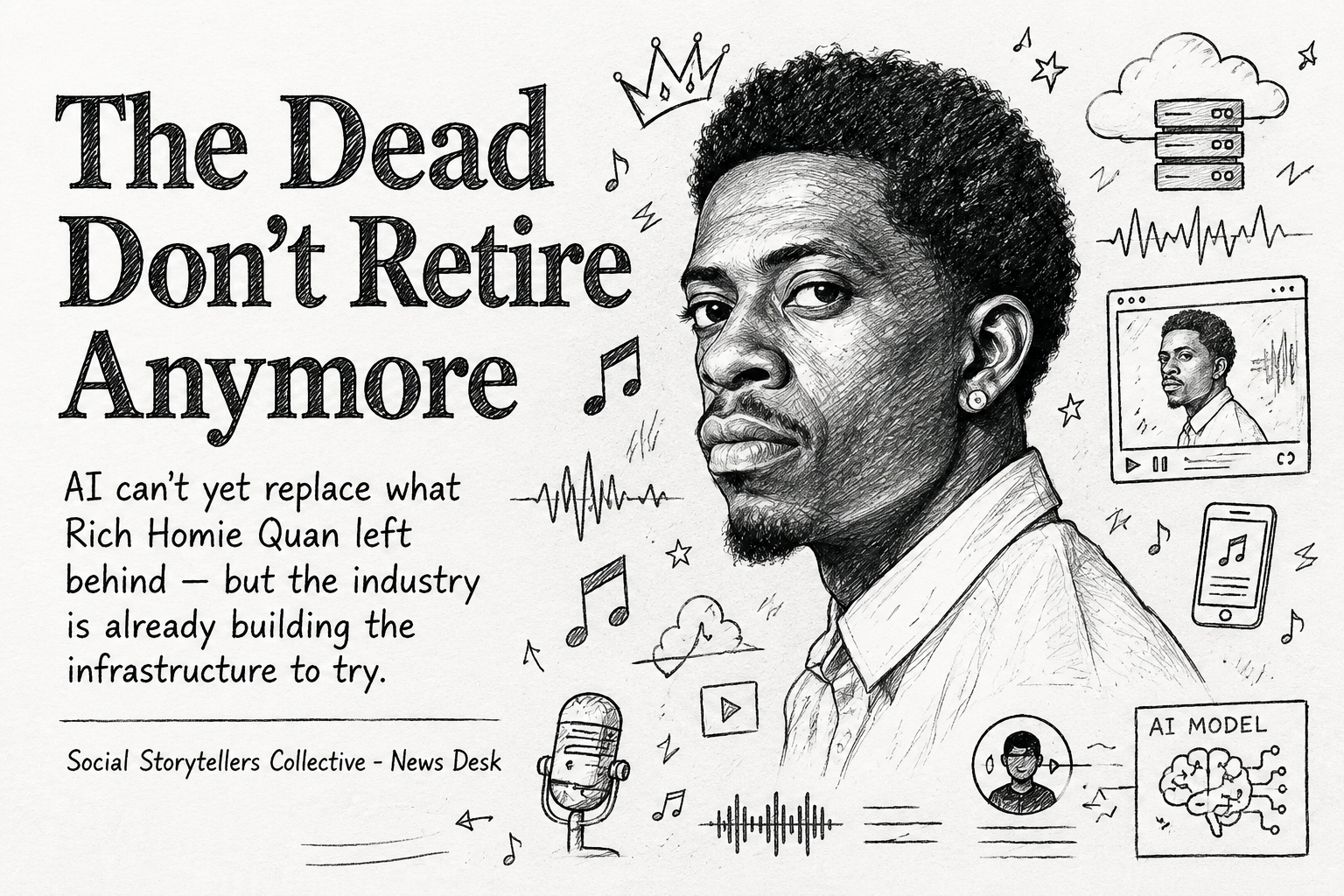
When My Mixtapez posted that Rich Homie Quan’s team was releasing a music video after his death, the internet did not respond with consensus. It responded with negotiation. Some fans called it exploitative and unsettling. Others defended it immediately: “If it’s feeding his kids, I don’t see the issue.” Another user argued that most rapper imagery is already heavily curated — how was this fundamentally different? Others landed somewhere in between, uncomfortable but resigned. “No big name music or media will be made going forward without at least some AI input,” one post read. “Sad but true.”
That last comment is worth sitting with, because it came in response to a video that didn’t actually use AI. “Song Cry” was assembled from footage Quan had already started filming before his death, mixed with clips from his funeral. Directed by MarcellJB, the video features scenes of Quan partying and in the studio alongside moments from his funeral service at World Changers Church International, with appearances from Boosie Badazz and D.C. Young Fly. The family approved it. The footage was real. And still, audiences immediately reached for the AI conversation.
That tells you something. The question is no longer whether AI was used. It’s whether it could have been — and whether that distinction still matters.
For decades, death imposed structural limits on celebrity. There were unreleased songs, archival footage, documentaries, tribute albums, unfinished films, and carefully managed estate releases. There was still an understood boundary between preserving someone’s work and generating new approximations of their presence. The technology being developed right now eliminates that distinction. It doesn’t simply restore old material. It creates continuity from nothing.
Hip-hop has been testing that threshold longer than most genres. In 2012, Dr. Dre and Snoop Dogg famously resurrected Tupac at Coachella with a CGI projection — a computer-generated image rising from the stage to perform his posthumously released “Hail Mary” to a roaring crowd. Dre had to request permission from Tupac’s mother, Afeni Shakur, to use the likeness, and donated to the Tupac Amaru Shakur Foundation as part of the arrangement. That negotiation felt like an exception at the time. Now it looks like the template.
More than a decade later, AI-generated videos and images of 2Pac are flooding platforms like X — creepy reconstructions pairing him with other deceased artists like Bob Marley and Amy Winehouse — and his family has had to publicly push back. The difference between what Dre did in 2012 and what anonymous accounts are doing today is authorization and intent. The technology no longer requires either one.
What makes the Rich Homie Quan reactions revealing is how quickly the conversation moved past what the video actually was and toward what it represented. That’s the real threshold now. Authenticity is becoming aesthetic rather than literal. Many of the commenters were essentially saying: if the music still sounds like him, if the family approves, if it connects emotionally — then the method becomes secondary.
That’s a meaningful shift in how audiences process celebrity and loss, particularly in hip-hop, where proximity to lived experience has historically been the currency. Real neighborhoods, real histories, real voices. The mythology of the genre is built on embodiment. You can’t fake where you’re from. Except now, increasingly, you can fabricate a version of someone after they’re gone that sounds and looks credible enough to pass.
And the industry has every financial incentive to let that continue. California has already passed bills restricting the use of AI to create digital replicas of deceased performers without explicit estate consent, and federal legislation — the NO FAKES Act — has been introduced to address the gap at the national level. Robin Williams’ estate declined to use AI to recreate his voice in a documentary, pointing to specific instructions he had reportedly left prohibiting posthumous digital manipulation. Those refusals are notable precisely because they have to be stated explicitly now — the default assumption has shifted toward production.
Control of an artist’s catalog, likeness, and musical direction still formally rests with the estate, but estate control has long been scrutinized by music fans. With every underwhelming posthumous release, faith in appointed stewards to properly guard a legacy has eroded. AI accelerates that erosion by expanding what’s technically possible faster than any estate, law, or fan base can negotiate what’s acceptable.
Artists are no longer just remembered. They are maintained. And for consumers raised inside algorithmic culture — where filters, edits, scripted livestreams, AI-enhanced visuals, ghostwriters, and label-controlled narratives have always blurred the line between documentation and construction — AI in posthumous releases doesn’t feel like an intrusion. It feels like infrastructure. The comments under the Rich Homie Quan post captured that transition in real time. Some users still treated the video as a boundary question. Others had already moved on to tolerance levels.
That’s the conversation the entertainment industry has been quietly hoping to avoid. The Quan video wasn’t AI-generated, but the fact that no one needed confirmation before the debate started anyway suggests the threshold has already shifted. Audiences aren’t asking whether AI resurrection is coming. They’re negotiating what they’ll accept once it gets here — and that negotiation is happening in comment sections, not courtrooms.