
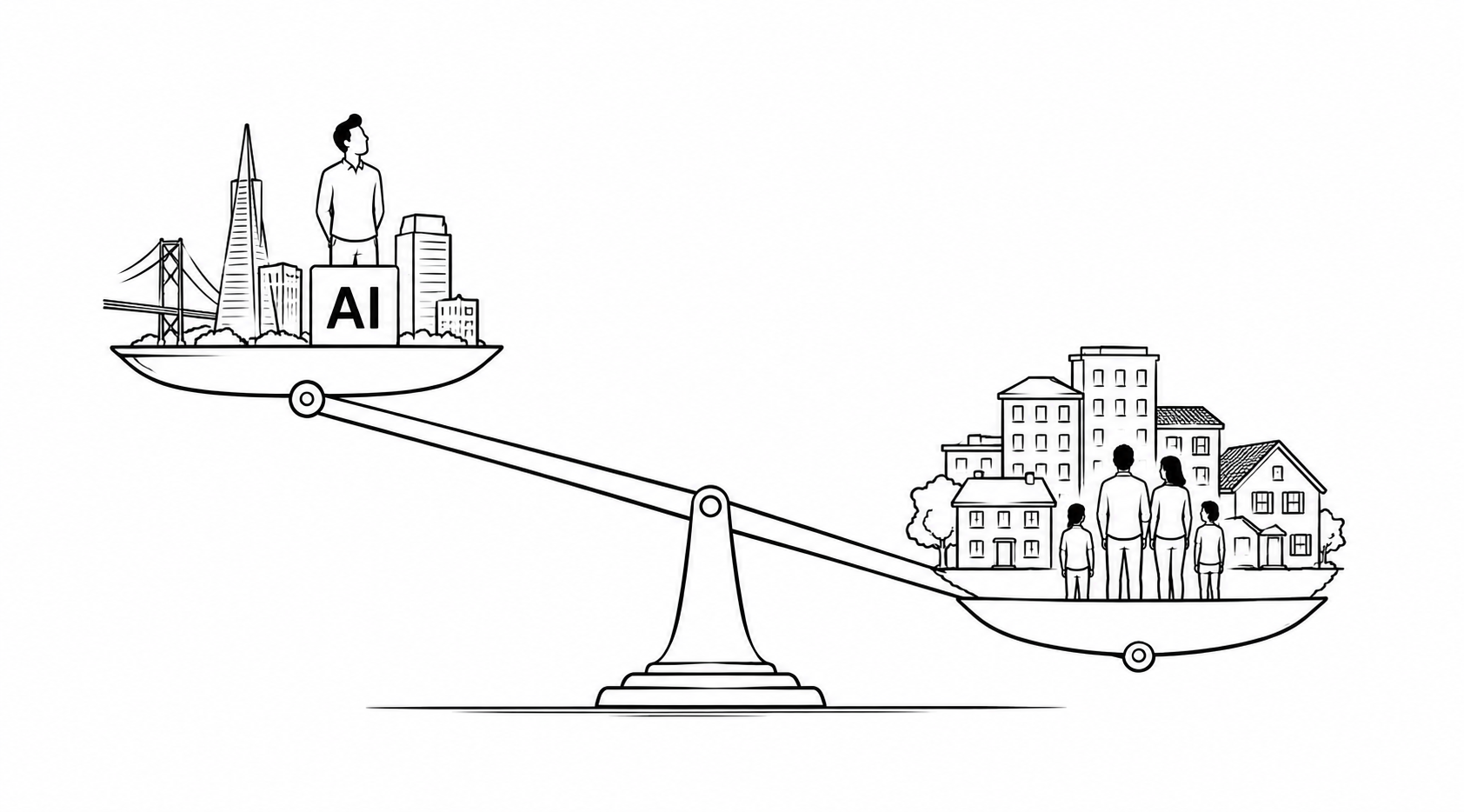
According to Business Insider’s June 3 reporting, homebuyers in San Francisco are once again bidding aggressively as investment and compensation tied to the artificial intelligence sector flow into the region. The report found that luxury home prices increased 15 percent year over year, while lower-priced segments of the housing market have not experienced comparable gains. The pattern suggests that AI’s economic effects are reaching beyond technology companies and into the structure of the city’s housing market.
Innovation concentrates wealth geographically. Breakthrough industries generate clusters of highly compensated workers, investors, founders, and executives who often seek housing in the same metropolitan areas where those industries develop. Housing systems, however, operate on a different timeline. New construction requires permitting, financing, infrastructure, and political approval. Capital can arrive in months. Housing supply often takes years.
The result is a familiar economic sequence. Increased purchasing power enters a constrained housing market, bidding up prices for desirable properties and neighborhoods. Existing homeowners experience appreciation and asset growth, while prospective buyers and renters encounter higher barriers to entry. The benefits of innovation and the costs of innovation are distributed through the same housing market but fall on different households.
The divergence between luxury and lower-end housing is particularly revealing. The strongest price growth is occurring where AI-generated wealth is concentrated, demonstrating that technological investment is reshaping local demand. The issue is not simply that homes are becoming more expensive. It is that a new source of purchasing power is arriving faster than the institutions responsible for expanding supply can respond.
This pattern extends beyond San Francisco. SSC has documented similar dynamics in Boston, where restrictive housing policies are contributing to the departure of young workers, and in Miami, where investment continues to outpace affordability for much of the workforce. The cities differ in their economic foundations, but they share the same mechanism: capital moves faster than housing systems.
Artificial intelligence is therefore becoming an urban policy issue as much as a technology story. Debates about AI often focus on productivity, employment, and regulation. Yet the wealth generated by the industry also reshapes land values, neighborhood composition, commuting patterns, and access to homeownership. The technology changes cities long before many residents ever use the products themselves.
The next phase of the AI economy will not be defined solely by which companies build the most powerful models. It will also be defined by which cities can absorb the wealth those models create without pricing out the workers and families that sustain urban life. If housing systems remain slower than capital flows, AI’s success will increasingly be measured not only in market valuations but in the geography of affordability.